How to Coach the Squat and Hip Hinge: Cues, Faults and Regressions for Beginner Clients
COACH SQUATS AND HINGES: Set the position first; use one cue at a time.
SET YOUR FOUNDATION: Keep big toe, little toe and heel grounded; brace.
PICK ONE CUE: Squat: sit between the hips. Hinge: push hips back.
HEELS RISING? Adjust stance and shorten depth; use a box target.
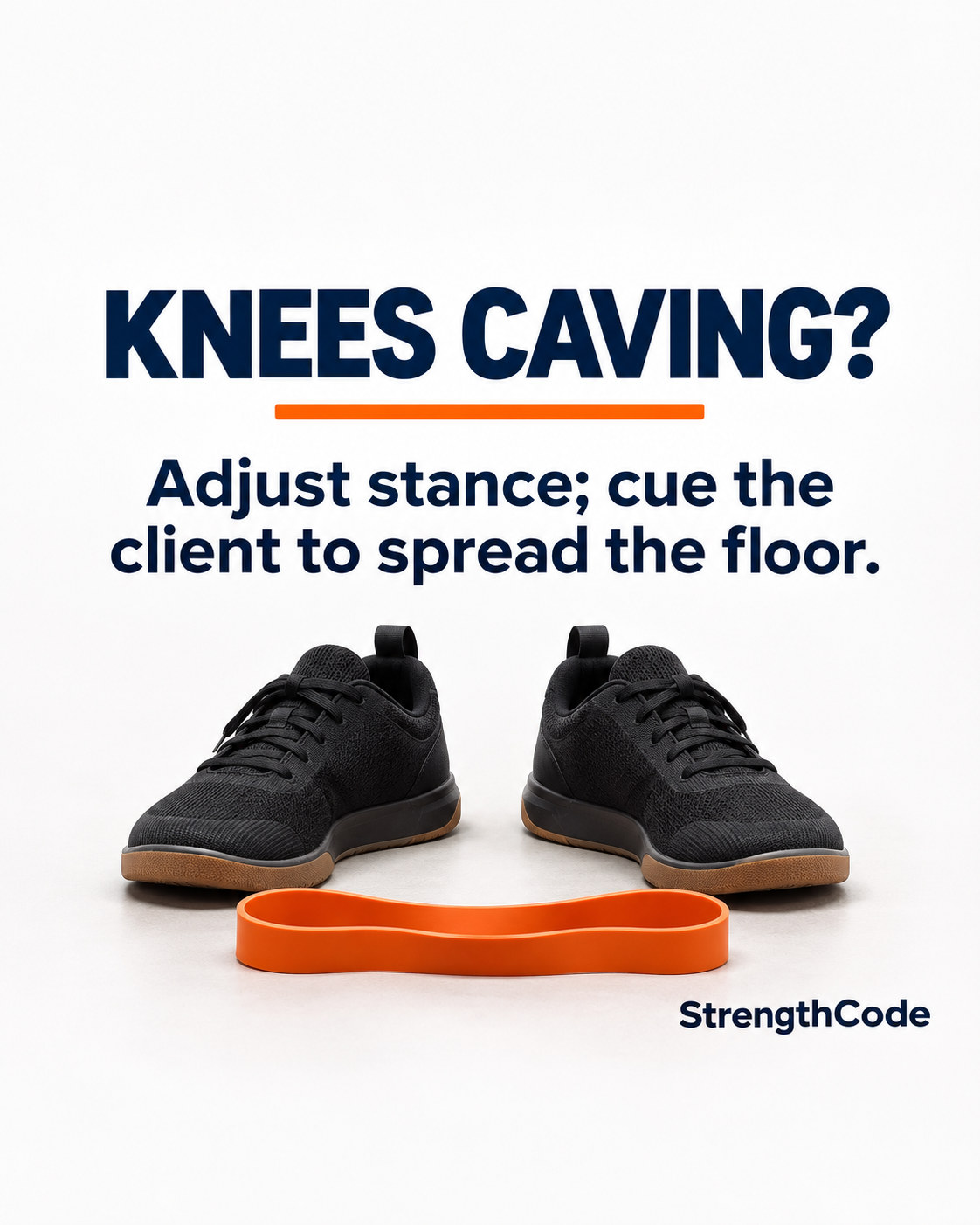
KNEES CAVING? Adjust stance; cue the client to spread the floor.
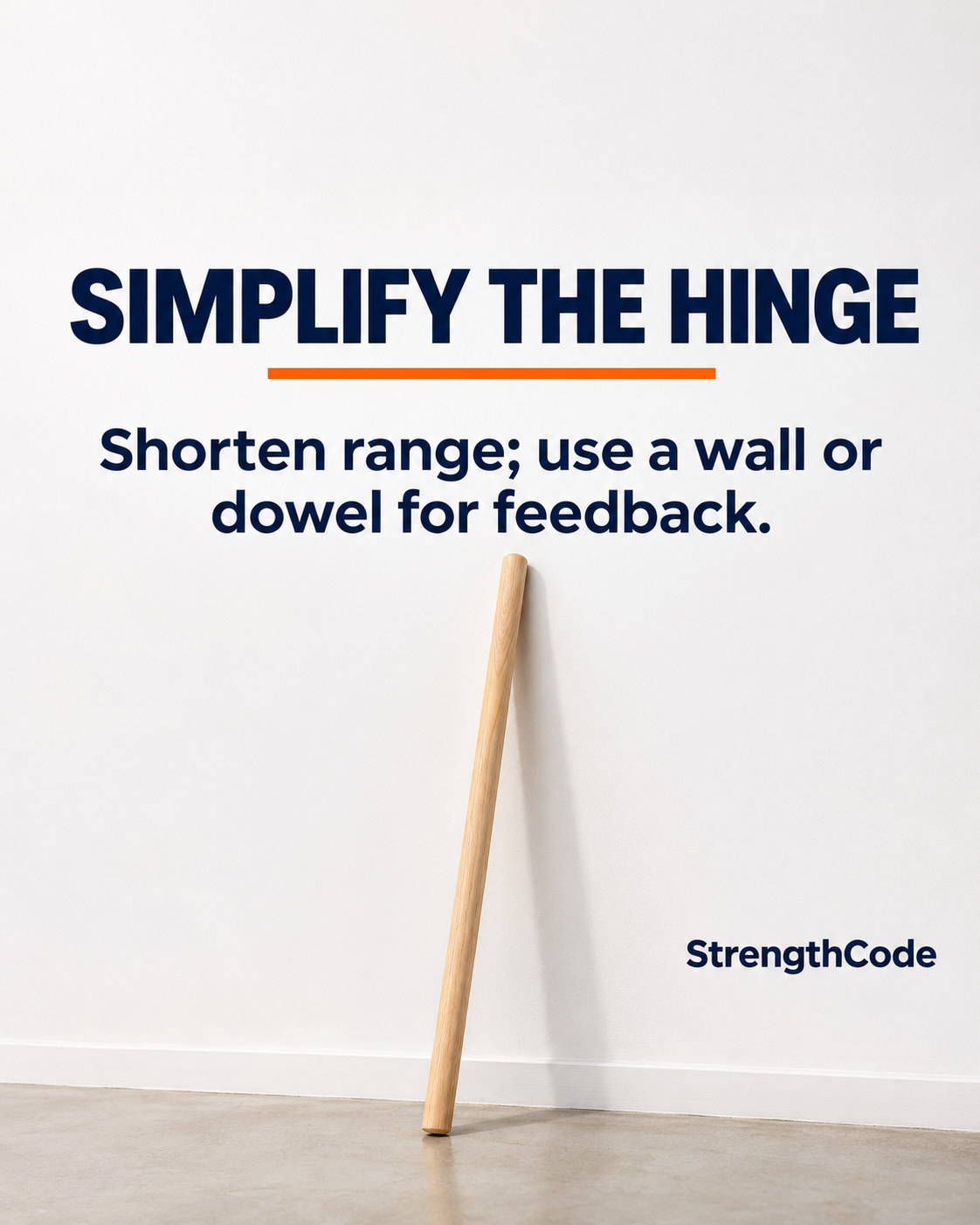
SIMPLIFY THE HINGE: Shorten range; use a wall or dowel for feedback.
EARN THE LOAD: Add weight only when reps stay controlled; referEARN THE LOAD: Add weight only when reps stay controlled; refer persistent pain.
Save photos and copy caption
Save the original photos in order, then add them and paste the caption in Instagram or Facebook.
You coach the squat and hip hinge by fixing the start position first, modelling three to five clean reps from the front and side, then giving one or two instructions only. Set stance, toe angle, foot pressure and brace before you cue the movement. Correct the four faults you will actually see: heels rising, knees caving, hips shooting early, lumbar rounding. Regress on complexity before you touch load, and add load only when the position survives the set.
Your client has a program. What they do not have is a squat.
That gap is the job. The squat is knee-dominant, the hinge is hip-dominant, and both are taught the same way: position first, one cue at a time, complexity before load. Get that right and you coach details for two years instead of rebuilding beginners every eight weeks.
Set the Position Before You Cue Anything
Setup is the coaching. It isn't the warm-up for the coaching. Run the same five checks on every client, every session, and half the faults you planned to shout about never appear.
The five setup checks
- Stance width. Hip width to shoulder width for most beginners. Wider if the client is taller, has long femurs, or cannot reach depth without the pelvis tucking.
- Toe angle. Five to twenty degrees out. Not 42 degrees. Researchers test extremes; you coach positions a client can hold.
- Foot pressure. Big toe, little toe, heel. Three points, full contact, no rocking to the outside edge.
- Ribcage over pelvis. Stacked, not flared. Ribs down, brace on.
- Load path and eyes. Bar or dumbbell over midfoot, gaze forward and slightly down, neck neutral.
Stance width and foot angle are not cosmetic. A study in BMC Sports Science, Medicine and Rehabilitation measured novice and experienced squatters across nine stance and foot-angle combinations. Both variables change hip and knee moments, with the largest joint loads at the extremes: narrow stance with 42 degrees of toe-out, wide stance with zero toe-out. You choose those positions on purpose, not inherit whatever the client saw on a video.
Model it, then shut up
Show three to five reps, setup included. Have the client watch from the front and side; a beginner cannot process a sagittal plane pattern from a three-quarter angle. Modelling covers points of contact, grip and starting position, and three to five reps is enough.
Then condense the instruction to one or two points. More detail crowds out the client's own movement exploration. For a squat, 'feet where they are, sit down between your hips, stand up.' For a hinge, 'push your hips back, keep the load close.' That is the entire verbal brief.
Use constraints instead of repetition
The wall and the dowel teach faster than your voice does. A back-to-wall hinge forces the hips backward because the wall will not move. A dowel held against the head, thoracic spine and sacrum gives the client physical feedback on trunk position through the whole rep.
Be honest about the dowel. It is a teaching constraint, not a truth machine. Research notes the tool does not account for individual spinal shape, so clients with pronounced lumbar lordosis get more flexion before the dowel loses contact. The constraint narrows options. It does not define perfect.
No single joint angle defines an optimal hinge either. Hinge kinematics research is explicit that hip-dominant bending varies across individuals and no universally accepted combination of angles exists. You are coaching a repeatable pattern, not a screenshot.
The Four Faults You Will Actually See and the Cue That Fixes Each
Heels rising get a wider stance and 'sit back toward the box.' Knees caving get a wider base, a moderate toe-out and 'spread the floor.' Hips shooting early on the hinge get a shorter range and the dowel. Lumbar rounding under load gets ribs down, less load and less range, in that order. Every common squat fault and correction you meet in the first month maps to one of those four problems, and each one gets one setup change, one external cue and one regression. That is the whole decision tree.
Heels rising
Check stance first, not the heels. Narrow stance and low toe-out push the shins vertical too early and send the weight forward. Widen the stance by 5 to 10 cm (2 to 4 in) and turn the toes out 10 to 20 degrees before you say a word about foot position.
A plate under the heels is a legitimate teaching tool and a bad permanent fix. Foot-position research shows heel elevation increases ankle dorsiflexion, squat depth and quadriceps demand. You changed the exercise, not solved the problem. Use it for two or three sets, then take it away and keep the stance change.
External cue: 'sit back toward the box.' Regression: box squat to a 40 cm (16 in) box, or the back-to-wall hinge if the pattern is a hinge rather than a squat.
Knees caving
Novices show more medial knee displacement than experienced lifters, and stance width and foot angle shift it. Wider stance, a moderate 10 to 20 degree toe-out, and a slower descent fix most of what you see. Valgus collapse is listed among the standard biomechanical errors in squat technique, so treat it as a position problem, not a discipline problem.
External cue: 'spread the floor' or 'push the ground apart.' Both direct attention to the environment and produce the same outward knee drive an internal cue would, with less thinking.
Regression: lateral band walk with the band at the ankles or forefeet in a semi-squat. A 2025 narrative review found distal band placement produces moderate to high gluteus medius activation, the tissue you want online before loading a squat. Then a split squat before bilateral work.
Hips shooting early on the hinge
This is lumbopelvic dissociation, not laziness. The client can flex the hips but cannot stop the lumbar spine joining in. Wearable-sensor research on hinge mechanics identifies lumbopelvic dissociation as a common limiting factor, and a major one to clear before loading.
Setup change: shorten the range. Hinge to mid-shin, not to the floor. External cue: 'keep three points on the dowel' or 'close the car door with your backside.' Regression: dowel hinge, then wall hinge, then load.
Lumbar rounding under load
Ribs down, brace on, load down, range down. In that order. Clinical commentary on squat errors is clear that forward trunk inclination achieved through lumbar flexion reduces tolerance to compressive loads compared with the same inclination held with a neutral spine.
External cue: 'long spine, chest through the gap' or 'keep the bar over midfoot.' Regression: cut the load to something the client can hold neutral for five clean reps, then rebuild range before you rebuild weight.
External versus internal cues
External cues point at the environment: the box, wall, floor, dowel. Internal cues point at the body: 'squeeze your glutes,' 'keep pressure through your heels.' External cues are preferred for accuracy and efficiency, and faster for a beginner with no reliable body map. Internal cues fit when you want a specific contraction felt. For teaching positions, change the environment before repeating yourself.
Progress and Regress on Complexity, Not on Load
Load is the last lever you pull. Beginners progress by removing support, cutting constraints and adding degrees of freedom. They regress by adding support, cutting range and slowing the tempo. Complexity, not weight, is the variable that decides whether a beginner owns the pattern.
| Lever | Progress (harder) | Regress (easier) |
|---|---|---|
| Support | Free standing | Wall, box or dowel contact |
| Base of support | Split stance | Bilateral, wider stance |
| Range of motion | Full depth | Partial, above parallel |
| Tempo | Controlled 2 second lower | 3 to 4 second lower with a pause |
| Load | Goblet, then barbell | Bodyweight only |
| Constraint | Remove the dowel | Dowel, wall or box target |
The squat ladder runs bodyweight to box squat, box to free squat, free squat to goblet at 6 to 12 kg (13 to 26 lb), goblet to barbell. The goblet squat is the recommended entry point for loaded squatting because the front load reinforces an upright trunk and gives the client something to brace against. The hinge ladder runs wall hinge, dowel hinge, kettlebell deadlift from a raised height, then floor deadlift and Romanian deadlift.
Complexity and maximum load move in opposite directions. You cannot introduce a new variation and expect a personal best the same day. When complexity goes up, load comes down.
The load rule
Load goes up when four things are true: the client holds the position for the whole set, the lowering phase is controlled, the range of motion stays honest at the last rep, and the reps still look the same when fatigue arrives. If any of those fail, the next step isn't more weight. It is a cleaner rep, a better variation or a more stable start. For the longer version of that argument, read technique before load and progressive overload in practice.
One caveat. A preliminary study found a single brief instructional session produced immediate changes in hip flexion angle, from 80.7 to 104.6 degrees, and higher self-reported movement confidence in healthy adults. It had no control group. Instruction changes what you see in a session. It does not prove the new pattern is biomechanically superior or clinically better.
How to integrate
Run a 12-minute teaching block inside a normal session and stop.
- 2 minutes: setup checks on both patterns. Feet, stance, toe angle, pressure, brace.
- 2 minutes: model three to five reps from front and side, setup included.
- 5 minutes: working reps with one cue per set. One correction per rep maximum.
- 3 minutes: the regression that made the rep clean. Finish on a good rep, not a hopeful one.
Then write the client card: variation, the one cue that worked, the regression in reserve, the load rule, and the review date. The structure in the beginner strength program framework is the same, with the coaching layer added.
If the client trains at home with limited kit, the dumbbell plan and resistance band routine run these patterns, so the teaching block transfers. For starting loads, use the beginner dumbbell weight guide.
What you need to keep in mind
Cue volume is the most common coaching error I see. One cue per set. One correction per rep. Stop talking once the rep is right; silence lets the client keep it.
Give feedback on good reps, not just bad ones. Name what went right in technical terms so the client can repeat it: 'hips back, spine long, that is the rep.' Praise that isn't specific teaches nothing.
And hold the referral line. If pain, a prior injury or a joint that will not reach position is the limiter, that is a clinician conversation, not a cue problem. Know the edge of your scope and refer without drama. The prehab routine bridges a cleared but under-prepared client; it does not replace assessment.
FAQ
How long before a beginner can squat and hinge without cues?
Most clients hold both patterns with one reminder cue after four to six sessions. Full independence, self-correcting under fatigue, usually takes eight to twelve weeks of twice-weekly practice.
Should I use external or internal cues first?
External first. Point at the box, the wall or the floor. Internal cues come later when you want a specific muscle felt, not when you want a position learned.
What if a client cannot get their heels down in a bodyweight squat?
Widen the stance, turn the toes out and shorten the depth. If the heels still lift, the ankle is the limiter. Use a plate under the heels temporarily and add ankle mobility work to the warm-up.
Is the goblet squat the right first loaded variation for everyone?
For most beginners, yes. It reinforces an upright trunk and gives a bracing target. Exception: limited front-rack mobility or wrist issues. Use a kettlebell by the horns or a dumbbell held vertically.
How many faults should I correct in one session?
One. Pick the fault that costs the most position and leave the rest. Chasing three faults at once produces a client who is thinking about their body instead of moving it.
When do I stop regressing and let them train the harder version?
When the regressed version is boring and the last three reps look identical to the first three. Then move one lever, not three.
Sources Used
- Progressive Strategies for Teaching Fundamental Resistance Training Movement Patterns (NSCA PTQ)
- A Biomechanical Review of the Squat Exercise: Implications for Clinical Practice
- How to squat? Effects of various stance widths, foot placement angles and level of experience on knee, hip and trunk motion and loading
- Lower Back Injury Prevention and Sensitization of Hip Hinge with Neutral Spine Using Wearable Sensors during Lifting Exercises
- Hip Hinge Kinematics and Movement Confidence Before and After Founder Exercise Instruction in Healthy Adults
- Addressing Biomechanical Errors in the Back Squat for Older Adults: A Clinical Perspective for Maintaining Neutral Spine and Knee Alignment
- Mechanobiological and neuromuscular responses to foot-position variations during front and back squat exercises
- Optimizing Hip Abductor Strengthening for Lower Extremity Rehabilitation: A Narrative Review on the Role of Monster Walk and Lateral Band Walk
- What Being a Good Personal Trainer Really Involves (NSCA)