Prehab Routine: 20-Minute Injury Prevention Routine to Stay Strong and Hard to Break
Prehab Routine: The 20-Minute Routine That Keeps You Strong, Mobile, and Hard to Break
Most people do not need more motivation. They need a body that can survive the training they keep asking it to do.
If your hips are locked up, your ankles move like concrete, your shoulders feel sketchy, and your lower back gets tight every time you push intensity, that is not bad luck. That is poor preparation.
A smart prehab workout fixes the weak links before they turn into pain, missed sessions, and forced time off.
This is not gentle stretching. This is not random mobility fluff. This is the work that keeps strong people training hard without constantly breaking down.
And the fitness world is catching up. Strava recently added Physical Therapy as a trackable activity type, placing rehab, recovery, and preventative training beside normal workouts like running, cycling, yoga, pilates, and weight training. That matters because injury prevention is no longer hidden in the background. It is becoming part of the training log.
You are not doing prehab because you are fragile.
You are doing it because you train hard enough to need armor.
1. What Is a Prehab Workout?
A prehab workout is a proactive training session built to improve mobility, stability, balance, joint control, and movement quality before pain forces you to slow down.
Rehab reacts after the damage is done.
Prehab prepares before the damage stacks up.
The difference is simple. Rehab asks, “How do we get you back?” Prehab asks, “How do we keep you from falling apart in the first place?”
A good prehab routine attacks the areas that usually fail first:
- Ankles that limit squats, lunges, running, and jumping
- Hips that cannot stabilize the knees or pelvis
- Glutes that do not fire when load gets heavy
- Core muscles that cannot hold position under fatigue
- Shoulders that lose control during pressing and pulling
- Thoracic spine stiffness that ruins posture and overhead movement
These are not small details. These are the systems that decide whether your body can handle serious training.
If your ankles are stiff, your knees compensate. If your hips are weak, your lower back takes the hit. If your core is lazy, your lifts leak power. If your shoulders have no control, pressing becomes a gamble.
That is how injuries build. Not always from one dramatic moment. Often from repeated bad positions, poor control, and ignored warning signs.
There is strong evidence behind this approach. Neuromuscular warm-up programs that combine strength, balance, control, and movement preparation have been shown in team-sport research to reduce injury rates by meaningful margins, with randomized trials reporting reductions between 29% and 60%.
That does not mean prehab makes you invincible. Nothing does.
It means smart preparation gives your body a better chance to absorb stress, control positions, and stay available for the next session.
And availability is everything.
The strongest program in the world is useless if your body keeps forcing you to skip it.
2. Why Prehab Training Matters More Now
Training is heavier, faster, and more mixed than ever.
People are not just lifting anymore. They are lifting, running, doing Hyrox, CrossFit, Pilates, padel, combat sports, group conditioning, and endurance events — sometimes all in the same week.
That is great for performance.
It is also a lot of stress.
Your body does not care that your plan looks impressive on paper. It cares whether your joints, tendons, muscles, and movement patterns can handle the workload.
This is where most people lose.
They chase more volume before earning better movement. They add intensity before building control. They hit another session when their hips are cooked, their calves are tight, and their lower back is already waving the white flag.
Then they act surprised when pain shows up.
Do not be that athlete.
ACSM named wearable technology the number one fitness trend for 2026 and reported that nearly half of U.S. adults now own a fitness tracker or smartwatch. The point is not just tracking more data. The point is learning how to use that data to train smarter.
If your sleep is poor, readiness is low, soreness is high, and your movement feels trash, the answer is not always another punishment workout.
Sometimes the answer is prehab.
Not because you are weak.
Because you are disciplined enough to protect the machine.
Prehab gives you a way to keep moving without adding more damage. It lets you build tissue tolerance, restore joint control, clean up movement, and maintain training rhythm.
That is the difference between emotional training and professional training.
Emotional training says, “Go hard no matter what.”
Professional training says, “Train hard, but keep the body ready enough to do it again.”
That is the standard.
3. The 20-Minute Prehab Workout
Use this 20-minute prehab workout two to four times per week.
Do it before hard sessions, after cardio, or on recovery days. Keep the reps clean. Keep the tempo controlled. Do not rush through it like a box-checking warm-up.
This is not filler.
This is body armor.
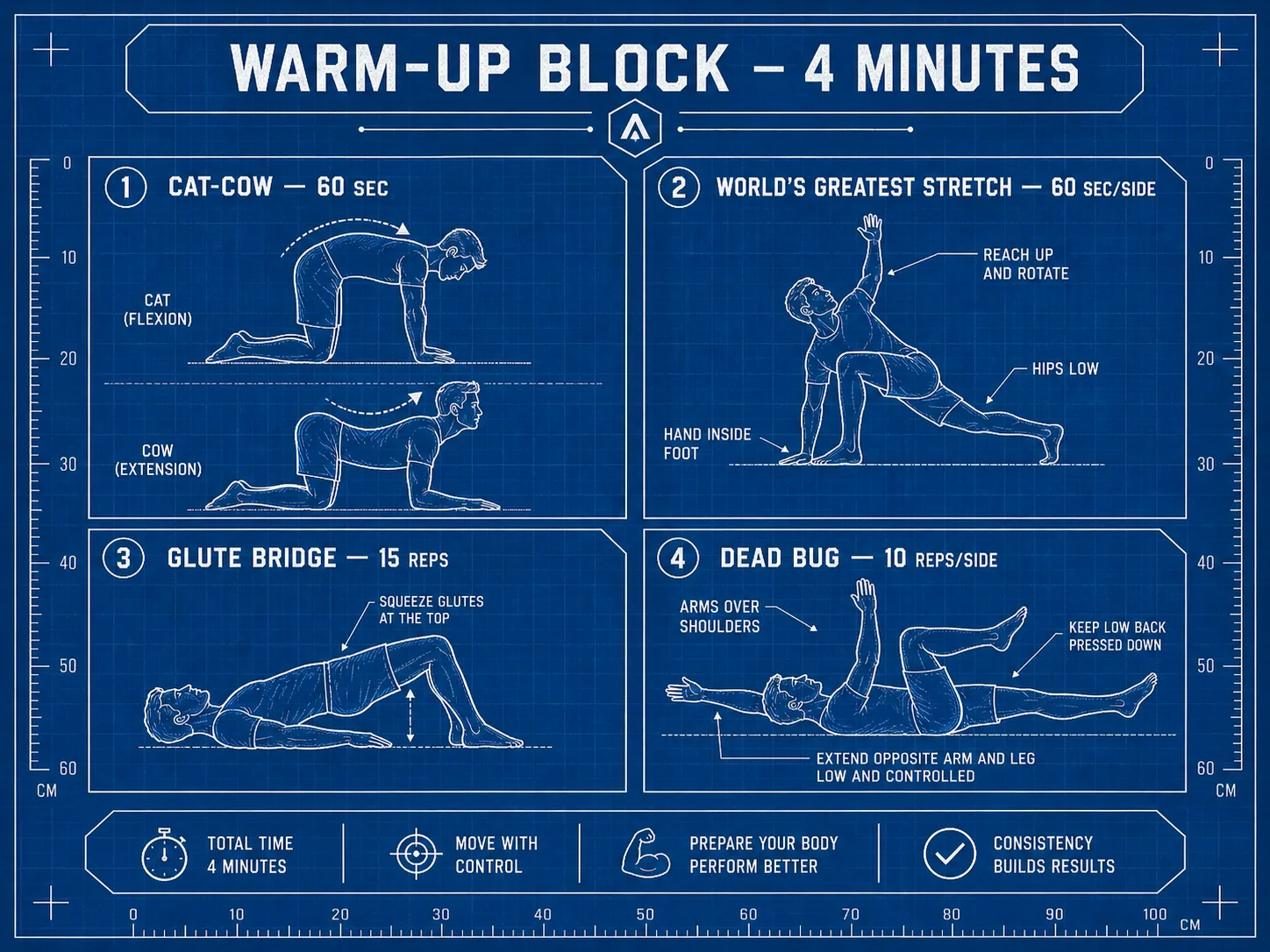
Warm-Up Block — 4 Minutes
Cat-Cow — 60 seconds
Move through the spine slowly. Open the back, ribs, and breathing. Do not force range. Control it.
World’s Greatest Stretch — 60 seconds per side
Step into a deep lunge. Drop the elbow toward the floor. Rotate the chest open. This opens the hips, hamstrings, adductors, and upper back.
Glute Bridge — 15 reps
Drive through the heels. Squeeze the glutes hard at the top. If you feel this mostly in your lower back, your setup is wrong. Reset and control the pelvis.
Dead Bug — 10 reps per side
Keep the lower back locked down. Move slowly. This teaches your core to resist movement instead of collapsing when training gets hard.
Strength-Stability Block — 10 Minutes
Perform two controlled rounds.
Banded Lateral Walks — 12 steps each direction
Keep your toes forward. Knees slightly bent. Hips level. This fires up the side glutes and improves knee control.
Split Squat Iso Hold — 30 seconds per side
Drop into the bottom half of a split squat and hold. Front foot flat. Torso tall. Knee tracks over toes. This builds tendon tolerance, hip control, and lower-body resilience.
Single-Leg Romanian Deadlift — 8 reps per side
Reach the hips back. Keep the spine long. Control every inch. This trains hamstrings, glutes, balance, foot strength, and single-leg stability.
Scapular Push-Ups — 12 reps
Keep the arms straight. Move only through the shoulder blades. Push the floor away. This builds shoulder control for pressing, pulling, and athletic posture.
Side Plank — 30 seconds per side
Stay long from head to heel. Do not let the hips sag. This trains lateral core strength, which matters for running, lifting, changing direction, and protecting the lower back.
Mobility-Control Block — 6 Minutes
90/90 Hip Switches — 10 reps
Control the rotation. Do not bounce. Your hips need ownership, not momentum.
Ankle Rocks — 12 reps per side
Keep the heel down and drive the knee forward. Better ankle mobility means better squats, lunges, running mechanics, and landing positions.
Thoracic Rotations — 10 reps per side
Rotate through the upper back. Do not fake it through the lower spine. Better thoracic rotation improves shoulder position, posture, and breathing mechanics.
Controlled Deep Squat Hold — 60 seconds
Sit as deep as you can control. Feet planted. Knees out. Chest proud. Breathe and own the position.
This routine hits the big rocks: ankles, hips, glutes, hamstrings, core, shoulders, and spine.
Simple does not mean easy.
Simple means repeatable.
And repeatable wins.
How to Integrate Prehab Into Your Training Week
Do not turn this into another complicated plan you abandon after three days.
Make prehab easy to execute.
Before lifting:
Use 8–10 minutes before your strength session. For lower body, prioritize ankle rocks, glute bridges, banded lateral walks, split squat holds, and dead bugs. For upper body, prioritize thoracic rotations, scapular push-ups, side planks, and controlled breathing.
After running or cardio:
Use 10–15 minutes after the session. Focus on calves, ankles, hamstrings, glutes, hips, and deep squat holds. This is especially useful if your stride gets tight, your calves stay loaded, or your lower back feels stiff after longer efforts.
On recovery days:
Do the full 20-minute prehab workout at low intensity. No ego. No rushing. No chasing fatigue. You are restoring quality and building durability.
Before sport or hybrid training:
Use the warm-up block, then add banded lateral walks, split squat holds, ankle rocks, and thoracic rotations. You want your joints ready, hips switched on, and nervous system alert before speed, impact, or fatigue enters the session.
Here is the rule:
Prehab should not crush you. It should sharpen you.
If you finish more tired than when you started, you turned preparation into another workout. That is not the goal.
The goal is better movement, cleaner positions, stronger joints, and a body that can handle hard training again tomorrow.
What You Need to Keep in Mind
You cannot outwork poor preparation forever.
Weak hips, stiff ankles, lazy core control, unstable shoulders, and bad positions do not disappear because you ignore them. They wait. Then they show up when the weight gets heavy, the pace gets fast, or fatigue strips away your fake confidence.
That is when the body tells the truth.
A prehab workout is not optional if you want long-term performance. It is the maintenance work that keeps the engine running. It is how you stop treating pain like a random event and start taking responsibility for the positions you bring into training.
You do not need to be injured to do prehab.
You need to be serious.
Add this 20-minute prehab workout to your week. Use it before hard sessions, after cardio, or on recovery days. Build better hips. Stronger ankles. Smarter shoulders. A tighter core. Cleaner control under fatigue.
The goal is not to avoid hard training.
The goal is to build a body that can handle it.
Strong athletes do not wait until they are hurt to take their body seriously.
They prepare, they train, and they stay ready.