Resistance Band Workout Plan for Beginners: 3-Day Full-Body Home Routine
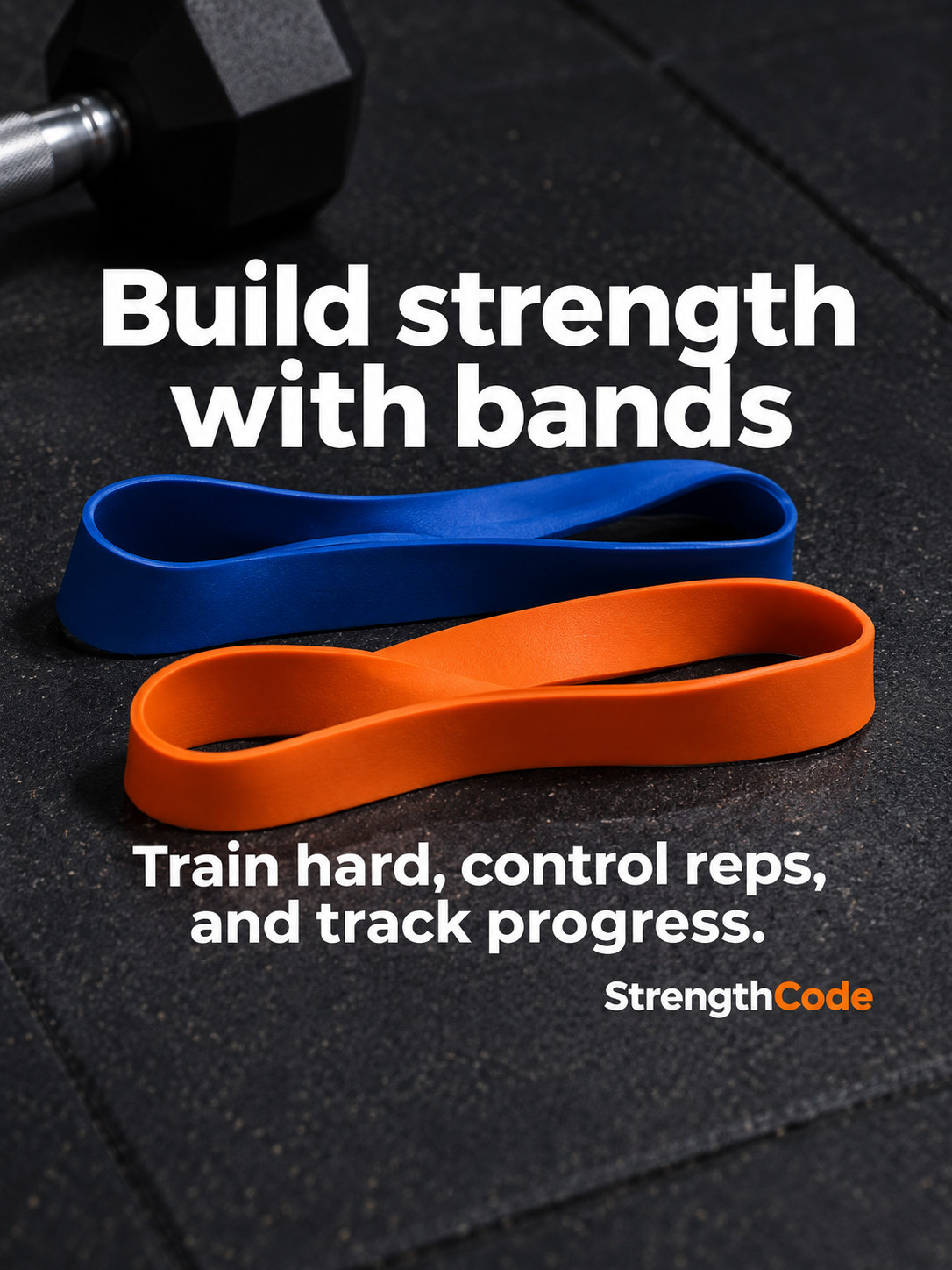
Build strength with bands. Train hard, control reps, and track progress.
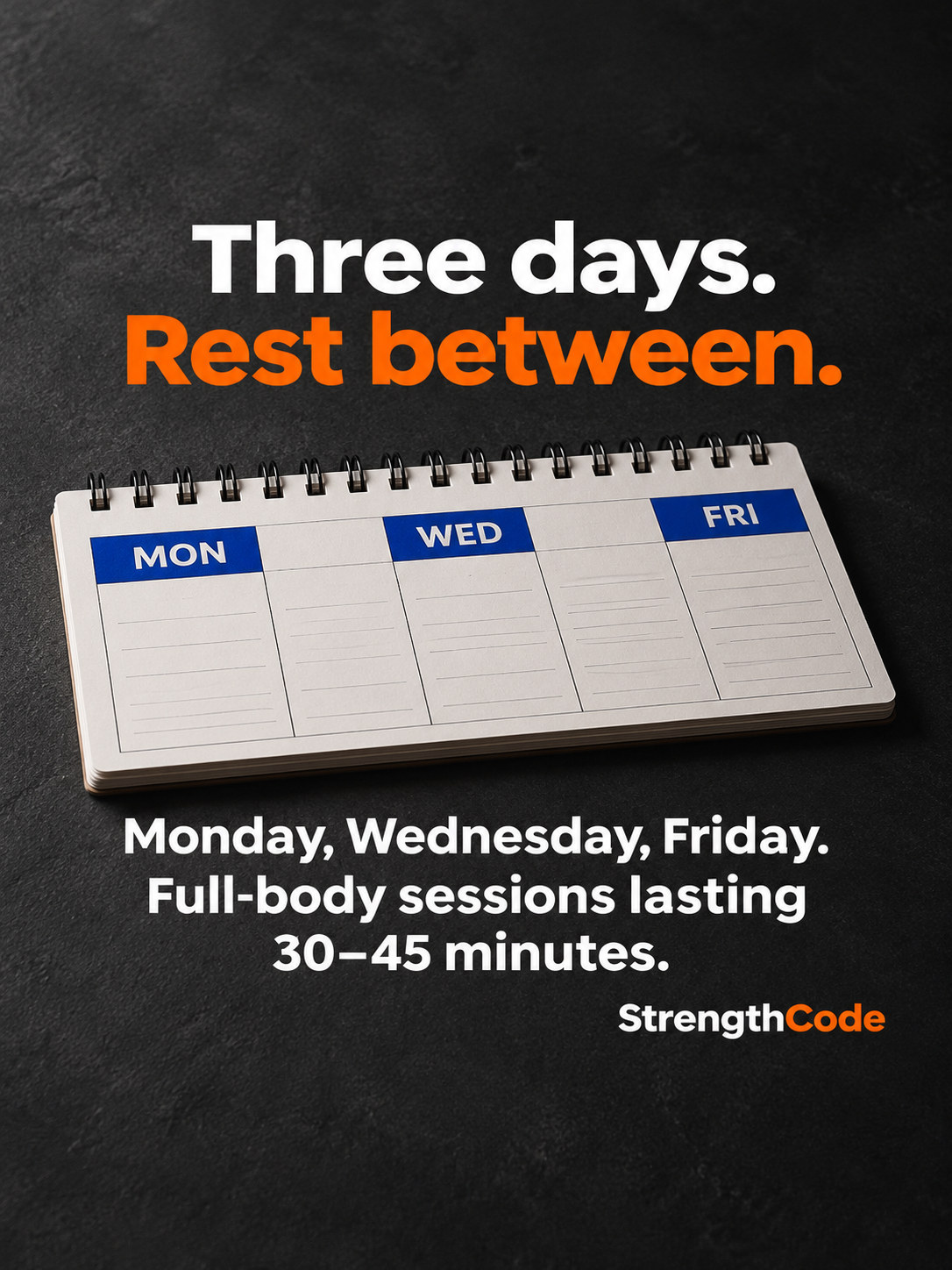
Three days. Rest between. Monday, Wednesday, Friday. Full-body sessionsThree days. Rest between. Monday, Wednesday, Friday. Full-body sessions lasting 30–45 minutes.
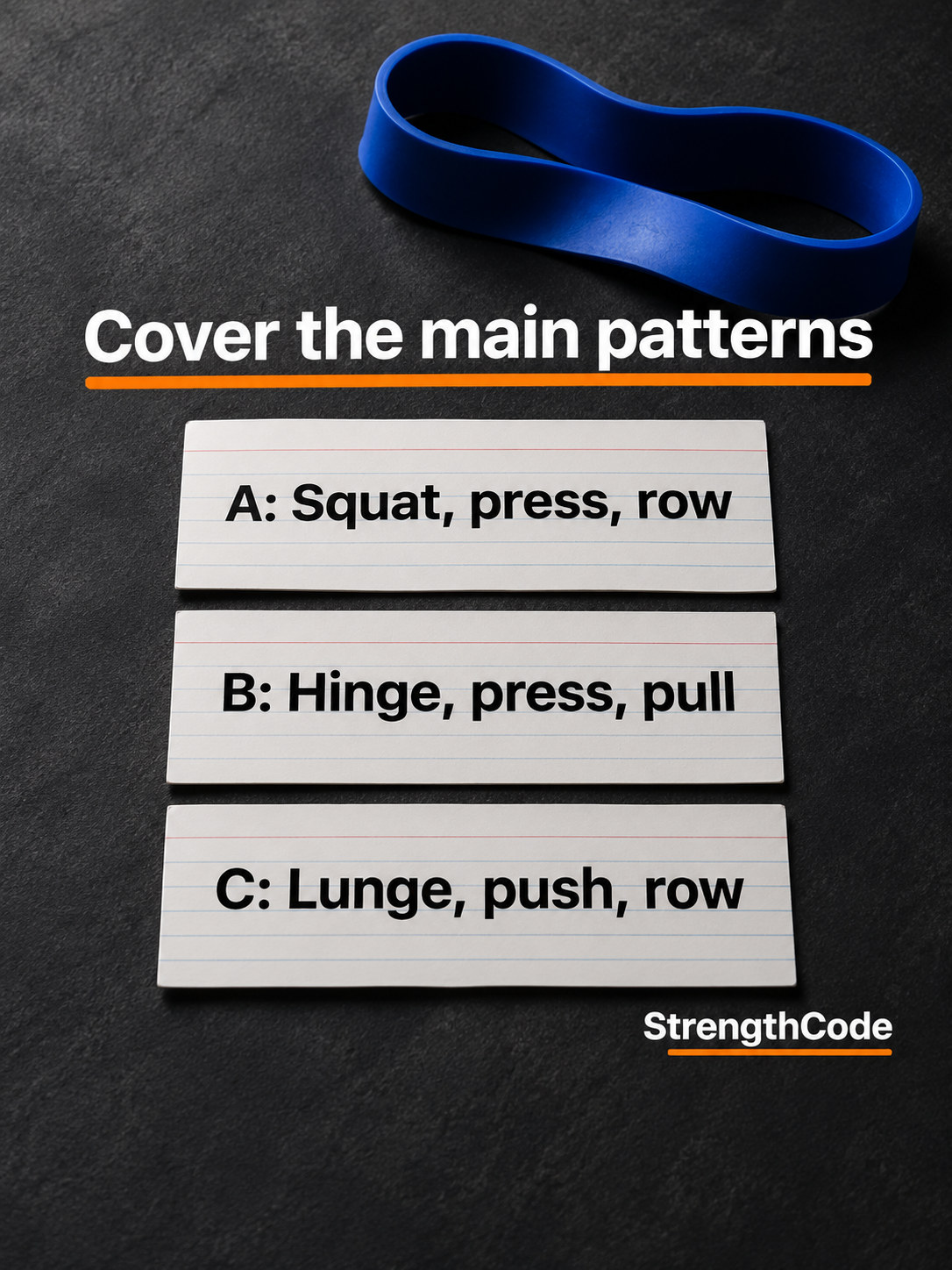
Cover the main patterns. A: Squat, press, row. B: Hinge, press, pull.Cover the main patterns. A: Squat, press, row. B: Hinge, press, pull. C: Lunge, push, row.
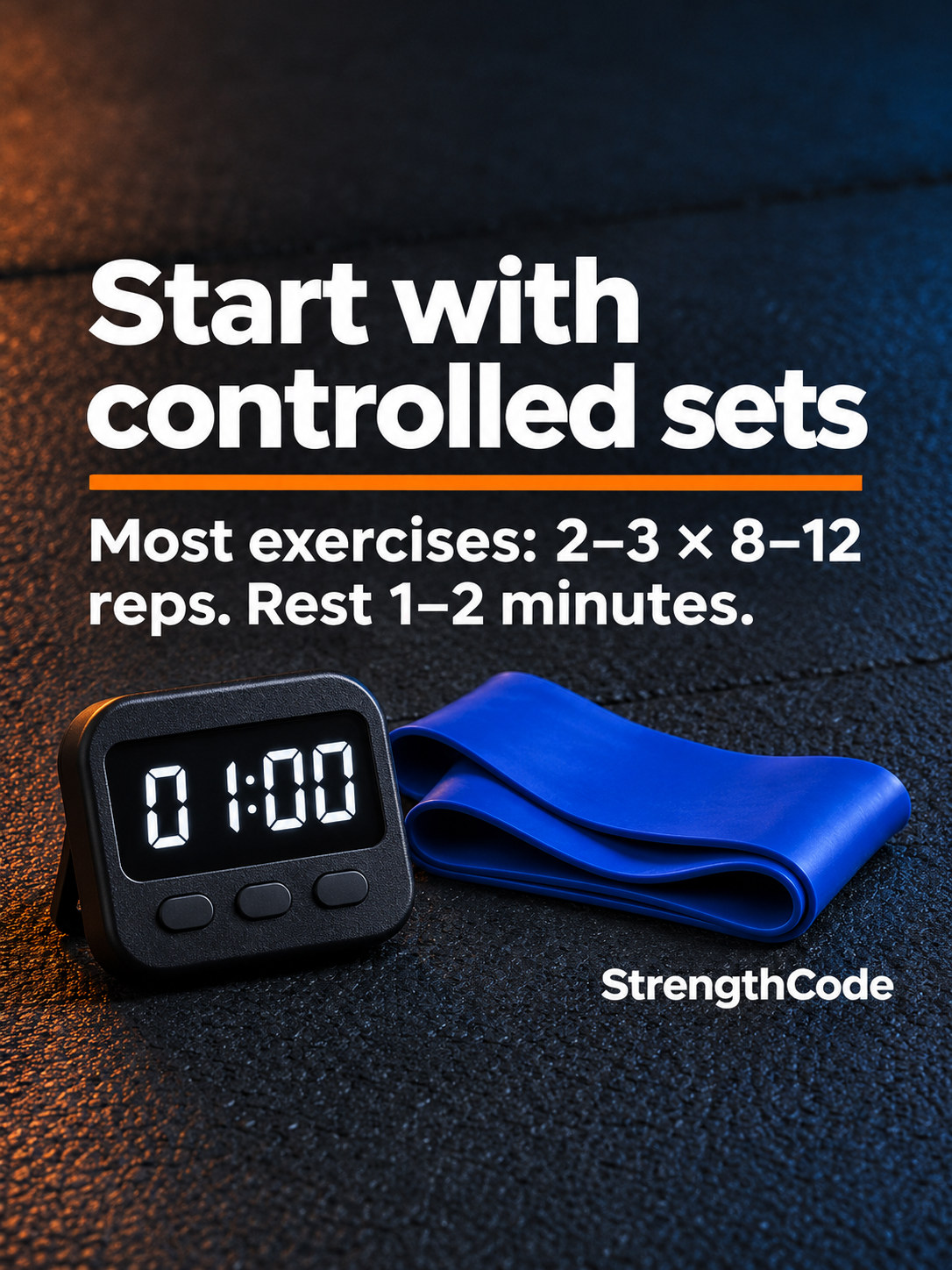
Start with controlled sets. Most exercises: 2–3 × 8–12 reps. Rest 1–2Start with controlled sets. Most exercises: 2–3 × 8–12 reps. Rest 1–2 minutes.
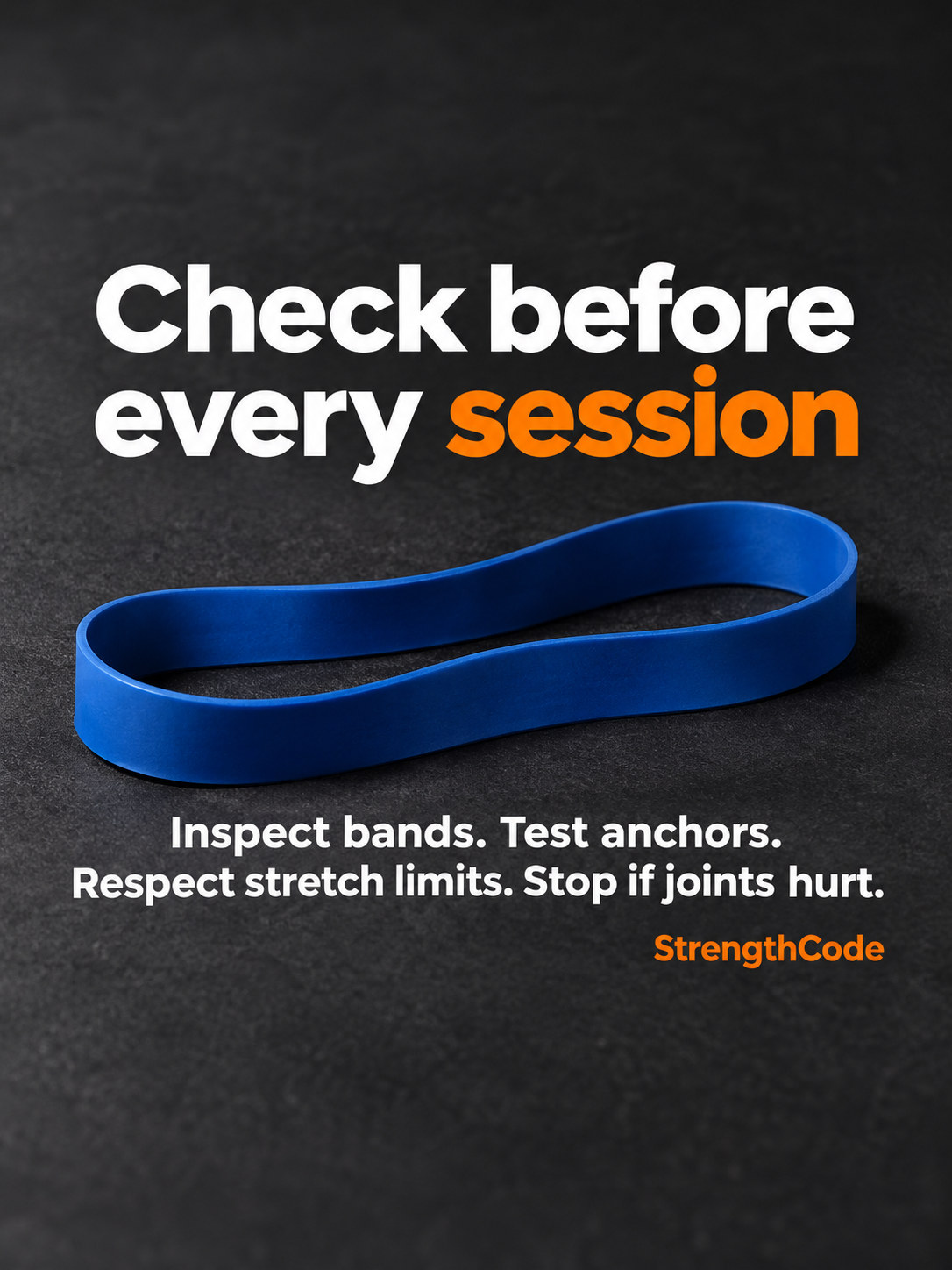
Check before every session. Inspect bands. Test anchors. RespectCheck before every session. Inspect bands. Test anchors. Respect stretch limits. Stop if joints hurt.
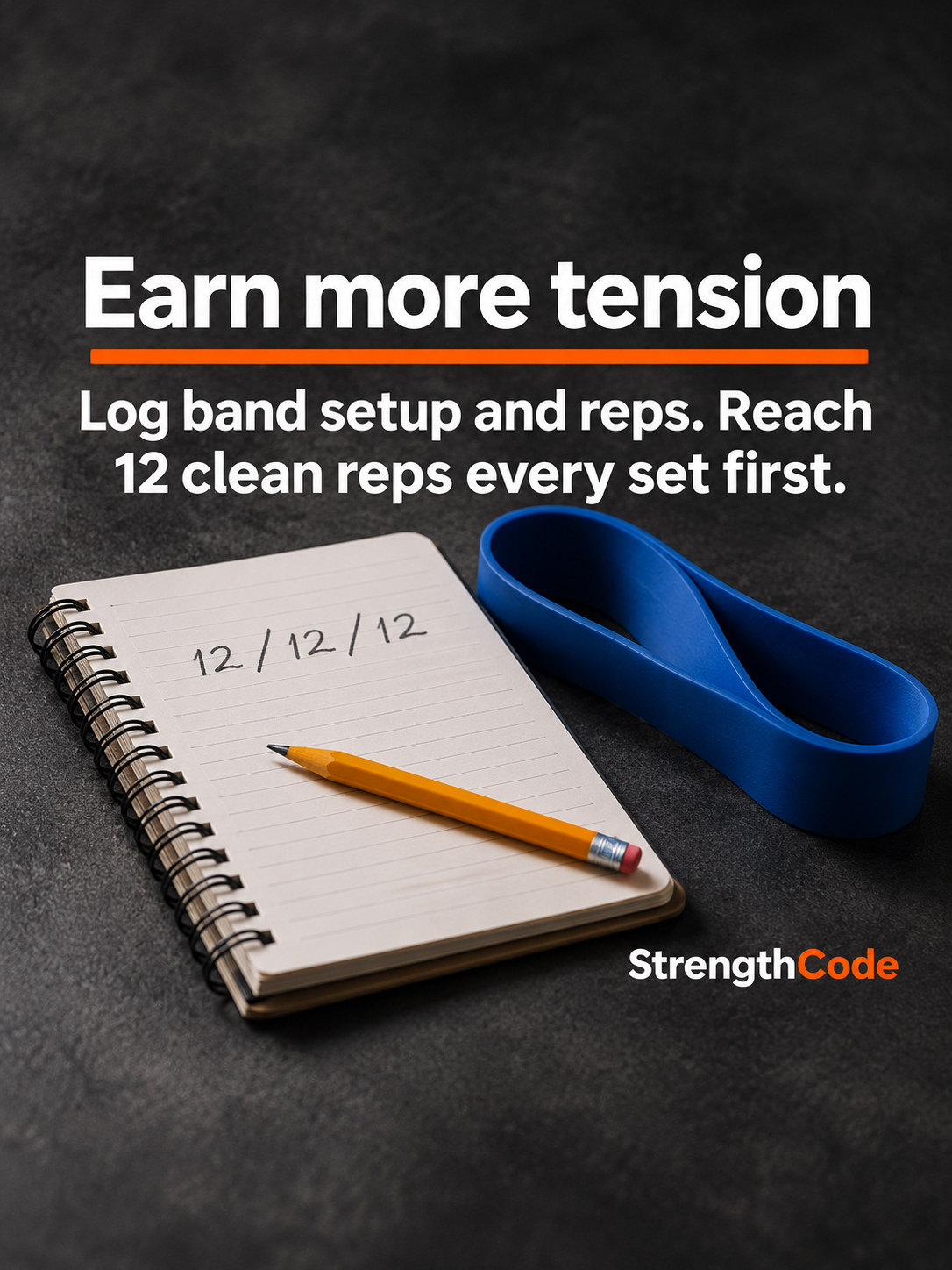
Earn more tension. Log band setup and reps. Reach 12 clean reps everyEarn more tension. Log band setup and reps. Reach 12 clean reps every set first.
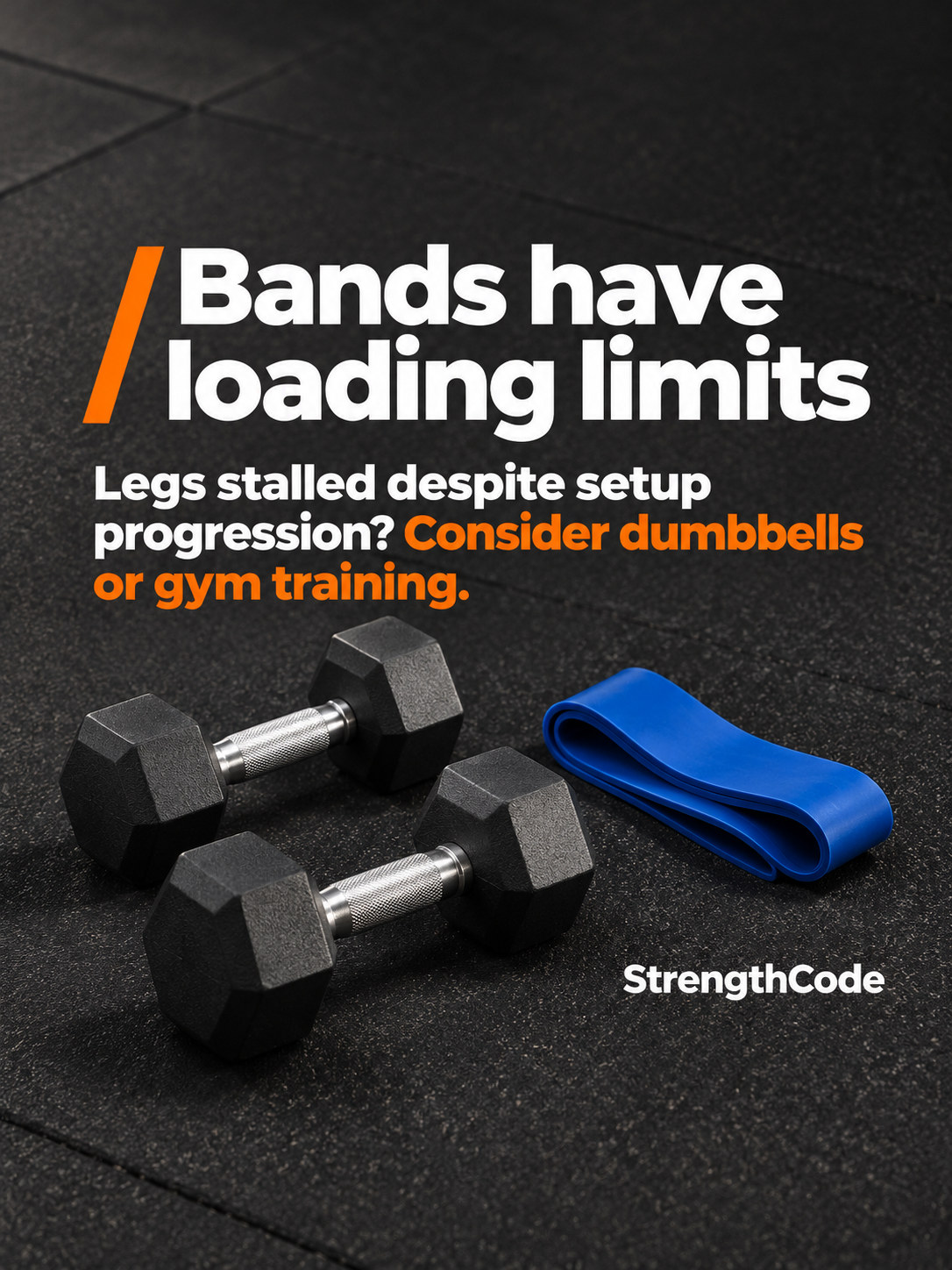
Bands have loading limits. Legs stalled despite setup progression?Bands have loading limits. Legs stalled despite setup progression? Consider dumbbells or gym training.
Save photos and copy caption
Save the original photos in order, then add them and paste the caption in Instagram or Facebook.
This resistance band workout plan for beginners is built for home training with a set of bands and a door anchor: three full-body sessions per week on nonconsecutive days, 30 to 45 minutes each, five exercises per session, 2 to 3 sets of 8 to 12 reps, 1 to 2 minutes of rest. Progress by double progression, topping the rep range before adding band tension. The main limitation is heavy lower-body loading, so the log decides when to switch.
Bands are a real strength tool when the sets are hard and the progression is measurable. They are a waste of time when the band hangs slack and nothing gets written down. That difference separates the people who get stronger on bands from the people who spend six months doing the same easy reps.
One rule runs through this whole article: progress the band setup before you progress the band. Anchor height, stance, tempo and range do more work in the first two months than any new equipment you can buy.
Why a Resistance Band Plan Works for Beginners
Bands work for beginners because elastic resistance produces strength gains comparable to dumbbells and machines when the sets are genuinely hard and the weekly volume is there. The band isn't the limiter. Your setup and your logging are.
The comparison data does not embarrass bands. A meta-analysis of eight trials comparing elastic resistance with weight machines and free weights found no superiority for either method on upper limb strength (standardised mean difference -0.011) or lower limb strength (0.09) [6]. Elastic training also improved lower limb strength and balance in older adults across 25 trials [5], and improved jump, change of direction and sprint performance in team sport athletes [4]. Beginners start from a lower base than any of those groups.
Exercise selection matters more than the tool. The time-efficient training review recommends prioritising bilateral, multi-joint movements with at least one leg press pattern, one upper-body pull and one upper-body push in the program [1]. That is exactly how the three days below are built.
Weekly sets beat weekly frequency. The same review puts the floor at roughly 4 weekly sets per muscle group in a 6 to 15 rep range, with 15 to 40 reps acceptable if sets go to volitional failure [1]. For the full logic on setting volume, read how many sets per muscle per week. Two or three full-body days per week works for novices, spaced so you get one to three days between sessions [7]. The National Institute on Aging sets the minimum at two days per week with one set of 8 to 12 reps per exercise, noting two or three sets may be more effective [9].
| Variable | Beginner target |
|---|---|
| Frequency | 2 to 3 full-body days, nonconsecutive |
| Weekly volume | Minimum 4 hard sets per muscle group |
| Rep range | 6 to 15 (15 to 40 if taken to failure) |
| Rest between sets | 1 to 2 minutes |
| Session length | 30 to 45 minutes |
One honest caveat. Electromyography work on single-joint upper-body movements found bands produced slightly lower activation in the prime movers and higher activation in the supporting muscles, likely because the band is less stable than a dumbbell [3]. That is an argument for choosing multi-joint exercises and controlling the reps, not an argument against bands.
Two versus three days per week produced similar strength and muscle adaptations when weekly volume was matched in trained men over 10 weeks [8]. Stop negotiating with the calendar. Protect the weekly sets.
The 3-Day Full-Body Resistance Band Plan
Run Day A, Day B and Day C on nonconsecutive days. Five exercises per session, 2 to 3 sets of 8 to 12 reps, 1 to 2 minutes of rest, 30 to 45 minutes on the clock. Every exercise below covers a main movement pattern or supports one directly, which is what a beginner resistance band workout should be built from.
Day A: squat, press, row
| Exercise | Sets x reps | Setup that matters |
|---|---|---|
| Band squat | 2 to 3 x 8 to 12 | Stand on the band, handles at shoulder height, feet shoulder width |
| Band chest press | 2 to 3 x 8 to 12 | Anchor at chest height, step back until the band is taut before rep one |
| Seated band row | 2 to 3 x 8 to 12 | Anchor at lower rib height, tall spine, pull to the belly |
| Band glute bridge | 2 to 3 x 10 to 15 | Band above the knees, drive through the heels, ribs down |
| Band Pallof press | 2 to 3 x 8 to 12 per side | Anchor at chest height, resist the rotation, no lean |
Day B: hinge, vertical press, pull
| Exercise | Sets x reps | Setup that matters |
|---|---|---|
| Band Romanian deadlift | 2 to 3 x 8 to 12 | Stand on the band, hinge at the hips, band stays close to the legs |
| Band overhead press | 2 to 3 x 8 to 12 | Anchor at floor level, press overhead without arching the lower back |
| Half-kneeling band lat pulldown | 2 to 3 x 8 to 12 | High anchor, kneel on the down knee, drive elbows to the ribs |
| Band hip thrust | 2 to 3 x 10 to 15 | Band across the hips, anchor low, finish with the glutes, not the lower back |
| Band face pull | 2 to 3 x 12 to 15 | Anchor at face height, pull apart and rotate, elbows above wrists |
Day C: lunge, push, pull variation
| Exercise | Sets x reps | Setup that matters |
|---|---|---|
| Band reverse lunge or split squat | 2 to 3 x 8 to 12 per leg | Front foot on the band, hold the handles at shoulder height |
| Band-resisted push-up or standing fly | 2 to 3 x 8 to 12 | Band across the upper back for push-ups, chest-height anchor for the fly |
| Single-arm band row | 2 to 3 x 8 to 12 per side | Anchor at waist height, no torso rotation, squeeze at the end |
| Band lateral walk | 2 to 3 x 10 to 12 steps per side | Band above the knees or at the ankles, stay low, feet never touch |
| Band triceps pressdown | 2 to 3 x 10 to 15 | High anchor, elbows pinned to the ribs, full extension |
A hard set has a signature. The last two reps slow down, you have to fight the return, and your form still looks the same as rep one. If rep twelve looks identical to rep two, the band is too light or you are standing too close to the anchor.
Equipment setup and safety checks
Test the anchor with a hard pull before your first rep. I have watched a door hinge give way mid-set because nobody yanked the band first, and the band always wins that argument. Loop around a solid door hinge side, a closed and locked door, or a structural post. Never trust a hook that flexes.
Inspect the band every session. Hold it up, look for nicks, tears, white stress marks or a faded chalky surface, and bin it if you find any. Never stretch a band past the manufacturer's rated limit. Rated sets are marked with a tension at a stated elongation, so you can compare week one to week eight instead of guessing.
Control the return. The snap-back is where people get hurt, not the pull. Take two to three seconds on the way back and keep the band off sharp door edges. Breathe out on the effort and in on the return, and do not lock joints hard at the end of a press [9]. Stop the set when range of motion or posture breaks, not when the timer says so.
How to Progress Without Buying Heavier Bands
Learn how to progress resistance bands with double progression first: stay on the same band until every set hits 12 clean reps, then make the exercise harder. That is progressive overload in its cheapest form. Everything below is how you make the exercise harder without shopping.
| Lever | How to apply | Use it when |
|---|---|---|
| Band tension | Step 15 to 30 cm (6 to 12 in) further from the anchor, choke up on the band, or double it | Every set hits 12 clean reps |
| Anchor height | Raise or lower the anchor to shift where the band loads hardest | You want more challenge at a specific joint angle |
| Stance width | Wider stance means more tension on lower-body work, narrower means less | You need a jump smaller than a band change |
| Tempo | Add a 3 second return | Reps get rushed or sloppy |
| Rest | Cut from 2 minutes to 1 minute | You need density rather than more load |
| Sets | Add one set per exercise | The last set hit the top of the range clean and the next session did not suffer |
Order matters. Fix tempo, then stance, then anchor height, then tension. Most people jump straight to a heavier band and lose the range of motion that made the exercise worth doing.
Volume has a ceiling and a floor. At least 4 weekly sets per muscle group is the floor, and anything above that is an individual decision based on recovery and response [1]. Beginners can get real strength gains from low doses, with one session per week producing results across the first 8 to 12 weeks [11]. You do not need to chase volume in month one. You need to beat your log.
Then the honest part. Bands are limited for heavy lower-body loading. When the log shows the same setup at the top of the rep range for three straight weeks with clean form, that is the equipment failing, not you. Blend in dumbbells for legs or run one gym session per week for lower-body work at that point. No apology needed. If you are deciding between the two rooms, the comparison in gym vs home workout for beginners covers the trade-offs.
How to integrate
Put the full body resistance band routine inside a real week instead of an ideal one. Monday, Wednesday and Friday, or Tuesday, Thursday and Saturday. Thirty to 45 minutes per session, and two days per week is a legitimate starting point if three will not happen [7][9].
Walk 20 to 40 minutes on off days. Keep it boring and easy so it does not eat the recovery the lifting needs.
Cap the warm-up. Two lighter sets on the first movement plus a couple of dynamic drills is enough, and the time-efficient review is blunt about restricting warm-ups to exercise-specific work [1]. If session length is your problem, read how long a beginner workout should be.
Write one log line per exercise: band colour or tension setting, reps per set, and a note on form. That notebook is your progression tool. Add a set only when your recovery supports it and the last set finished clean, and write the progression rule down instead of reinventing it each week.
Stop rules, stated plainly. Stop the set when the rep slows and the band takes over the movement. Skip the session or cut sets if a joint is painful rather than sore. Do not stack two hard lower-body days back to back. If you are unsure how hard to push, RIR and RPE explained will calibrate you in five minutes.
What you need to keep in mind
Bands will carry a beginner for months, and the log, not boredom, tells you when to add load. Run the same three sessions for six weeks before you change anything. If you want the wider equipment picture, the four-piece home gym kit shows where bands sit next to dumbbells and a bench.
Keep the weekly sets honest and the reps controlled, and expect the lower body to stall before the upper body does. That is normal with elastic resistance and it isn't a reason to quit the plan. It is the signal to blend in external load for legs while the bands keep doing the upper-body work.
FAQ
Is a resistance band workout good for beginners?
Yes. Elastic resistance produced strength gains comparable to weight machines and dumbbells in controlled comparisons, with no significant difference in upper or lower limb strength [6]. The conditions are hard sets, controlled reps and a written progression. Slack bands and random reps build nothing.
How many days per week should a beginner do resistance band workouts?
Two or three nonconsecutive full-body days per week. Novices do well on that frequency with one to three days between sessions [7], and the National Institute on Aging sets two days per week as the minimum [9].
Can resistance bands build muscle?
Yes, when weekly volume and effort are sufficient. Roughly 4 weekly hard sets per muscle group in a 6 to 15 rep range is the documented floor [1], and elastic training improved lower limb strength and balance in older adults across 25 trials [5]. Bands are weaker for heavy lower-body loading, which is where progress slows first.
How do I know when to move from bands to dumbbells?
When your log shows the same band setup at the top of the rep range for three straight weeks with clean form, and you have already used tempo, stance and anchor height to add difficulty. That is the equipment failing, not your effort. Start with adjustable dumbbells for lower-body work and keep bands for upper body and shoulders.
Sources Used
- [1] No Time to Lift? Designing Time-Efficient Training Programs for Strength and Hypertrophy: A Narrative Review
- [3] Muscle Activity in Upper-Body Single-Joint Resistance Exercises with Elastic Resistance Bands vs. Free Weights
- [4] Effects of Elastic Band Training on Physical Performance in Team Sports: A Systematic Review and Meta-Analysis
- [5] Effects of elastic band resistance training on lower limb strength and balance function in older adults: a systematic review and meta-analysis
- [6] Effects of training with elastic resistance versus conventional resistance on muscular strength: A systematic review and meta-analysis
- [7] Determination of Resistance Training Frequency (NSCA)
- [8] Similar Muscular Adaptations in Resistance Training Performed Two Versus Three Days Per Week
- [9] Three Types of Exercise Can Improve Your Health and Physical Ability (National Institute on Aging)
- [11] Minimalist Training: Is Lower Dosage or Intensity Resistance Training Effective to Improve Physical Fitness? A Narrative Review