Dumbbell Workout Plan for Beginners: 3-Day Full-Body Home Strength Program
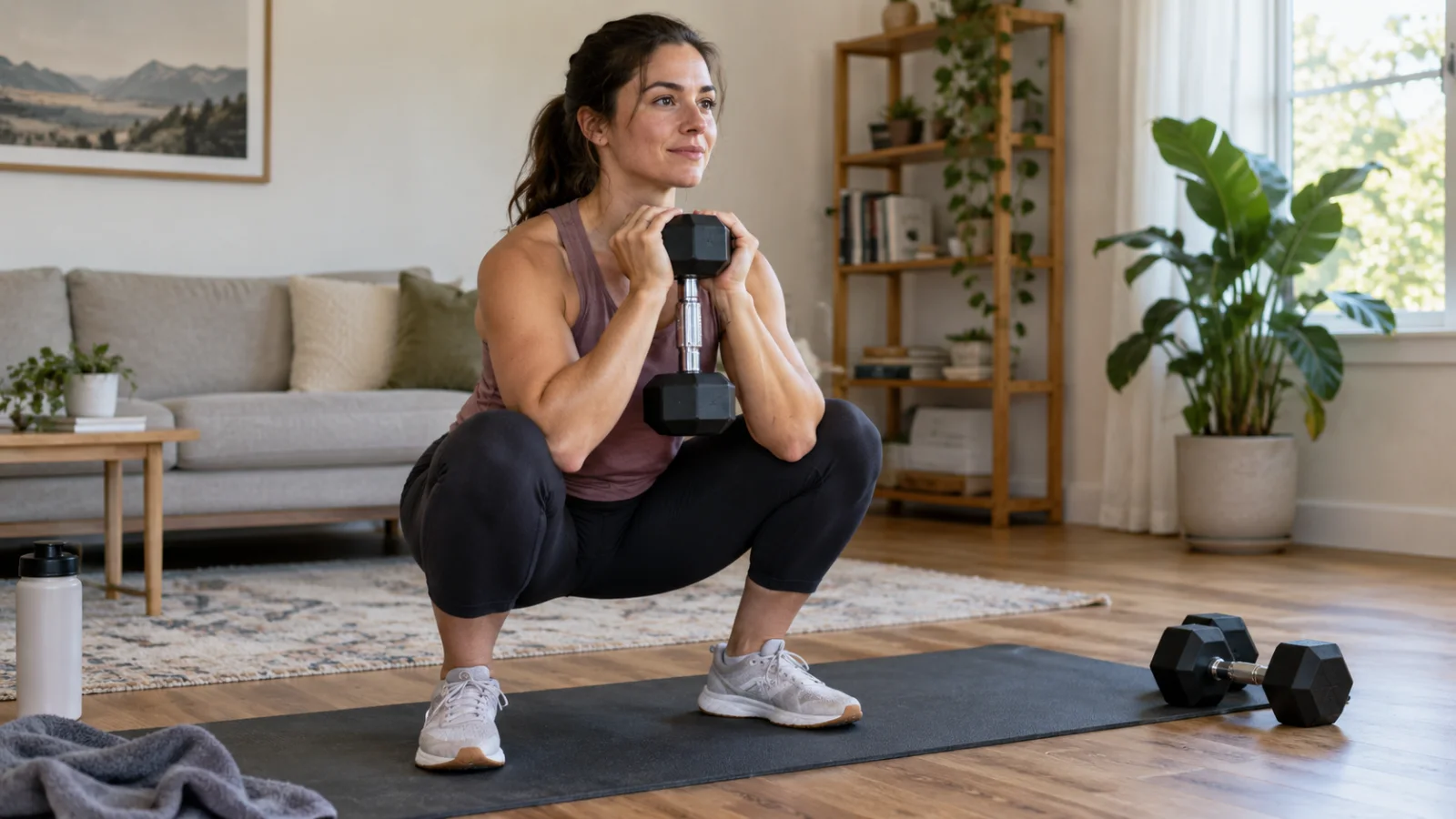
You don't need a rack, a bench, or a six-day split. You need three full-body sessions a week, a pair of dumbbells that challenge you, and a progression rule you'll actually follow.
This is the plan for the beginner who wants to start strength training in a living room, garage, or spare bedroom. Not a list of 30 random dumbbell exercises. Not a program that assumes you own a full commercial gym. Three days, five or six exercises per session, compound work first, isolation work only where it earns its place. This is a beginner dumbbell workout at home that works because it keeps the structure simple and the effort high.
The setup is minimal. Adjustable dumbbells make progression smoother, but a few fixed pairs can work if you apply the progression rules in Section 3. A flat surface for floor presses and rows. A chair or wall for balance on single-leg work. That's it. If you have a yoga mat, great. If you don't, a towel works.
Why a 3-Day Full-Body Dumbbell Plan Works for Beginners
Split routines look impressive on paper. Chest day, back day, leg day. The problem is they spread volume so thin that a beginner never gets enough exposure to any movement pattern to actually learn it well.
Full-body training fixes that.
You Practice the Patterns More Often
Resistance training is a skill. The goblet squat is a skill. The Romanian deadlift is a skill. The one-arm row is a skill. Skills improve with frequency. When you squat three times a week instead of once, you simply get more reps in. More reps means faster motor learning, more stable positions, and less wasted time wondering why the movement still feels awkward.
Experts agree that novice-appropriate exercises should be technically manageable, meaning you can learn them without spending three weeks just figuring out how to stand correctly. A goblet squat fits that standard. A barbell back squat with heavy load doesn't, yet. The dumbbell versions of fundamental patterns give you the same movement skill without the same technical barrier. You build competence that transfers to barbell work later if you choose to go that route.
Weekly Volume Beats Split Complexity
Your muscles don't know what day of the week it is. They respond to weekly training volume. The research comparing split routines to full-body routines with volume equated shows similar improvements in strength and muscle size. If the total weekly sets are the same, the weekly layout matters much less than beginners assume.
The meta-analysis on training frequency backs this up. Across the pooled data, when weekly volume is matched, training a muscle three days a week doesn't magically beat training it twice or even once. What matters is that the muscle gets enough total work across the week. A full-body routine lets you spread 8 to 10 weekly sets per major muscle group across three sessions. That's far more practical than trying to shove that volume into one brutal leg day.
Three Days Fits Real Life
The National Institute on Aging recommends strength training major muscle groups at least two days per week. Three days is better for most beginners. Three nonconsecutive days, Monday, Wednesday, Friday being the classic setup, gives you 48 to 72 hours of recovery between sessions while hitting every major muscle group enough times to drive adaptation.
You can miss a session and still get two solid training days in that week. You can train in 40 to 50 minutes if you keep rest periods focused and don't wander between sets. You can do this even when life gets loud.
Home Equipment Isn't the Limitation
A pair of dumbbells won't replicate a loaded barbell squat. That's true. But for a beginner, it doesn't need to. The time-efficient training review from Iversen and Schoenfeld makes a point worth repeating: prioritize bilateral, multi-joint exercises that include full dynamic movements, and include a minimum of one leg pressing exercise, one upper-body pulling exercise, and one upper-body pushing exercise in the program.
You can do all of that with dumbbells in your living room. Goblet squat for the leg press. One-arm row for the pull. Floor press or overhead press for the push. Romanian deadlift for the hinge. Carry variations for loaded stability. That's a complete full body dumbbell routine using movements that recruit large amounts of muscle mass and teach you to stabilize a load through space, something machines never will.
The equipment isn't the barrier. A plan that tries to look like a YouTube compilation is the barrier.
The 3-Day Full-Body Dumbbell Plan: Day A, Day B, Day C
Every session follows the same logic: hardest compound work first, easier isolation work last. You warm up, you do your big movements while you're fresh, and you finish with smaller muscle groups that need less systemic energy.
Rest 2 to 3 minutes between compound sets. Rest 1 to 2 minutes between isolation sets. For a deeper breakdown of rest periods, read how long you should rest between sets. Track your weights, your reps, and your RIR, which means repetitions in reserve, every single session. RIR is how many more reps you could have done before failure. When a program says 2 RIR, stop the set when you could still do two more clean reps. That's a training decision, not a guess. It keeps you honest and keeps your technique from turning to garbage on rep 12 of a set you should have ended at rep 10. If you want the full explanation of RIR and training intensity, read how close to failure you should train.
Day A: Squat, Press, Row
| Exercise | Sets | Reps | RIR | Rest |
|---|---|---|---|---|
| Goblet Squat | 3 | 8-12 | 2 | 2-3 min |
| Floor Press | 3 | 8-12 | 2 | 2-3 min |
| One-Arm Dumbbell Row | 3 | 8-12 per side | 1-2 | 2-3 min |
| Romanian Deadlift | 3 | 8-12 | 1-2 | 2-3 min |
| Dumbbell Biceps Curl | 2 | 10-15 | 1-2 | 1-2 min |
Goblet Squat: Hold one dumbbell vertically against your chest, elbows tight, feet about shoulder-width. Squat between your hips, not straight down. Your thighs should go at least parallel or slightly below. Pause at the bottom for half a second to kill the bounce. This builds your squat pattern while forcing your upper back and core to hold position. No bench needed.
Floor Press: Lie on your back, dumbbells at your chest, feet planted. Press the weights up and slightly back so they finish over your shoulders. Lower with control until your upper arms touch the floor. This short range of motion might feel limiting, but it protects your shoulders while you build pressing strength and teaches you to control the lowering phase. When you eventually get a bench, you can switch to a full-range dumbbell press.
One-Arm Dumbbell Row: Brace one hand on a chair, bed, or bench. Keep your hips square and your spine neutral. Row the dumbbell to your hip, not your shoulder. Squeeze at the top for a moment. This teaches you to use your lats instead of yanking with your biceps.
Romanian Deadlift: Dumbbells in front of your thighs, knees slightly bent, push your hips back until you feel a strong hamstring stretch. Keep the dumbbells close to your legs. Return by driving your hips forward. The hip hinge is foundational. Every beginner should learn it, and dumbbells make it far more approachable than a barbell.
Biceps Curl: Optional but useful. Two sets to failure-adjacent. Keep your elbows pinned to your sides. No swinging. This isn't the main course. It's the accessory work that helps your arms grow while you chase bigger compound lifts.
Day B: Hinge, Vertical Press, Vertical Pull
| Exercise | Sets | Reps | RIR | Rest |
|---|---|---|---|---|
| Romanian Deadlift | 3 | 8-12 | 2 | 2-3 min |
| Seated Dumbbell Overhead Press | 3 | 8-12 | 2 | 2-3 min |
| Pullover (or Two-Arm Row) | 3 | 8-12 | 1-2 | 2-3 min |
| Reverse Lunge | 3 | 8-12 per leg | 1-2 | 2-3 min |
| Dumbbell French Press | 2 | 10-15 | 1-2 | 1-2 min |
Romanian Deadlift: Day starts with the hinge instead of the squat. That's intentional. Practicing the hinge twice a week will pay off in every other lower-body lift you ever learn. Same technique as Day A.
Seated Dumbbell Overhead Press: Sit on a chair with back support if you have one. This removes the urge to cheat with leg drive and keeps your lower back from arching hard. Press the dumbbells from shoulder height to full lockout. Lower with control. If you don't have a bench or chair, you can do this standing, but sitting will let you handle more weight safely as a beginner.
Pullover: Lie across a bench or on the floor. Hold one dumbbell with both hands above your chest, arms mostly straight. Lower it behind your head with control, then pull it back over your chest. This hits the lats and chest through a stretched position that rows don't touch. If a pullover feels awkward, substitute with a two-arm dumbbell row. Keep the same sets and reps.
Reverse Lunge: Dumbbells at your sides. Step back with one leg until your back knee nearly touches the floor. Push through your front foot to return. Alternate legs. This trains single-leg stability and balance while giving your quads and glutes more work than a bodyweight lunge.
Dumbbell French Press: Lying on your back or seated, extend a dumbbell overhead and bend at the elbows to lower it behind your head. This isolates the triceps. Two sets, no heroics.
Day C: Squat Variation, Press Variation, Row Variation
| Exercise | Sets | Reps | RIR | Rest |
|---|---|---|---|---|
| Goblet Squat (Heavier) or Split Squat | 3 | 8-12 | 2 | 2-3 min |
| Single-Arm Floor Press | 3 | 8-12 per side | 1-2 | 2-3 min |
| Chest-Supported Row | 3 | 8-12 | 1-2 | 2-3 min |
| Dumbbell Stiff-Leg Deadlift | 3 | 8-12 | 1-2 | 2-3 min |
| Dumbbell Lateral Raise | 2 | 12-20 | 1-2 | 1-2 min |
Squat Variation: Use a heavier goblet squat than Day A if you can still maintain clean depth. Or switch to a split squat: one foot forward, one foot back, descend until your back knee is close to the floor. Split squats demand more balance and hit each leg harder. If you're still learning the pattern, keep the goblet squat and just add a bit more weight or a slightly slower tempo.
Single-Arm Floor Press: The same mechanics as Day A's floor press, but each arm works independently. This forces your core and shoulder to stabilize the load without the other arm covering for weakness.
Chest-Supported Row: Brace your chest against an incline bench, a sturdy chair back, or even the edge of a couch. Let the dumbbells hang straight down, then row them to your hips. Because your chest is supported, there's no momentum and no lower-back fatigue. You just row.
Dumbbell Stiff-Leg Deadlift: Similar to the Romanian deadlift but with less knee bend and a slightly different hamstring stretch. Keep your back flat. Push your hips back. Lower until you feel a strong hamstring stretch, then return. No rounding.
Lateral Raise: The shoulder isolation work most plans forget. Light weight, higher reps, strict form. Dumbbells to your sides, elbows slightly bent, raise until your arms are parallel to the floor. Lower with control. Your shoulders need direct work eventually, and this gives it to them without risking your rotator cuff on heavy overhead presses.
Substitutions for Limited Equipment
No bench? Do floor presses instead of bench presses. Do chest-supported rows by bracing against a chair. Do seated overhead presses on a sturdy chair.
Only light dumbbells? Increase the reps within the given range first, then add sets. If you can do 12 reps with a weight that once challenged you for 8, move up. But don't rush to add weight at the cost of turning into a shallow, fast, ugly set. Slow your tempo down, pause at the bottom, and stay in the range where one more rep feels earned.
No dumbbells at all yet? Run this plan with bodyweight versions. Squat, inverted rows, pushups, single-leg work. The structure still works. You're still training all major muscle groups three days a week with progressive effort. The equipment just changes the load.
Progression Rules That Make Dumbbells Actually Work
The plan works if progression works. And progression is where most home strength training for beginners stalls out. Not because the exercises are wrong, but because there's no clear rule for when to add more weight or more reps. Most people just do the same thing every week and hope something changes.
It doesn't.
Double Progression
Here's the rule: pick a repetition range, say 8 to 12. Start with a weight you can lift for 8 clean reps with 2 RIR. Train that exercise every session it's scheduled. Each week, try to add one rep per set. When you can hit 12 reps on all three sets with your RIR staying around 2, increase the weight by the smallest jump available. With adjustable dumbbells, that's usually 2.5 to 5 pounds per dumbbell. Drop back to 8 reps. Repeat.
That's double progression. Reps increase first. Load increases second. Both variables move in a controlled cycle, and you always earn the next jump. For a deeper breakdown of the principle, read progressive overload.
When to Add Reps Versus Load
If you're stuck at 10 reps and the jump to the next dumbbell pair feels too big, add reps first. Press 11. Then 12. Then 13, even if it means going outside the planned range by a rep or two. More reps at the same load is a valid form of progression.
If adding reps while maintaining tempo and depth feels impossible, add sets before adding load. Three sets of 10 becomes four sets of 10. That's more weekly volume, which is more stimulus.
If you can add load but only by turning every rep into a fast, shallow mess, don't. Technique comes before load. A cleaner rep with controlled lowering phase beats a heavier rep that wrecks the movement pattern. Load only matters if the movement stays recognizable. This is the core idea behind technique before load.
What to Do When Dumbbell Jumps Are Too Heavy
Fixed dumbbells are the problem here. If you have 20s and 30s but nothing in between, the jump from 20 to 30 is a 50 percent increase. That's huge for a beginner.
Solutions: perform the exercise with a slower lowering phase using the lighter weight. A controlled three-second descent on every rep makes the same dumbbell substantially harder. Or add a second set instead of going heavier. Or hold the top position for a two-count pause on exercises like the floor press and row. None of these require equipment you don't own. They all make a lighter dumbbell feel harder, which is the entire point.
The honest truth about home training is that dumbbells eventually become limiting for lower-body work. A pair of 50-pound dumbbells might challenge your legs for a while, but you won't goblet squat your way to massive wheels indefinitely. When every lower-body set becomes a double-digit rep grind and you still aren't challenged, that's the signal to consider a gym membership or invest in a heavier loading setup. Until then, run this 3 day dumbbell workout plan with the tools you have and demand steady progress from them.
How to integrate
Run this plan for eight weeks. That's long enough to see real strength progression without overhauling your life.
Schedule Monday, Wednesday, and Friday. If those days don't work, any three nonconsecutive days will. Never train the same muscles on back-to-back days. Recovery is where adaptation happens. If you miss a session, don't double up the next day. Just resume the next scheduled training day and continue the sequence from there.
Start every session with a five-minute dynamic warm-up. Bodyweight squats, arm circles, leg swings, hip openers. Then do one light set of the first exercise with half your working weight. That's enough. You don't need a 20-minute mobility routine before three dumbbell exercises. Use those first warm-up sets to find your positions.
Track everything. Exercise, weight, sets, reps, RIR. Write it in a notebook or a notes app. If you didn't record it, you didn't train it in any meaningful way. Tracking is how you know whether double progression is actually happening or you're just working out for the sake of working out.
On cardio: it's fine. Two or three 20-minute walks or easy sessions a week won't hurt your strength progress, and they contribute to overall health. Don't turn cardio into a second leg day. Keep it at a conversational pace unless you have a specific endurance goal.
Protein matters. Aim for roughly 1.6 to 2.2 grams per kilogram of bodyweight daily, or 0.7 to 1.0 grams per pound. Spread it across three or four meals. Keep the target on rest days too. Muscle repair isn't exclusive to training days. For the full breakdown, read how much protein you need.
After eight weeks, look at your log. If the weights went up or the reps went up, you repeat the plan with a slightly different emphasis: maybe start Day C with the hinge instead of the squat, or bump every exercise from 3 sets to 4 on the compounds. If you plateaued on everything for two straight weeks despite consistent effort and decent sleep, you're either not recovering enough or you've hit the ceiling of your current equipment. At that point, a gym-based barbell program is the logical next step.
What you need to keep in mind
This plan works if you work. Hard sets, stuck to consistently, beat a perfectly engineered program that you abandon in week two. If you want to understand the minimum effective dose for strength training and how to make 2 to 3 sessions a week work long-term, read minimum effective dose strength training.
Your technique will drift when the weight gets hard. That's normal. That's also exactly when you should slow down and clean it up. If you can't maintain the same range of motion on rep 11 that you had on rep 3, the set was over a rep earlier than you thought. End it. Log it. Move on.
The program is simple on purpose. Simple means repeatable. Repeatable means you actually do it next week. The beginner who runs a basic full-body plan for eight straight weeks will outperform the beginner who keeps redesigning their program every third training day.
No home plan removes the need for consistent hard sets. Three days a week, you will show up. You will record your reps. You will add reps when you can, weight when you earn it. That's the entire game.
You'll be stronger in the same space you started in. It isn't about the equipment. It's about the demands you place on yourself week after week.
Your first session is Day A. Do it today or tomorrow. Write down your reps, your RIR, and what the sets felt like. That log is the start of the entire process.
FAQs
Can beginners build muscle with dumbbells?
Yes. Dumbbells allow progressive resistance, which is the driver of muscle growth. The limiting factor with dumbbells is that the load eventually gets too light for lower-body work. Up to that point, a beginner can absolutely build meaningful muscle with them.
How heavy should the dumbbells be?
Pick a weight that challenges you for 8 to 12 reps on the goblet squat and floor press. The exact number depends on your current strength level. If you can hit 12 reps easily on your hardest exercises, go heavier. If you can't hit 8 clean reps, drop down. The range matters. The specific dumbbell doesn't.
How many days per week should a beginner train?
Three nonconsecutive days is the sweet spot for beginners. That provides enough frequency to learn the movements and enough weekly volume to drive adaptation without overwhelming recovery.
What if I only have light dumbbells?
Increase reps before anything else. Slow down the lowering phase of every rep. Add more sets. The goal is progressive overload, which is about creating a more challenging stimulus. Light weight with high reps and slow tempo can still build muscle in beginners.
Can I swap exercises?
Yes, but only if the swap solves a problem. Replacing an exercise because you don't feel like doing it is not a valid reason. Replacing it because it causes pain or because you can't perform it safely with your equipment is valid. Read exercise selection for muscle growth if you want the full framework for choosing lifts.
How long until progress shows?
Noticeable strength changes typically appear within 4 to 6 weeks of consistent training. Visual muscle changes usually take longer, 8 to 12 weeks of consistent training, progressive overload, and reasonable nutrition before you'll clearly see changes in the mirror.
Do I need a bench?
No. Floor presses, chest-supported rows using furniture, and seated presses on a chair cover the movements you need without a bench.
Should I add cardio?
You can add light cardio on non-training days. Two or three 20 to 30-minute walks don't interfere with strength gains and contribute to overall health. Just don't let intense cardio sessions compromise your leg training.
Sources Used
No Time to Lift? Designing Time-Efficient Training Programs for Strength and Hypertrophy
Weekly Training Frequency Effects on Strength Gain: A Meta-Analysis
Split or full-body workout routine: which is best to increase muscle strength and hypertrophy?
Selecting Resistance Training Exercises for Novices: A Delphi Study with Expert Consensus
Three Types of Exercise Can Improve Your Health and Physical Ability