What Dumbbell Weight Should a Beginner Start With? How to Pick, Load, and Progress at Home
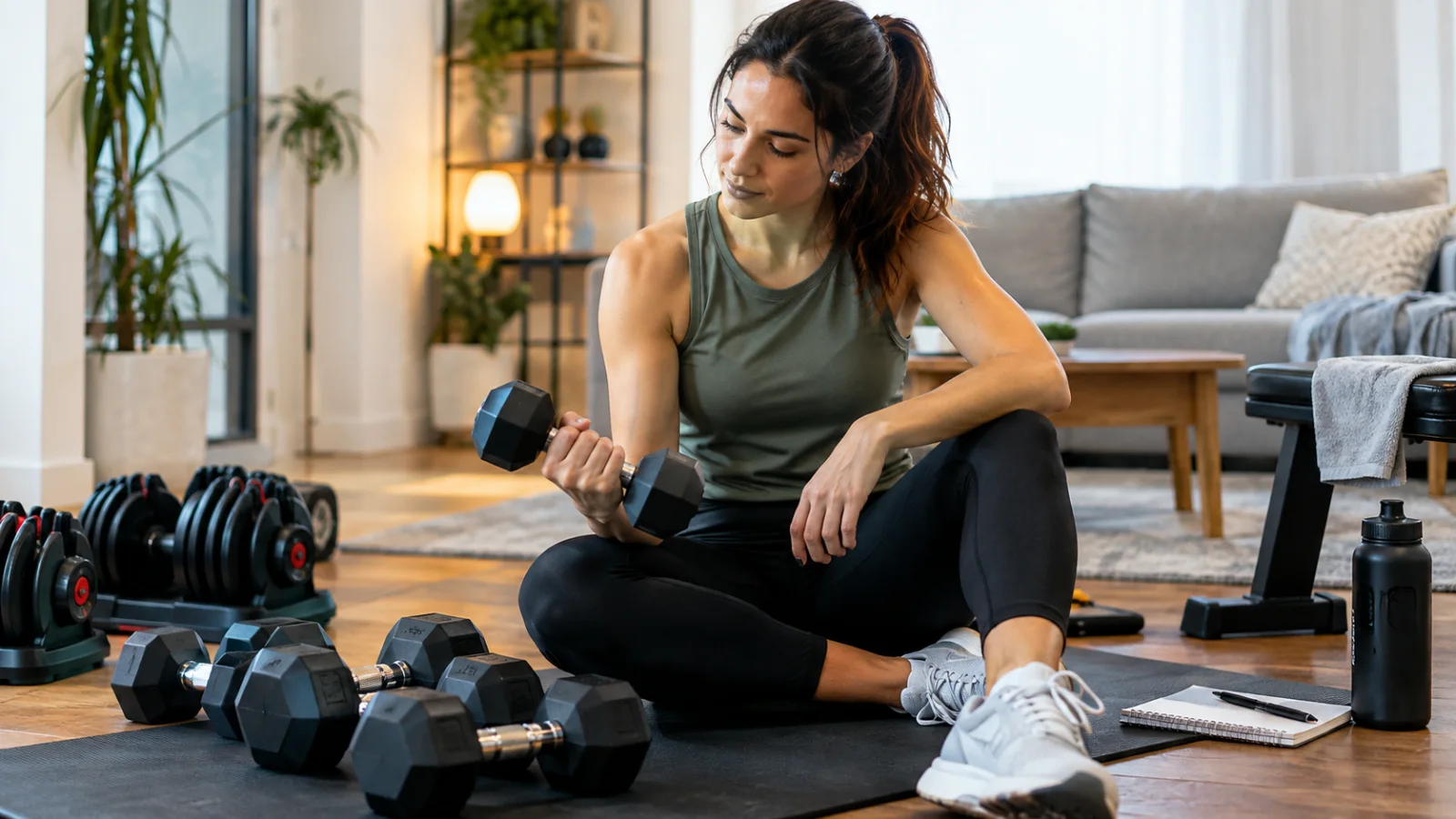
The number on a dumbbell is not a difficulty rating.
A 10 kg (≈ 22 lb) press can feel heavier than a 20 kg (≈ 44 lb) goblet squat because leverage and exercise choice decide the challenge. Your limbs are levers. Your joints are fulcrums. The longer the lever, the harder the same weight fights you. That is why a lateral raise with 7.5 kg (≈ 17 lb) dumbbells can humble you while a squat with 20 kg (≈ 44 lb) dumbbells feels manageable. Stop asking what weight to buy. Start asking what weight you can actually train hard with.
As a coaching starting point, most beginners land between 5 and 12.5 kg (≈ 11–28 lb) per dumbbell. But a 50 kg (≈ 110 lb) beginner and a 100 kg (≈ 220 lb) beginner will not start in the same place. The number printed on the side matters less than what happens when you pick it up and move well for eight to twelve clean reps with a couple reps left in the tank. Pick that load. Then progress it on purpose.
This is the beginner dumbbell workout at home problem solved before you even open a program. Because if the load is wrong, no three-day plan will save you.
Test the dumbbell before you trust it
Put the 12.5 kg (≈ 28 lb) dumbbells down.
Show me eight goblet squats with the 10 kg (≈ 22 lb) dumbbells. If your knees cave, your hips shoot back, and you stop at six, that isn't your set. That is a load that owns you.
The rep test is simple and it works across every movement pattern you will use in a full body dumbbell routine. Grab a pair. Perform eight to twelve reps of a given exercise. Stop when you have two or three clean reps left in you. That means the weight is appropriate. You worked hard. The muscle got the signal. You did not turn the last three reps into a form-crime scene.
What does clean look like?
For a squat: hips sink below parallel, knees track over your toes without collapsing inward, chest does not fold into a good morning. If your heels come off the floor or your lower back rounds at the bottom, the rep doesn't count.
For a hinge: spine stays neutral from hip to head, dumbbells track close to your legs, and you feel the hamstrings and glutes do the work. If your lower back aches or you're pulling with your arms, that's a missed rep.
For a press: both feet stay planted, ribs stay stacked over your pelvis, and the dumbbells lower under control instead of dropping onto your chest. If you arch your lower back off the bench or flare your elbows out like wings, you're sacrificing the rep.
For a row: your shoulder doesn't shrug toward your ear, your torso stays square, and the dumbbell finishes at your hip, not your armpit. If you're twisting your torso or yanking with your biceps, that is the wrong muscle doing the work.
For a split squat: your front knee tracks over your toes, your hips stay level, and you lower under control. If you rock side to side or your front heel lifts, the load is above your pay grade.
Ten sloppy reps that leave you gasping for air are not strength training. They are bad cardio with a joint tax. Twenty sloppy reps where the weight feels like a suggestion and you could have done thirty more means you are practicing movement, not training muscle. Both are failure states for a beginner. One because it breaks your technique before it builds your strength. The other because it never creates enough tension to demand adaptation.
The research on load selection supports the range. Six to fifteen reps taking you close to but not always into failure is effective for building strength and muscle. The key in that wording is close to failure. Not miles away. Not grinding out rep fifteen with your face tied in a knot. Two or three reps in the tank is the sweet spot for training intensity that triggers growth without burying you for three days.
Test each pattern. Squat, hinge, press, row, split squat. Five movement families. Five separate loads. A 7.5 kg (≈ 17 lb) pair might be right for your press but a joke for your squat. A 12.5 kg (≈ 28 lb) pair might be perfect for goblet squats but unusable for a single-arm row. That is normal. Your body leverages differently in each position, and dumbbell exercises for beginners demand different weights because they force different biomechanics.
Here is your starting reference. Not law. A map.
| Movement pattern | Typical beginner starting range | Notes |
|---|---|---|
| Squat (goblet) | 7.5–15 kg (≈ 17–33 lb) | Stronger legs, bilateral support. Often the heaviest pattern for beginners. |
| Hinge (Romanian deadlift) | 7.5–15 kg (≈ 17–33 lb) | Start light. The lower back is unforgiving when form falls apart. |
| Press (floor or overhead) | 4–10 kg (≈ 9–22 lb) | Shoulders are vulnerable. If a lighter pair is all you control, use it. |
| Row (one-arm or bent-over) | 7.5–12.5 kg (≈ 17–28 lb) | Choose a load that lets you feel lats, not arms. |
| Split squat (goblet or two dumbbells) | 2.5–7.5 kg (≈ 6–17 lb) each hand | Balance and single-leg demand spike fast. Go lighter than your bilateral squat. |
The test takes one session. Write down the load, the reps, and how many you had left. That log is the foundation of progressive overload. It isn't decoration. It is the only way to know if you are actually progressing or just maintaining.
Too light is not safe. It is useless. Too heavy is not brave. It is sloppy. Pick the load where effort and control both show up.
When the weight won't change, change the stimulus
You have a pair of 10 kg (≈ 22 lb) dumbbells. You can now do twelve clean reps per set. The jump to the next pair, say 15 kg (≈ 33 lb) dumbbells, feels like trying to press a refrigerator. Most beginners hit this wall and assume they need new equipment. They don't. They need to change the way they use the weight they already own.
Four progression levers do the job. And you can apply them for months before the load itself has to move.
One: More reps at the same weight.
The six to fifteen rep range is a lane, not a cell. If you're stuck at ten reps with your 10 kg (≈ 22 lb) dumbbells and the 15 kg (≈ 33 lb) dumbbells are still too heavy, add reps. Go to eleven. Then twelve. Then thirteen, even fourteen if form holds. Each additional clean rep adds training volume, and volume drives growth when effort is high. Train those higher reps close to failure. The research on low-load training indicates that light loads taken to high effort produce meaningful hypertrophy, even when the absolute weight looks modest.
Two: Single-arm and single-leg variations.
A bilateral movement lets both limbs share the load. Remove one limb from the equation and the demand shifts. A single-arm floor press with a 10 kg (≈ 22 lb) dumbbell forces your trunk to stabilize while one pec and triceps does the pushing. A split squat with 10 kg (≈ 22 lb) dumbbells in both hands puts your front leg under tension your bilateral goblet squat never created. You did not buy new weights. You bought instability and leverage, both of which cost nothing and demand everything.
Three: Slower lowering phase.
A three-second eccentric turns a manageable rep into a grind. You create more time under tension without changing the load. Lower for three full seconds, pause for one, press up normally. The same 10 kg (≈ 22 lb) dumbbell now feels like a different animal by rep six. Control is free load.
Four: Shortened rest or extra sets.
Rest less between sets or add one additional set per exercise. Both increase training density and weekly volume. The minimum effective dose for progress might be lower than you think, but adding a fourth set to a three-set baseline is a legitimate progression even when the weight never changes. Recoverable, yes. Hard? Also yes.
Here is the worked example, split into phases so you can see the timeline.
Weeks 1–4: Rep accumulation. You start with a pair of 10 kg (≈ 22 lb) dumbbells. Week one, you manage eight clean reps per set with roughly three reps left. By week four, you are at twelve reps with two left.
Weeks 5–8: Tempo work. Week five, you attempt the 15 kg (≈ 33 lb) dumbbells for your press and fail at rep four with ugly form. So you stay at 10 kg (≈ 22 lb) and apply lever three: three-second lowering phase. Week six, the tempo feels controlled. Week eight, you own every rep.
Weeks 9–12: Unilateral shift. Week nine, you switch to single-arm floor press with the same 10 kg (≈ 22 lb) dumbbells. The stabilization demand is new. Week twelve, you can grind out twelve controlled reps per arm.
That is twelve weeks of real progress from one pair of dumbbells. The rep range article is blunt about this: ranges are guidelines, not laws, and the number printed in the program is not the goal. When the next dumbbell up is too big a jump, reps remain a legitimate way to keep progressing.
Progression is not a shopping trip. It is a training decision you make every session using the tool you already hold.
The equipment decision that actually matters
Fixed pairs or adjustable dumbbells. That is the only question worth asking when you are setting up home strength training for beginners, and most people ask it wrong.
The instinct is to buy the heaviest pair you can afford. That instinct is wrong. You will end up with a pair of 17.5 kg (≈ 39 lb) or 20 kg (≈ 44 lb) dumbbells you can barely control for three shaky reps, plus a shelf of lighter weights you never touch because programming around them feels confusing. The heavy pair sits in the corner. The light pairs gather dust. You stop training and blame the equipment.
Buy for the range you will actually train hard in.
For most beginners, that range is roughly eight to fifteen reps across five movement patterns. Your squat might handle 12.5–15 kg (≈ 28–33 lb) by month two. Your lateral raise might live at 5 kg (≈ 11 lb) for a year. An adjustable set that covers moderate loads, say 2.5–25 kg (≈ 6–55 lb), gives you access to every range you will realistically use in a 3 day dumbbell workout plan. One heavy fixed pair does not.
Adjustable dumbbells solve the progression problem structurally. When the 10 kg (≈ 22 lb) dumbbells become easy for your row, you can move to 12.5 kg (≈ 28 lb) dumbbells without driving to a store. When your press needs a smaller jump, a quality adjustable set lets you add 2.5 kg (≈ 5.5 lb) instead of 5 kg (≈ 11 lb). That smaller increment is often the difference between progressing and staying stuck.
This is not a product endorsement. I am not telling you which brand to buy or what price is fair. I am telling you that the decision should be driven by the rep range you train in and the increments you can actually use. The meta-analytic evidence shows strength gains are specific to the modality you train. You get stronger at what you actually do. Free-weight advocates also argue that strength built with dumbbells carries over to daily tasks better than machine work. That transfer is plausible, not proven. The specificity half is settled.
The heavy pair is not a flex. It is a liability. Buy the range you will train hard in, not the number that looks impressive in a photograph.
How to integrate
Two weeks of calibration. That is all you need to turn this into a repeatable beginner dumbbell workout at home.
Session one, test every pattern. Squat, hinge, press, row, split squat. Log the load, the reps, and how many you had left in the tank. Use two to three reps in reserve as the target. If you cannot hit eight clean reps, the load is too heavy. If you could hit fifteen without working, it is too light. Adjust and retest the next session.
Set a start load per pattern. Write it down. Your squat load is not your press load is not your split squat load. Accept that and train each pattern on its own terms.
Apply one progression lever per two weeks, not all four at once. Weeks one and two, add reps. Weeks three and four, slow the lowering phase. Weeks five and six, shift to single-arm or single-leg variation where appropriate. Weeks seven and eight, add a set or trim rest. Rotate the lever. Do not stack them.
Re-test at week six. Log reps in reserve just like you did in session one. If your squat start was eight reps at 10 kg (≈ 22 lb) and you are now at twelve clean reps with two left, progress worked. That is load selection becoming load progression, and it plugs directly into the structure of the 3-day dumbbell workout plan. You are not doing random exercises. You are filling a structure with loads you tested and recorded.
What you need to keep in mind
Load is a tool for effort, not a scoreboard. Nobody cares what the dumbbell says. Your muscles care what the tension demands.
If your reps look different every set, the weight is wrong. If every set is identical for six weeks, the programming is wrong. Both are fixable. One requires changing the load or the lever. The other requires you to stop sleepwalking through your own training.
Test each pattern. Log every set. Progress on purpose. That is how home strength training for beginners actually works.
FAQs
Is it better to start too light or too heavy?
Too light. You can always add reps, slow the tempo, or switch to a harder variation. Too heavy teaches bad technique and shortens your training career before it starts. Start conservative and earn your way up.
How do I know my dumbbells are too light?
When you can hit fifteen or more clean reps on every set with no effort and no form breakdown, the load has stopped providing a meaningful stimulus. It is now active recovery, not training. Add weight, slow the rep, or switch to a unilateral variation.
Are adjustable dumbbells worth it for beginners?
For most home trainees, yes. They give you smaller weight increments and a wider usable range without buying a rack of fixed pairs. The value of an adjustable set depends on whether the range and increments match the exercises and rep schemes you plan to train. If the heaviest setting is still below your squat load, it is less useful. If it covers eight to fifteen reps across your patterns, it solves a lot of problems at once.
Can I build muscle with only light dumbbells at home?
Yes, within limits. Hypertrophy research consistently shows that lighter loads taken close to failure produce comparable muscle growth to heavier loads when total volume is matched. The catch: you have to genuinely push those lighter weights, and you will eventually run out of productive progression levers. Your ceiling is lower with a single light pair, but it is not zero.
How long before I need heavier dumbbells?
It depends on your starting strength, your recovery, and how aggressively you apply the progression levers. A beginner who trains three days a week and applies one lever per two weeks can often stretch a single pair for eight to twelve weeks before the load becomes the limiting factor. If you're using adjustable dumbbells, you can extend that timeline significantly by moving up in small increments.
Should I buy 12.5 kg (≈ 28 lb) dumbbells as a beginner?
Depends on your training history and which exercises you plan to use them for. For a larger beginner, two fixed 12.5 kg (≈ 28 lb) dumbbells might work for goblet squats and rows but be unusable for presses and raises. For a smaller beginner, 12.5 kg (≈ 28 lb) dumbbells could be too heavy for every pattern for weeks. Buy for the rep test, not the number. If you cannot perform eight clean reps with a given load, it is not a starting weight. It is a goal.
Sources Used
Split or full-body workout routine: which is best to increase muscle strength and hypertrophy?
Dumbbell Workout Plan for Beginners: 3-Day Full-Body Home Strength Program
Best Rep Range for Muscle Growth: How Many Reps Should You Actually Do?
How Close to Failure Should You Train? RIR, RPE, and Training Intensity Explained