How Often Should You Train Each Muscle for Muscle Growth? Training Frequency Explained
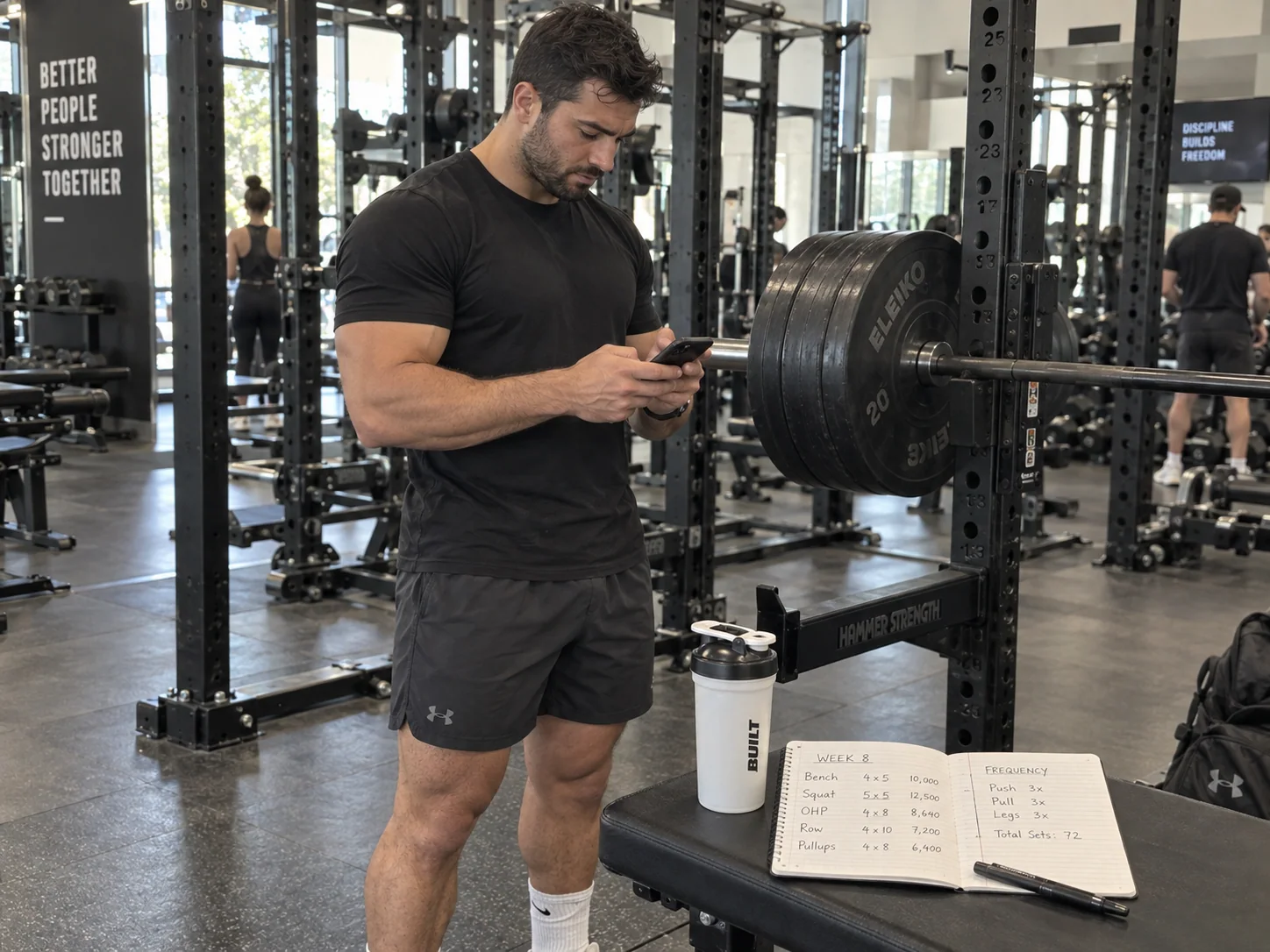
How often should you train each muscle for muscle growth?
For most lifters, training each muscle around twice per week is an excellent practical starting point.
But training a muscle twice per week is not automatically more anabolic than training it once.
Current evidence shows that when total weekly training volume is matched, training frequency itself has little consistent independent effect on muscle growth. Frequency matters because it helps you distribute your weekly sets, maintain training quality, manage fatigue, and recover between workouts.
That distinction changes how you should program hypertrophy training.
Do not ask only:
“How many times per week should I train chest, back, or legs?”
Ask:
“How often do I need to train this muscle to perform my weekly volume at a high level?”
That is the question that actually matters.
1. What Is the Best Training Frequency for Muscle Growth?
Training frequency describes how often you train a muscle group over a given period, usually one week.
If you train chest every Monday, your chest frequency is 1x per week.
If you train chest Monday and Thursday, it is 2x per week.
If you train it Monday, Wednesday, and Friday, it is 3x per week.
This is different from your total number of gym sessions.
You could train five days per week while directly training your chest only twice. A three-day full-body program could hit almost every major muscle three times.
For hypertrophy, the important number is therefore muscle-group training frequency, not simply how many days you go to the gym.
So is 2x per week optimal?
It is a very strong default.
But it is not a magic frequency.
A 2019 systematic review and meta-analysis found that when weekly training volume was equated, higher training frequencies did not meaningfully improve hypertrophy compared with lower frequencies.
The updated 2026 American College of Sports Medicine position stand reached a similar conclusion after synthesizing 137 systematic reviews involving more than 30,000 participants. Hypertrophy was clearly influenced by training volume, while frequency did not consistently affect hypertrophy when total volume was matched.
An additional 2026 meta-regression examining 67 studies found a clear positive relationship between weekly volume and hypertrophy, although with diminishing returns. The independent relationship between higher frequency and hypertrophy was much less consistent.
The practical takeaway is simple:
Muscle growth is not determined by how many times a muscle appears on your weekly calendar.
Frequency is primarily a way to organize productive training.
2. Training Frequency vs Training Volume: What Actually Matters?
Imagine two lifters.
Lifter A
Trains chest once per week:
- Bench press — 4 sets
- Incline dumbbell press — 4 sets
- Machine press — 4 sets
Total: 12 weekly sets
Lifter B
Trains chest twice per week:
Monday
- Bench press — 3 sets
- Incline dumbbell press — 3 sets
Thursday
- Machine press — 3 sets
- Cable fly — 3 sets
Total: 12 weekly sets
Both lifters perform 12 weekly sets.
The second lifter does not automatically grow more muscle because the frequency is higher.
The advantage is that six sets in one session may be easier to perform at a high level than forcing all 12 sets into one workout.
That can mean:
- Better repetition quality
- Higher loads
- Better technique
- Less local fatigue
- Better performance on later exercises
- Shorter individual workouts
- Easier recovery management
This is why volume and frequency should never be treated as separate concepts.
The StrengthCode Frequency Rule
Use frequency to distribute your weekly volume before fatigue destroys set quality.
A practical starting framework looks like this:
| Approximate weekly hard sets | Practical starting frequency |
|---|---|
| 4–8 sets | 1–2x per week |
| 8–12 sets | Around 2x per week |
| 12–18 sets | 2–3x per week |
| Higher specialization volume | Often 3x+ if recovery supports it |
These are programming ranges, not physiological laws.
You do not suddenly need three workouts because you perform 13 sets instead of 12.
The goal is to recognize when one session is becoming overloaded with work.
If you can perform your entire weekly volume in one session with excellent technique, strong performance, adequate effort, and good recovery, once-per-week training can work.
If later sets become progressively worse, split the workload.
That is what frequency is for.
Your weekly volume should therefore be established first.
Read: How Many Sets Per Muscle Per Week? Stop Wasting Your Training Volume
3. Should You Train Each Muscle 1x, 2x, or 3x Per Week?
All three approaches can build muscle.
The correct frequency depends on your weekly volume, experience, training split, recovery, exercise selection, and schedule.
Training each muscle once per week
Training a muscle once per week can absolutely build muscle.
A classic bodybuilding split might look like:
- Monday — Chest
- Tuesday — Back
- Wednesday — Legs
- Thursday — Shoulders
- Friday — Arms
The weakness of this structure is not automatically frequency.
The problem appears when lifters attempt to cram an excessive amount of work into each muscle's single weekly session.
Four strong chest exercises may quickly become six mediocre ones.
The beginning of the workout is productive.
By the end, loads drop, technique deteriorates, repetitions become less controlled, and the final sets may add more fatigue than useful stimulus.
Once-per-week training therefore works best when the required weekly workload can still be performed effectively in one session.
Training each muscle twice per week
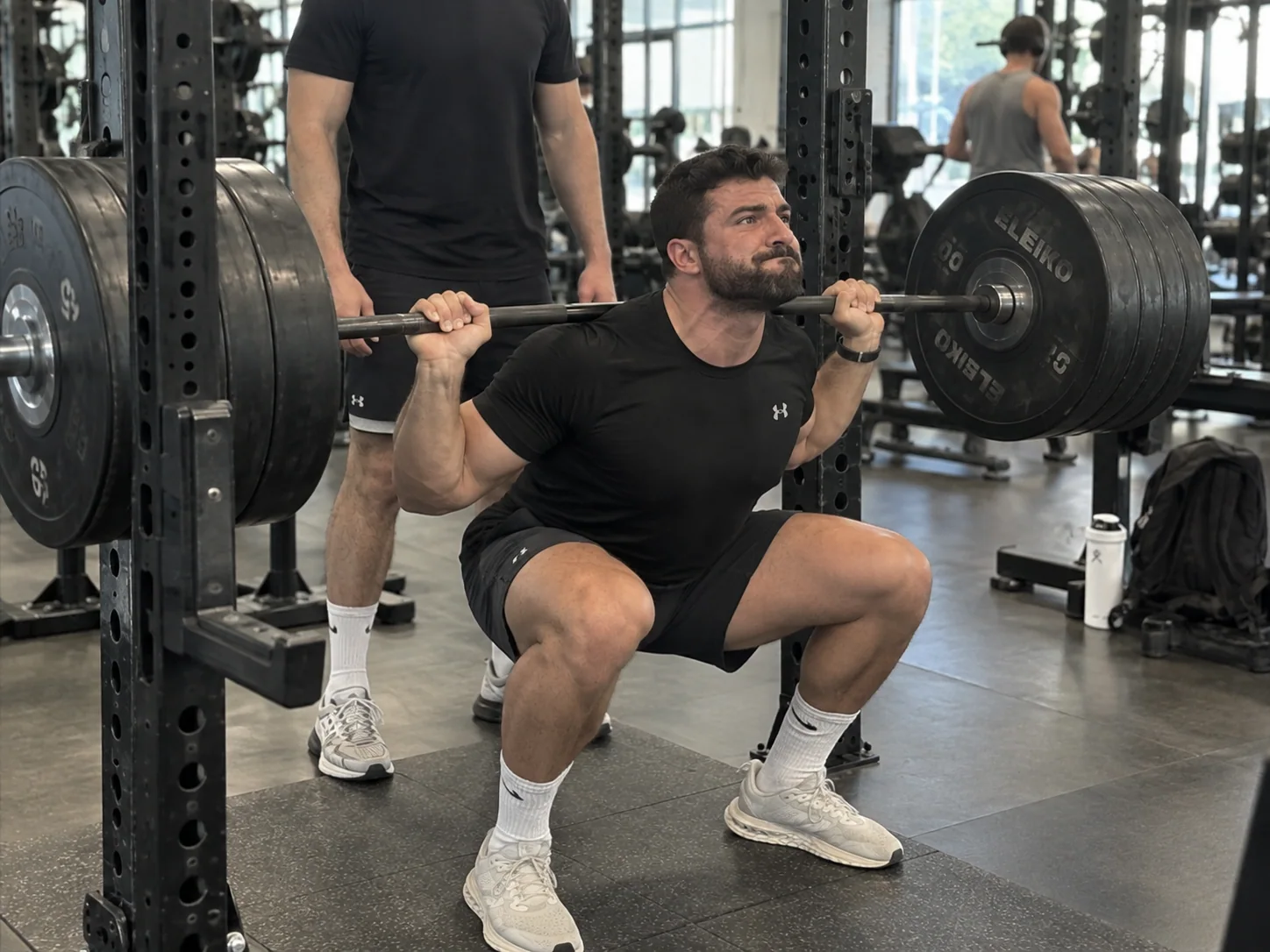
For most recreational and intermediate lifters, 2x per week is the most practical starting point.
It distributes training without requiring excessive weekly sessions.
An upper/lower split makes this simple:
Monday — Upper
Tuesday — Lower
Thursday — Upper
Friday — Lower
Each major muscle receives roughly two weekly exposures.
Push-pull-legs can accomplish the same thing when repeated across a longer rotation.
Two weekly exposures are especially useful when moderate or higher weekly volume would otherwise create very long sessions.
This is why “train every muscle twice per week” is often good advice even though twice-weekly frequency itself is not magic.
It is simply easy to program well.
Training each muscle three times per week
Training a muscle three times per week can also work extremely well.
This is common with full-body training.
For example:
Monday
- Squat
- Bench press
- Row
Wednesday
- Romanian deadlift
- Incline press
- Pulldown
Friday
- Leg press
- Machine chest press
- Cable row
Instead of completing 12 chest sets in one day, you might perform four sets on each training day.
Higher frequency becomes especially useful when:
- Weekly volume is high
- You prefer shorter workouts
- You use full-body training
- You are specializing in a particular muscle
- Performance drops during high-volume sessions
- You recover well between smaller training exposures
But higher frequency does not mean you should automatically increase weekly volume.
Going from two sessions to three while keeping volume the same is one change.
Going from two sessions and 12 sets to three sessions and 18 sets changes both frequency and volume.
Do not confuse the two.
How Many Sets Should You Do Per Muscle Per Workout?
There is no universal number of sets per muscle per workout that suddenly becomes ineffective.
That is why rigid rules such as “never perform more than six sets per muscle in one session” are too simplistic.
Instead, watch what happens to the quality of your training.
Suppose your first six quadriceps sets look like this:
- Strong repetitions
- Stable technique
- Full intended range of motion
- Appropriate RIR
- Consistent loading
But sets seven through twelve turn into:
- Falling repetitions
- Reduced load
- Poor technique
- Shortened range of motion
- Excessive fatigue
- Lower target-muscle output
You have a programming problem.
Instead of automatically deleting those sets, move some of them to another day.
For example:
Before
Monday — 12 quadriceps sets
After
Monday — 6 quadriceps sets
Thursday — 6 quadriceps sets
Same weekly volume.
Higher frequency.
Potentially better training quality.
This is exactly how frequency should be used.
Does Muscle Protein Synthesis Mean You Must Train Every Muscle Every 48 Hours?
No.
This idea is often oversimplified.
Resistance training increases muscle protein synthesis after training, which is one part of the adaptation process.
But you cannot turn the duration of that response into a precise rule stating that every muscle must be trained again as soon as protein synthesis falls toward baseline.
Long-term hypertrophy depends on repeated productive resistance training combined with sufficient recovery and nutrition.
The research comparing different weekly frequencies does not support the claim that everyone must train every muscle every 48 hours to maximize growth.
Build your program around long-term performance and progression, not around trying to chase an acute physiological response.
Training Frequency Does Not Fix Low-Quality Training
Adding another training day will not rescue a poor program.
If your sets lack sufficient effort, another session gives you more low-quality training.
If your weekly volume is already excessive, adding another day and more sets may make recovery worse.
If you never progressively overload your exercises, higher frequency does not solve the absence of progression.
Your training variables work together.
Effort
Your working sets need to be sufficiently challenging.
Read: How Close to Failure Should You Train? RIR, RPE, and Training Intensity Explained
Rep range
Muscle can grow across a relatively broad loading range when sets are performed appropriately, but different rep ranges have different practical advantages.
Read: Best Rep Range for Muscle Growth: How Many Reps Should You Actually Do?
Rest periods
Rest long enough to preserve meaningful performance between demanding sets.
Read: How Long Should You Rest Between Sets for Muscle Growth?
Progressive overload
Your program must eventually produce more repetitions, more load, more high-quality work, better execution, or another measurable progression.
Read: Progressive Overload: How to Build Muscle and Strength
Frequency organizes these variables.
It does not replace them.
How to Integrate Training Frequency
Start with the amount of weekly training you need.
Then ask whether you can perform that work effectively.
Step 1: Establish weekly volume
Determine roughly how many productive sets you currently perform for the muscle.
Do not immediately add more.
Use your current recoverable training as the starting point.
Step 2: Evaluate session quality
Look at your later sets.
Are repetitions collapsing?
Are loads dropping dramatically?
Does technique deteriorate?
Are workouts becoming unnecessarily long?
If yes, you may benefit from distributing your volume.
Step 3: Split the workload
If you perform 12 chest sets once per week, try six sets across two sessions.
If you perform 15 quadriceps sets across two sessions and the workouts are still excessive, three smaller exposures may work better.
Step 4: Keep weekly volume stable initially
Do not increase volume just because you increased frequency.
Give the new structure time to prove itself.
Step 5: Track recovery and performance
You should be able to return to the muscle with enough recovery to produce another high-quality session.
Persistent performance loss, joint irritation, excessive soreness, or declining motivation can all indicate that the overall workload needs adjustment.
The goal is not to train as frequently as possible.
The goal is to train as frequently as necessary.
What You Need to Keep in Mind
So, how often should you train each muscle for muscle growth?
For most lifters:
Around twice per week is an excellent starting point.
But the deeper answer is:
Train each muscle often enough to distribute your weekly volume without allowing fatigue to destroy training quality.
Once per week can work.
Twice per week can work.
Three or more times per week can work.
The strongest current evidence does not show a consistent independent hypertrophy advantage from simply increasing frequency when weekly volume is matched.
What frequency does give you is control.
It lets you distribute volume.
It lets you shorten overloaded sessions.
It can improve the quality of your later sets.
It gives you another way to balance stimulus and recovery.
That is the StrengthCode rule:
Volume determines how much work you need. Frequency determines how you distribute it. Performance tells you whether the setup is working.
Stop chasing the perfect number of training days.
Build a weekly structure that lets you train hard, recover, and progress.
Frequently Asked Questions
How often should you train each muscle for maximum growth?
Training each muscle around twice per week is a strong practical starting point, but there is no universally optimal frequency. When weekly volume is matched, research does not consistently show greater hypertrophy simply from increasing frequency.
Is training a muscle once per week enough?
Yes. Once-per-week training can build muscle when the session provides sufficient productive volume and you can maintain good training quality.
Is training a muscle twice per week better than once?
It can be more practical, especially when you perform enough weekly volume that one session becomes excessively fatiguing. The main advantage is usually better volume distribution rather than an automatic hypertrophy advantage from frequency itself.
Can I train each muscle three times per week?
Yes. Three weekly exposures can work well with full-body programs, higher-volume training, shorter workouts, and specialization phases, provided total workload and recovery are controlled.
How many days should I rest before training the same muscle again?
There is no mandatory number for every person or muscle. Your next session should occur when you can again produce high-quality training. Volume, exercise selection, effort, training status, sleep, nutrition, and individual recovery all affect the answer.
Is a bro split bad for muscle growth?
No. A bro split can build muscle. Its main limitation is that high weekly volume may need to be compressed into one session per muscle, which can reduce performance as fatigue accumulates.
Is full-body training three times per week good for hypertrophy?
Yes. Full-body training can distribute weekly volume across several sessions and is a highly practical way to train major muscle groups multiple times per week.
Does higher training frequency build muscle faster?
Not necessarily. Current evidence suggests that increasing weekly volume has a clearer relationship with hypertrophy than simply increasing frequency. Higher frequency is most useful when it improves how that volume is distributed.
Sources
American College of Sports Medicine Position Stand — Resistance Training Prescription for Muscle Function, Hypertrophy, and Physical Performance in Healthy Adults: An Overview of Reviews. Published 2026. The review synthesized 137 systematic reviews involving more than 30,000 participants and found that higher training volume enhanced hypertrophy, while frequency did not consistently affect hypertrophy when volume was equated.
https://pmc.ncbi.nlm.nih.gov/articles/PMC12965823/
Pelland JC, Remmert JF, Robinson ZP, et al. — The Resistance Training Dose Response: Meta-Regressions Exploring the Effects of Weekly Volume and Frequency on Muscle Hypertrophy and Strength Gains. Sports Medicine, 2026. The analysis included 67 studies and found a clear dose-response relationship between weekly volume and hypertrophy with diminishing returns, while frequency showed less consistent independent effects on hypertrophy.
https://pubmed.ncbi.nlm.nih.gov/41343037/
Schoenfeld BJ, Grgic J, Krieger J. — How Many Times per Week Should a Muscle Be Trained to Maximize Muscle Hypertrophy? Journal of Sports Sciences, 2019. The systematic review and meta-analysis found no meaningful hypertrophy difference between higher and lower frequencies when volume was equated.
https://pubmed.ncbi.nlm.nih.gov/30558493/
Schoenfeld BJ, Ogborn D, Krieger JW. — Effects of Resistance Training Frequency on Measures of Muscle Hypertrophy. Sports Medicine, 2016. This earlier meta-analysis suggested an advantage to training muscles twice rather than once weekly, illustrating how the evidence base developed before later volume-equated analyses refined the conclusion.