How to Prevent Muscle Loss While Losing Weight
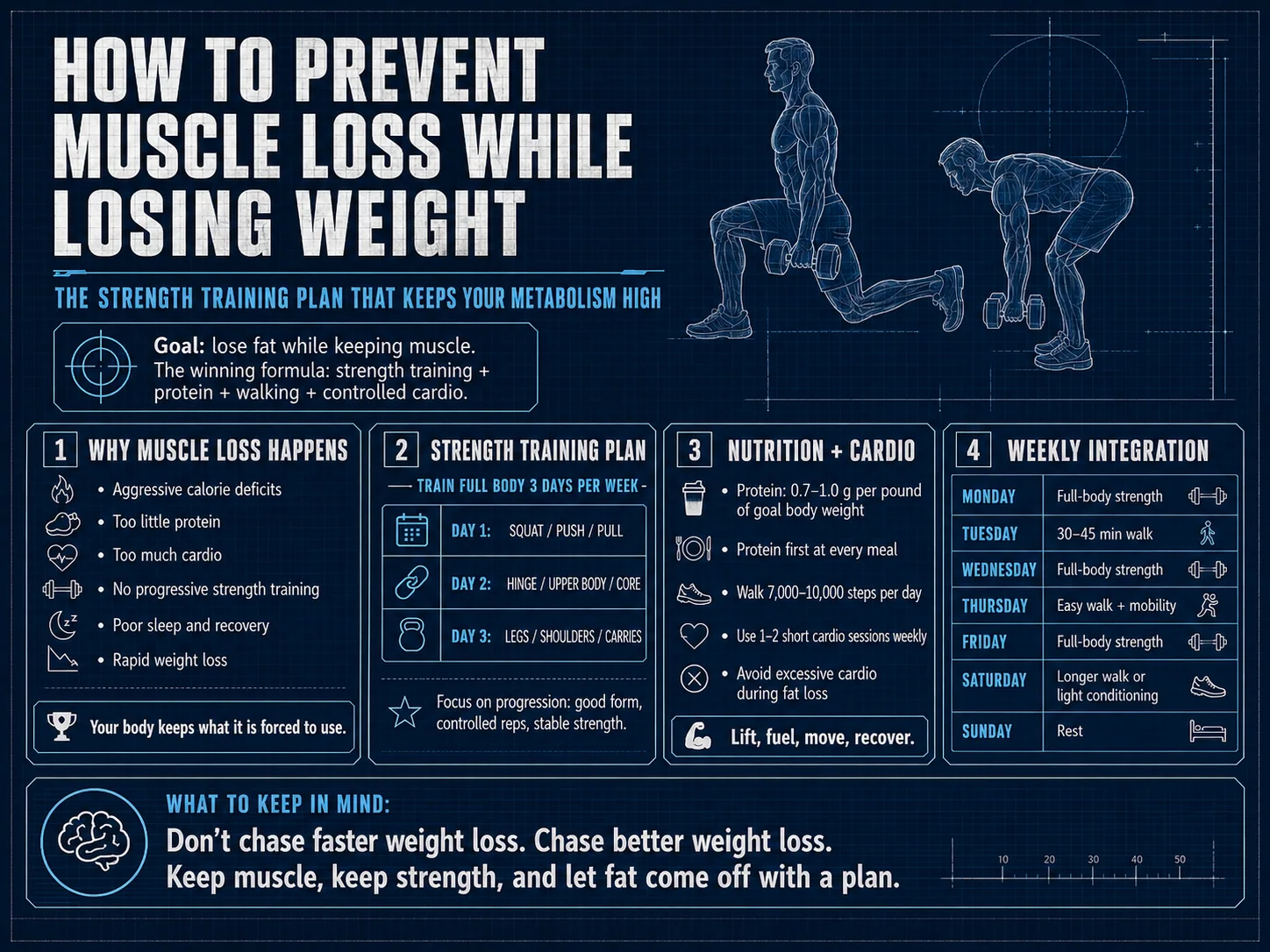
How to Prevent Muscle Loss While Losing Weight: The Strength Training Plan That Keeps Your Metabolism High
Most people lose weight the wrong way.
They slash calories, do random cardio, chase the scale every morning, and think they are winning because the number is dropping. Then the problems show up. Strength drops. Muscle shape fades. Energy crashes. Hunger climbs. The body gets smaller, but it does not look tighter, stronger, or more athletic.
That is not a fat-loss win. That is muscle loss.
The goal is not just to lose weight. The goal is to lose fat while keeping muscle. Muscle is what gives your body shape, strength, performance, and metabolic power. If you want a leaner body that actually looks better, moves better, and performs better, your plan has to protect muscle from day one.
The formula is clear: lift weights, eat enough protein, walk consistently, and avoid extreme dieting.
This is how you do it.
1. Why Muscle Loss Happens During Weight Loss
Muscle loss happens when your body does not have a strong enough reason to keep muscle while you are in a calorie deficit.
When calories drop, your body needs energy from somewhere. Ideally, most of that energy comes from stored body fat. But if your training is weak, your protein is low, and your deficit is too aggressive, your body can also break down lean tissue.
That is why “eat less and move more” is not enough.
You need a smarter plan.
Muscle loss becomes more likely when you:
- Diet too aggressively
- Skip strength training
- Rely only on cardio
- Eat too little protein
- Lose weight too fast
- Sleep poorly
- Stop progressively challenging your muscles
This is especially important for people who are losing weight quickly or using GLP-1 weight-loss medications. When appetite drops hard, protein intake often drops with it. That can make it harder to recover, train well, and preserve lean mass.
The coaching rule is simple:
Your body keeps what it is forced to use.
If you want to keep muscle, you need to train muscle. Not once in a while. Not randomly. Not only when motivation is high.
Consistently.
The scale does not tell the full story. You can lose 20 pounds and still lose the wrong kind of weight. The better goal is to lose fat while keeping strength, muscle, and performance as high as possible.
That is how you build a body that looks leaner, not just smaller.
2. The Best Strength Training Plan to Preserve Muscle
Strength training is the foundation of muscle retention during weight loss.
Cardio helps with calorie burn and heart health. Walking helps increase daily movement without crushing recovery. But lifting gives your body the strongest signal to keep muscle while fat comes off.
If you are dieting and not lifting, you are leaving your muscle exposed.
A smart fat-loss strength plan should train the full body 3 days per week. That gives you enough frequency to protect muscle without creating too much recovery stress while calories are lower.
You do not need circus workouts. You need the basics done hard and consistently.
Day 1: Squat + Push + Pull
- Squat or leg press: 3 sets of 6–10 reps
- Dumbbell bench press or push-up: 3 sets of 8–12 reps
- Seated row or dumbbell row: 3 sets of 8–12 reps
- Romanian deadlift: 3 sets of 8–10 reps
- Plank: 3 rounds of 30–60 seconds
Day 2: Hinge + Upper Body + Core
- Deadlift variation: 3 sets of 5–8 reps
- Lat pulldown or assisted pull-up: 3 sets of 8–12 reps
- Incline dumbbell press: 3 sets of 8–12 reps
- Reverse lunge: 3 sets of 8–10 reps per leg
- Pallof press: 3 sets of 10–12 reps per side
Day 3: Legs + Shoulders + Carries
- Bulgarian split squat: 3 sets of 8–10 reps per leg
- Overhead press: 3 sets of 6–10 reps
- Cable row: 3 sets of 8–12 reps
- Hip thrust or glute bridge: 3 sets of 8–12 reps
- Farmer carry: 4 rounds of 30–45 seconds
This plan works because it trains the major movement patterns: squat, hinge, push, pull, lunge, carry, and core stability.
That is what most people are missing.
They are doing random sweat sessions instead of training with purpose. Sweat is not the goal. Progression is the goal.
During weight loss, your job is to maintain strength as much as possible. You may not hit personal records every week in a calorie deficit, but you should fight to keep your performance stable.
That means:
- Keep good form
- Train close to failure without destroying yourself
- Add reps when possible
- Increase weight when ready
- Control the lowering phase
- Track your lifts
If your weight is dropping and your lifts are holding steady, you are doing it right.
That means your body is getting the message: keep the muscle, burn the fat.
3. Protein, Walking, and Cardio Without Sacrificing Muscle
Training tells your body to keep muscle.
Protein gives your body the raw material to repair and maintain it.
This is where many fat-loss plans fall apart. People cut calories, but they also cut protein too low. Then they wonder why they feel flat, weak, hungry, and tired.
Protein is non-negotiable if you want to prevent muscle loss while losing weight.
A strong target for most active fat-loss clients is:
0.7–1.0 grams of protein per pound of goal body weight per day.
Example:
If your goal weight is 180 pounds, aim for roughly 125–180 grams of protein per day.
You do not need to make this complicated. Build every meal around a protein anchor.
Good options include:
- Eggs
- Greek yogurt
- Chicken breast
- Lean beef
- Turkey
- Tuna
- Salmon
- Cottage cheese
- Tofu
- Protein powder
If your appetite is low, protein comes first. Do not fill up on low-protein snacks and then miss the nutrients your body needs to keep muscle.
A simple plate setup works best:
Protein first. Vegetables second. Smart carbs around training. Healthy fats in controlled portions.
Carbs are not the enemy. You just need to use them with purpose. Put more of your carbs around your workouts to support training performance. Better training means a stronger muscle-preserving signal.
Cardio also belongs in your plan, but it should support fat loss, not wreck your recovery.
Walking is the best default.
It is low impact, easy to recover from, and effective for increasing daily calorie burn. Aim for 7,000–10,000 steps per day, or start with your current baseline and add 1,000–2,000 steps.
For conditioning, use 1–2 short sessions per week:
- 20–30 minutes of incline walking
- Bike intervals: 30 seconds hard, 90 seconds easy, 8–10 rounds
- Brisk outdoor walk for 30–45 minutes
- Sled pushes if available
- Rowing machine intervals in small doses
Do not turn every cardio session into punishment.
Excessive cardio plus low calories plus low protein is the classic muscle-loss trap.
Your fat-loss engine should run on strength training, protein, walking, and controlled cardio.
That is the winning combination.
How to Integrate This Into Your Week
Here is a simple weekly structure you can use right away.
Weekly Muscle-Preserving Fat-Loss Plan
Monday: Full-body strength
Tuesday: 30–45-minute walk
Wednesday: Full-body strength
Thursday: Easy walk + mobility
Friday: Full-body strength
Saturday: Longer walk or light conditioning
Sunday: Rest
This setup works because it gives your body enough resistance training to preserve muscle, enough walking to support fat loss, and enough recovery to keep you consistent.
Keep the plan simple.
Do not change exercises every week. Do not chase soreness. Do not turn every workout into a test.
Train the same key movements long enough to improve them.
Track these five markers:
- Body weight trend
- Waist measurement
- Strength performance
- Daily steps
- Protein intake
The scale is only one data point. It should not control the whole process.
If your waist is shrinking, your strength is stable, your steps are consistent, and your protein is on target, you are moving in the right direction.
That is what quality fat loss looks like.
What You Need to Keep in Mind
Weight loss without muscle retention is not the win.
The real goal is to look better, move better, perform better, and keep your metabolism strong while body fat comes down.
Do not chase the fastest drop on the scale. Fast weight loss may feel exciting at first, but if you lose muscle with it, you are making the next phase harder. Less muscle means weaker training, lower output, worse body composition, and a higher chance of regaining weight.
Train like you want to keep your muscle.
Eat like recovery matters.
Walk like consistency beats punishment.
Your body does not need another crash diet. It needs a plan that forces fat off while keeping muscle on.
Lift weights 3 days per week. Eat protein at every meal. Walk daily. Keep cardio controlled. Sleep like it matters.
Because it does.
That is how you lose weight without losing the body you are trying to build.
FAQs About Preventing Muscle Loss While Losing Weight
Can you lose weight without losing muscle?
Yes. You can lose weight without losing significant muscle if you strength train consistently, eat enough protein, keep your calorie deficit moderate, and avoid excessive cardio. The goal is not just faster weight loss. The goal is better weight loss.
How many days should I strength train while losing weight?
Most people should strength train 3 days per week while losing weight. This gives your body a strong muscle-preserving signal without creating too much recovery stress during a calorie deficit.
Does cardio cause muscle loss?
Cardio does not automatically cause muscle loss. The problem happens when cardio is excessive, calories are too low, protein is too low, and strength training is missing. Walking and moderate conditioning are usually better choices than high-volume intense cardio during fat loss.
How much protein do I need to keep muscle while dieting?
A strong target is 0.7–1.0 grams of protein per pound of goal body weight per day. For example, if your goal weight is 180 pounds, aim for roughly 125–180 grams of protein daily.
Is walking enough to prevent muscle loss?
No. Walking is excellent for fat loss, heart health, and daily calorie burn, but it does not replace strength training. To preserve muscle, you need resistance training.
What is the best workout for GLP-1 weight loss?
The best workout for GLP-1 weight loss is a combination of full-body strength training 3 days per week, daily walking, and controlled cardio. Protein should be prioritized because appetite may be lower, and muscle retention becomes a major goal during rapid weight loss.
How fast should I lose weight without losing muscle?
A smart target is usually 0.5–1% of body weight per week. Faster loss can work for some people, but the faster you push, the more disciplined you need to be with strength training, protein, sleep, and recovery.
What are signs you are losing muscle while dieting?
Common signs include strength dropping quickly, workouts feeling worse every week, constant fatigue, poor recovery, a flatter look, and weight dropping fast while measurements and performance do not improve. If that happens, increase protein, reduce aggressive cardio, and make sure your calorie deficit is not too extreme.