Best Rep Range for Muscle Growth: How Many Reps Should You Actually Do?

If you want to build muscle, you have probably heard the same rule:
Do 6–12 reps.
It is one of the most repeated recommendations in strength training.
It is also incomplete.
The 6–12 rep range is excellent for hypertrophy, but your muscles do not suddenly stop growing when you perform five reps or thirteen.
Muscle can be built across a much broader spectrum of resistance-training loads when the training stimulus is sufficiently challenging.
The real question is not:
“What single rep range builds muscle?”
It is:
“Which rep range works best for the exercise I am doing?”
That distinction will make your programming significantly better.
Quick Answer: What Is the Best Rep Range for Muscle Growth?
For most muscle-building exercises, roughly 6–15 reps per set is an excellent practical default.
But hypertrophy is not limited to that range.
A useful framework is:
| Rep Range | Best Use |
|---|---|
| 3–6 reps | Heavy compound training and maximal-strength development |
| 6–12 reps | Main hypertrophy work and strength-hypertrophy overlap |
| 10–20 reps | Machines, accessories and isolation exercises |
| 15–30 reps | Lighter isolation work and exercises where heavy loading is impractical |
Research shows that muscle growth can occur across a wide range of training loads when sets provide a sufficiently challenging stimulus.
However, heavier loads tend to produce greater improvements in maximal strength.
That means the best rep range depends on your goal, exercise, technique and fatigue cost.
There is no magical hypertrophy number.
There are simply better and worse rep ranges for different movements.
1. Does the 6–12 Rep Hypertrophy Range Really Matter?
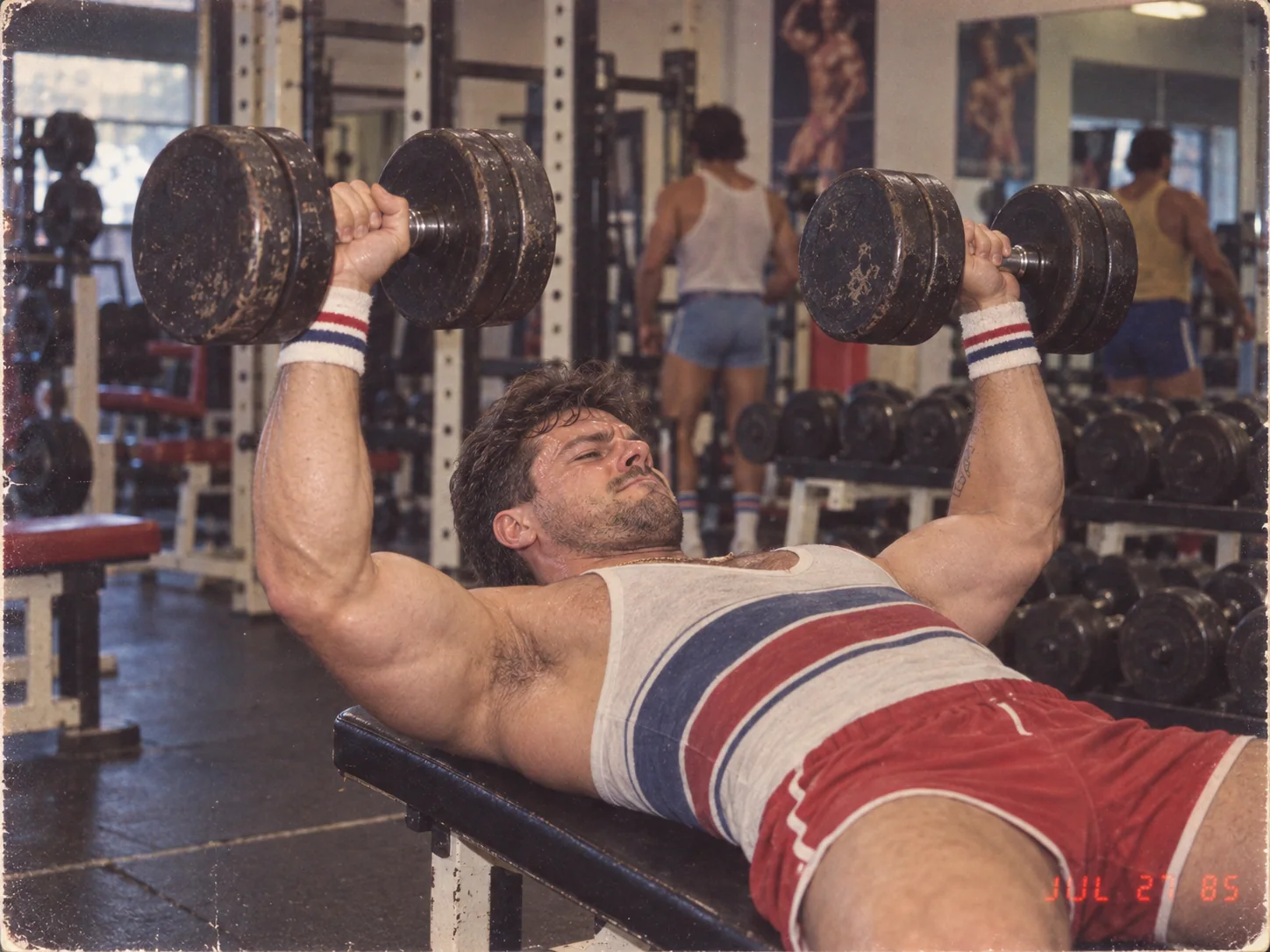
The traditional hypertrophy zone usually sits somewhere around 6–12 repetitions per set.
There is a reason this range became popular.
Moderate reps allow you to use meaningful resistance while still performing enough repetitions to accumulate productive training volume.
You can usually maintain good technique, create substantial muscular tension and progressively overload the movement without the set becoming excessively long.
That makes 6–12 reps highly effective.
It does not make it physiologically mandatory.
Research comparing different resistance-training loads has consistently shown that hypertrophy can occur under both heavier and lighter loading conditions.
Heavier training tends to have an advantage when maximal strength is the priority.
Muscle growth is more flexible.
Why 6–12 reps remains useful
Imagine trying to build your quadriceps with sets of 25 barbell squats.
Your legs may be working hard, but your breathing, bracing and general systemic fatigue can become limiting factors before the target muscles receive the best possible stimulus.
Now imagine performing three-rep cable curls.
You can load the stack heavily.
You will probably also spend half the set trying to stop your shoulders and hips from doing the work.
Neither extreme is automatically wrong.
They are simply less practical.
Moderate reps often sit in the sweet spot where you can:
- Use meaningful resistance
- Maintain technique
- Accumulate productive repetitions
- Control fatigue
- Progress the load over time
That is why 6–12 reps works so well.
It is a useful default, not a rule.
2. Low Reps vs High Reps for Muscle Growth
If multiple rep ranges can build muscle, does rep range even matter?
Absolutely.
Rep range changes how an exercise feels, how much load you can use, how much fatigue you generate and how practical the movement becomes.
3–6 reps: best for heavy strength work
Lower repetitions work extremely well for exercises such as:
- Squats
- Bench presses
- Deadlift variations
- Overhead presses
- Weighted pull-ups
- Heavy rows
These movements respond well to heavier loading, especially when strength development matters.
The major advantage is specificity.
If you want to become stronger at lifting heavy weights, you need regular exposure to heavy weights.
The downside is that very low-rep training is not always the most efficient way to accumulate hypertrophy-focused work.
Extremely heavy loads can also increase the technical demands of the exercise.
For hypertrophy, you therefore do not need to turn every movement into a strength test.
6–12 reps: the strongest general-purpose range
This is where a large percentage of your main hypertrophy work can live.
Exercises such as:
- Bench press
- Dumbbell press
- Rows
- Pulldowns
- Hack squats
- Leg presses
- Romanian deadlifts
all work extremely well in moderate rep ranges.
You can load them heavily enough to create substantial tension without turning every set into a maximal-effort grind.
This is why 6–12 reps remains one of the most useful ranges in resistance training.
10–20 reps: excellent for accessories and machines
As exercises become more stable and less systemically demanding, higher reps become increasingly useful.
Think:
- Leg extensions
- Hamstring curls
- Cable rows
- Pec fly variations
- Biceps curls
- Triceps extensions
- Calf raises
The target muscle can be trained very hard without your cardiovascular system, bracing or technique becoming the main limiting factor.
15–30 reps: useful when heavy loading makes little sense
Some exercises simply work better with lighter resistance.
The lateral raise is a perfect example.
Trying to perform extremely heavy sets of three usually turns the exercise into a shrug, swing and full-body negotiation with gravity.
Higher reps let you maintain control and actually train the intended muscle.
The tradeoff is discomfort.
High-rep sets burn.
They can also become mentally and cardiovascularly demanding.
The goal is not to chase the highest rep count possible.
The goal is to choose a rep range that allows the target muscle to work hard without other factors ending the set first.
3. Best Rep Range by Exercise
This is where rep-range programming becomes useful.
Do not force every movement into 8–12 reps.
Match the reps to the exercise.
| Exercise | Practical Rep Range | Why |
|---|---|---|
| Back squat | 5–10 | Strong strength-hypertrophy overlap |
| Front squat | 5–10 | High technical and systemic demand |
| Barbell bench press | 5–10 | Heavy loading remains practical |
| Dumbbell bench press | 6–12 | Excellent combination of load and control |
| Romanian deadlift | 6–10 | High muscular tension without excessively long sets |
| Leg press | 8–15 | Stable enough for higher-rep hypertrophy work |
| Hack squat | 6–15 | High quad stimulus with less balance demand |
| Chest-supported row | 8–15 | Stable setup reduces systemic fatigue |
| Lat pulldown | 8–15 | Easy to control and progressively overload |
| Cable row | 8–15 | Stable and hypertrophy-friendly |
| Dumbbell curl | 8–15 | Heavy enough to progress without excessive cheating |
| Cable curl | 10–20 | Constant tension works well with moderate-high reps |
| Triceps extension | 10–20 | Lighter loading is often more joint-friendly |
| Leg extension | 10–20 | Very stable and easy to push hard |
| Hamstring curl | 10–20 | Excellent isolation stimulus |
| Lateral raise | 12–25 | Heavy low-rep loading is usually impractical |
| Calf raise | 8–20 | Effective across a broad range |
These are guidelines, not laws.
Your structure, exercise technique, equipment and personal preference can shift the ideal range.
But this framework gives you a much better starting point than automatically prescribing 3 × 10 for everything.
4. Does Training to Failure Change the Best Rep Range?
Rep range means very little without training effort.
You can perform 15 repetitions with a light weight and create almost no meaningful hypertrophy stimulus if you stop while another 15 repetitions were still available.
The set has to become challenging.
Research examining proximity to failure suggests that muscle growth generally benefits when sets are performed with meaningful effort and terminated relatively close to failure.
That does not mean every working set must reach absolute muscular failure.
It also does not mean that there is one magical number of reps in reserve.
The practical lesson is simpler:
Your working sets should actually be hard.
If you finish a set of ten and know you could have performed another ten clean repetitions, the problem is not the rep range.
The load and effort were too low.
This matters even more during lighter-load, higher-repetition training.
With heavier resistance, substantial force is required immediately.
With lighter resistance, the set generally needs to progress further toward fatigue before the same level of effort is reached.
If you want the full breakdown, read:
How Close to Failure Should You Train? RIR, RPE, and Training Intensity Explained
Think of it this way:
Rep range tells you how many repetitions you perform.
RIR tells you how difficult those repetitions were.
You need both.
How to integrate
The simplest way to use rep ranges is to assign a range to each movement instead of a single fixed number.
For example:
Dumbbell Bench Press — 3 × 8–12
Week 1:
32 kg × 9, 9, 8
Week 2:
32 kg × 10, 9, 9
Week 3:
32 kg × 11, 10, 9
Week 4:
32 kg × 12, 11, 10
Week 5:
32 kg × 12, 12, 12
Once you can complete the top of the range with appropriate technique and effort, increase the resistance and begin progressing through the range again.
This is one of the easiest ways to apply progressive overload without constantly testing your maximum strength.
Read the full framework here:
Progressive Overload: How to Build Muscle and Strength
Use different rep ranges within the same workout
A hypertrophy session does not need one universal rep target.
A lower-body workout could look like this:
Back Squat
3 × 5–8
Romanian Deadlift
3 × 6–10
Leg Press
3 × 8–15
Leg Extension
3 × 12–20
Hamstring Curl
3 × 10–15
Calf Raise
3 × 10–20
The heavier compound movements use lower-to-moderate reps.
The stable accessory movements use moderate-to-higher reps.
Everything has a purpose.
Do not separate reps from weekly volume
Rep range is only one variable.
You also need enough productive training volume across the week.
A perfectly chosen rep range will not compensate for doing too little useful work—or burying yourself under unnecessary junk volume.
For that, read:
How Many Sets Per Muscle Per Week? Stop Wasting Your Training Volume
Common Rep-Range Mistakes

Using the same reps for every exercise
Three sets of ten is not a universal programming system.
A barbell squat and a lateral raise should not automatically be treated the same way.
Going too heavy on isolation exercises
If the load forces you to swing, shorten the range of motion or recruit half your body to complete the repetition, the extra weight is not automatically productive.
Going too light without training hard enough
High reps only work if the set becomes sufficiently challenging.
Twenty easy repetitions are still twenty easy repetitions.
Changing rep ranges constantly
You do not need to shock your muscles every week.
Choose a productive range, progress inside it and give the program enough time to work.
Ignoring progression
The number written in the program is not the goal.
Improving what you can do inside that rep range over time is the goal.
What you need to keep in mind
There is no single best rep range for muscle growth that applies to every exercise and every lifter.
The classic 6–12 range is excellent because it provides a highly practical balance of load, muscular tension, technique and fatigue.
But hypertrophy is possible outside that range.
Use lower reps when strength development and heavy compound lifting matter.
Use moderate reps as the foundation of most hypertrophy work.
Use higher reps when lighter loading improves execution and lets you challenge the target muscle without unnecessary systemic fatigue.
Then progress.
Do not judge your workout by whether you performed exactly 8, 10 or 12 repetitions.
Judge it by whether:
- The exercise fits the goal
- Your technique is controlled
- The target muscle is being challenged
- The effort is high enough
- Your performance is improving over time
- Your weekly volume remains recoverable
6–12 reps is a great tool.
It was never a law.
FAQs
What is the best rep range for muscle growth?
For most exercises, roughly 6–15 reps per set is an excellent practical range. However, muscle can also be built with lower and higher repetitions when the resistance and training effort are appropriate.
Is 8–12 reps best for hypertrophy?
It is one of the most useful hypertrophy ranges, but it is not uniquely superior. Lower and higher rep training can also stimulate muscle growth.
Is 5 reps enough to build muscle?
Yes. Sets of five can build muscle while also providing a strong strength stimulus. Very low reps simply may not be the most efficient way to perform all of your hypertrophy work.
Can 20 or 30 reps build muscle?
Yes. Higher-repetition training can stimulate hypertrophy when sets become sufficiently challenging. It is usually most practical on stable machines and isolation exercises.
Are low reps or high reps better for muscle growth?
Neither is universally better. Lower reps are more specific to maximal strength, while moderate and higher reps are often easier to use for accumulating hypertrophy-focused training.
How many reps should a beginner do?
Beginners usually benefit from spending most of their time in moderate rep ranges such as 6–15 reps, where technique can be practiced and resistance can be progressed without relying on extremely heavy loads.
How many reps should I do for compound exercises?
Most compound exercises work well somewhere around 5–12 repetitions. The exact range depends on the movement and whether strength or hypertrophy is the greater priority.
How many reps should I do for isolation exercises?
Isolation exercises commonly work well around 10–20 repetitions, with some movements such as lateral raises also fitting comfortably into the 15–25+ rep range.
Should I increase weight or reps first?
A simple method is to increase repetitions inside a target range first. Once you reach the top of the range with good execution, increase the load and build the reps back up.
Do I need to train to failure to build muscle?
No. Absolute muscular failure is not required for hypertrophy. However, working sets need to be sufficiently challenging, and training closer to failure generally produces a stronger hypertrophy stimulus than repeatedly stopping far from failure.
Is 3 sets of 10 good for muscle growth?
It can be. Three sets of ten is a perfectly valid prescription when the exercise, load, weekly volume and training effort are appropriate. It is not inherently superior to other productive set-and-rep combinations.
How many sets and reps should I do to build muscle?
Rep range and weekly training volume need to be considered together. Use appropriate rep ranges for each movement, then structure enough hard weekly sets to stimulate progress without exceeding your ability to recover.
For weekly volume guidelines, read:
How Many Sets Per Muscle Per Week? Stop Wasting Your Training Volume
Sources
Schoenfeld BJ, Grgic J, Ogborn D, Krieger JW. Strength and Hypertrophy Adaptations Between Low- vs. High-Load Resistance Training: A Systematic Review and Meta-analysis. Journal of Strength and Conditioning Research.
https://pubmed.ncbi.nlm.nih.gov/28834797/
Lopez P, Radaelli R, Taaffe DR, et al. Resistance Training Load Effects on Muscle Hypertrophy and Strength Gain: Systematic Review and Network Meta-analysis. Medicine & Science in Sports & Exercise.
https://pubmed.ncbi.nlm.nih.gov/33433148/
Lacio M, Vieira JG, Trybulski R, et al. Effects of Resistance Training Performed With Different Loads in Untrained and Trained Male Adult Individuals on Maximal Strength and Muscle Hypertrophy: A Systematic Review.
https://pubmed.ncbi.nlm.nih.gov/33874848/
Refalo MC, Helms ER, Trexler ET, Hamilton DL, Fyfe JJ. Influence of Resistance Training Proximity-to-Failure on Skeletal Muscle Hypertrophy: A Systematic Review with Meta-analysis. Sports Medicine.
https://pubmed.ncbi.nlm.nih.gov/36334240/
Robinson ZP, Pelland JC, Remmert JF, et al. Exploring the Dose-Response Relationship Between Estimated Resistance Training Proximity to Failure, Strength Gain, and Muscle Hypertrophy: A Series of Meta-Regressions. Sports Medicine.
https://pubmed.ncbi.nlm.nih.gov/38970765/
Morton RW, Oikawa SY, Wavell CG, et al. Neither Load Nor Systemic Hormones Determine Resistance Training-Mediated Hypertrophy or Strength Gains in Resistance-Trained Young Men. Journal of Applied Physiology.