Minimum Effective Dose Strength Training
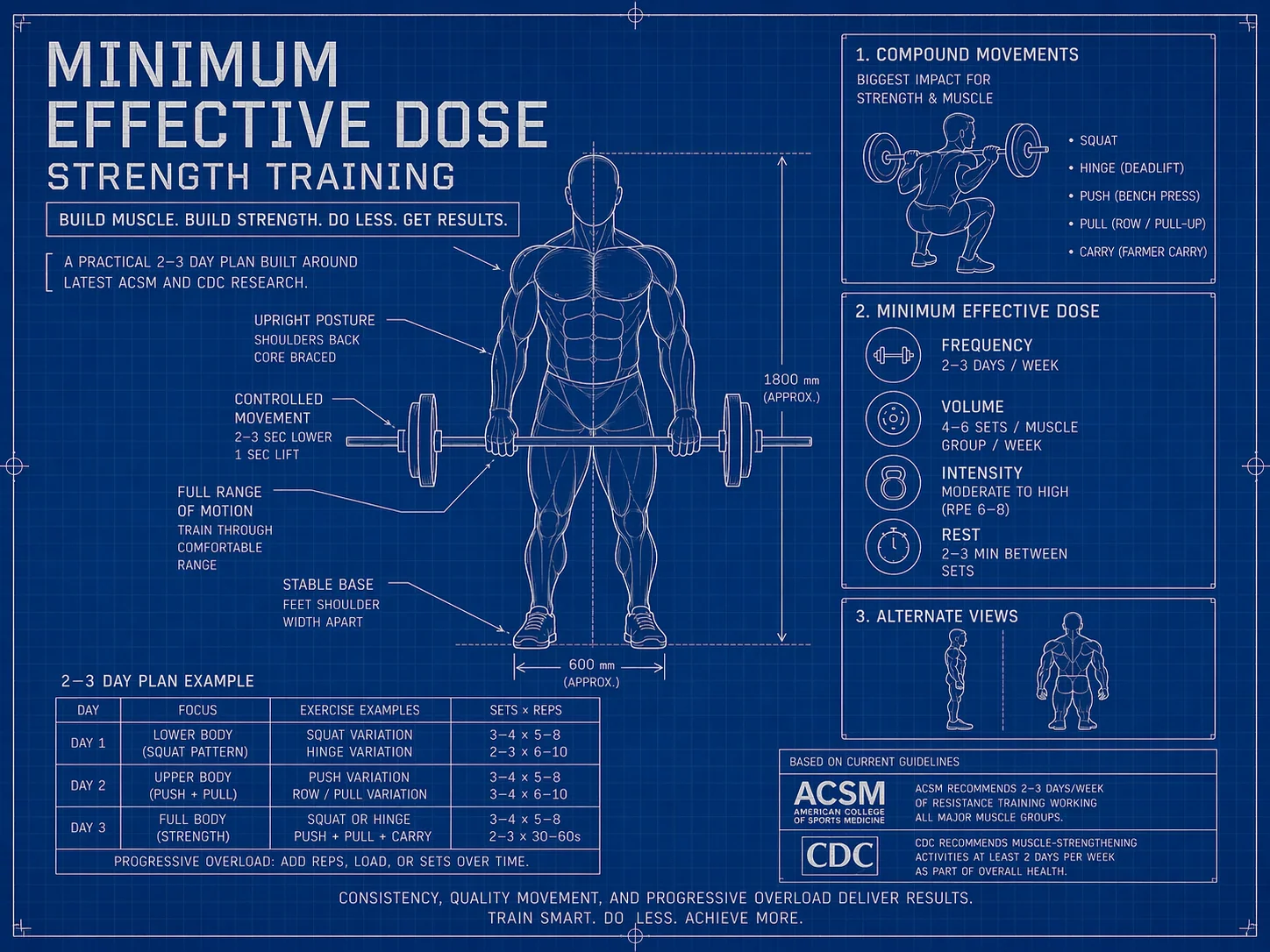
Minimum Effective Dose Strength Training: Build Muscle With 2–3 Workouts Per Week
Minimum effective dose strength training means doing the least amount of work needed to keep building muscle and strength. Not the least amount of effort. The least amount of training volume and frequency that still gets the job done.
That matters because most people do not need a more advanced plan. They need a more repeatable one.
A lot of lifters can make excellent progress on 2–3 well-built sessions per week. That does not mean more training is bad. It means more training is not automatically necessary for everyone. If you are an advanced lifter, a physique athlete, or somebody who simply enjoys training four, five, or six days per week and recovers well, that can absolutely work too. But for the average person trying to build muscle, get stronger, and stay consistent, the smart play is to start with enough work to progress and earn the right to do more later.
That is the real point of minimum effective dose training: get strong on the basics, recover well, and keep stacking quality weeks.
What minimum effective dose really means
Minimum effective dose is one of the most useful ideas in strength coaching because it forces you to separate what is effective from what is just extra.
A lot of programs look hard on paper. That does not make them better. Good training is not about how packed the session looks or how wrecked you feel afterward. Good training is about whether the work creates adaptation and whether you can come back and do it again next week with quality.
That is where minimum effective dose comes in.
For most beginners and intermediate lifters, you do not need endless exercise variety, marathon sessions, or a different split every month. You need enough hard work on the main movement patterns, enough weekly volume to drive progress, and enough recovery to keep performance moving up.
That usually means focusing on a handful of big lifts and repeating them long enough to get better at them. Squat pattern. Hinge pattern. Press. Pull. Some single-leg work. Some trunk work. That is not basic in a bad way. That is basic in the way that wins.
The mistake people make is thinking that if two or three sessions work, then five or six must work even better. Sometimes yes. Sometimes no. More volume can absolutely be productive when the lifter’s goal, training age, lifestyle, and recovery support it. But if the extra work is dragging down performance, recovery, or consistency, it is not helping. It is just more.
A good coach does not start by asking, “How much can we cram in?” A good coach asks, “What is the lowest dose that will move you forward given your situation?”
How many workouts do you actually need to build muscle?
For most people, 2–3 strength sessions per week is enough to build muscle and get stronger.
That works because muscle growth does not come from training every day. It comes from giving the body a reason to adapt, then recovering well enough for that adaptation to happen. If your weekly plan covers all major muscle groups, includes enough hard sets, and gives you a clear progression target, you can get a lot done in a small number of sessions.
This is where many lifters overcomplicate things.
They think they need a “bro split,” a push-pull-legs rotation, a hypertrophy day, a strength day, a power day, and a finisher day. Maybe later. Not first.
First, you need a plan that lets you train hard on the movements that matter most:
- a squat or leg press
- a hip hinge
- a horizontal press
- a vertical press
- a row
- a pull-down or pull-up
That covers a lot of ground fast. Then you add a small amount of accessory work where it makes sense.
The real drivers of progress are simple:
- quality exercise selection
- hard working sets
- enough total weekly volume
- progressive overload
- consistent recovery
That is it.
If you are only training two days per week, each session needs to do more. Full-body training is usually the best fit. If you are training three days per week, you get a little more room to spread the work out and keep session quality high. Both can work very well.
And to be clear, this is not an anti-volume argument. Higher-volume plans have a place. Advanced lifters often need more weekly work. Some people love being in the gym more often and thrive on it. Good. That is not the audience problem this article is solving.
This article is for the lifter who wants to know, “Can I still make real progress without living in the gym?” The answer is yes, if the plan is built correctly.
Why this approach works so well in real life
Minimum effective dose training works because it respects two things at the same time: the body’s need for stimulusand real life’s demand for recovery.
Most people are not managing training in a vacuum. They are managing it alongside work, family, sleep, stress, travel, and everything else that affects recovery. That is why a plan that looks great in theory can fall apart in practice.
A two- or three-day training plan is often easier to execute with intent. You come into the session fresher. You can push the work sets harder. You recover better between sessions. And most importantly, you can keep doing it week after week.
That consistency matters more than people think.
Muscle and strength are built on repeated exposure to good training. Not one hard week. Not a motivation spike. Not one month of perfect eating and perfect sleep. Results come from stacking enough quality work over time. Minimum effective dose training makes that easier for a lot of people because it trims away unnecessary fatigue without trimming away the main driver of progress.
This approach is especially useful for:
- beginners
- busy professionals
- parents
- people coming back after time off
- athletes in-season
- lifters in a fat-loss phase who need to manage recovery carefully
Where does it stop being the best fit? Usually when the lifter becomes more advanced or more specialized. If your goal is to maximize hypertrophy, bring up specific weak points, or compete in strength sports, you may need more volume, more frequency, or more specialization. That is normal. But even then, minimum effective dose is still a valuable lens. It teaches you to respect what is necessary before piling on what is optional.
How to integrate
Here is a clean way to run this for 8–10 weeks.
Day 1
- Squat or leg press
- Bench press or dumbbell press
- Row
- Romanian deadlift
- Lateral raise or triceps work
- Core
Day 2
- Deadlift variation or hip hinge
- Overhead press
- Pull-down or pull-up
- Split squat or hack squat
- Curl or rear-delt work
- Core
Optional Day 3
- Front squat or leg press
- Incline press
- One-arm row
- Hip thrust or hamstring curl
- Shoulder accessory
- Arms or calves
A few coaching rules:
- Keep 4–6 movements per session.
- Use 2–4 hard work sets on the main lifts.
- Keep 1–3 reps in reserve on most sets.
- Progress by adding reps, load, or control over time.
- Run the same core lifts long enough to actually improve them.
- Do not add more work just because you had one good week.
Start with what you can recover from. Then build up only when your performance says you should.
What you need to keep in mind
Minimum effective dose strength training is not about doing less for the sake of doing less. It is about doing enough to get results without wasting recovery on work you do not need yet.
That is why this approach is so effective.
It gives beginners and busy lifters a clear path to muscle and strength without making the process feel complicated. It also gives more experienced lifters a useful reminder: not every phase of training needs to be high volume, and not every goal requires maximum weekly gym time.
The key is matching the plan to the person.
If you recover well, enjoy training often, and have goals that justify more volume, train more. There is nothing wrong with that. But if your goal is to build muscle, get stronger, and stay consistent on a realistic schedule, 2–3 focused sessions per week can take you a long way.
Train hard. Keep the plan simple. Progress the lifts. Recover well. Repeat.
That is how real progress is built.