How Much Protein Do You Need to Build Muscle? Evidence-Based Guide
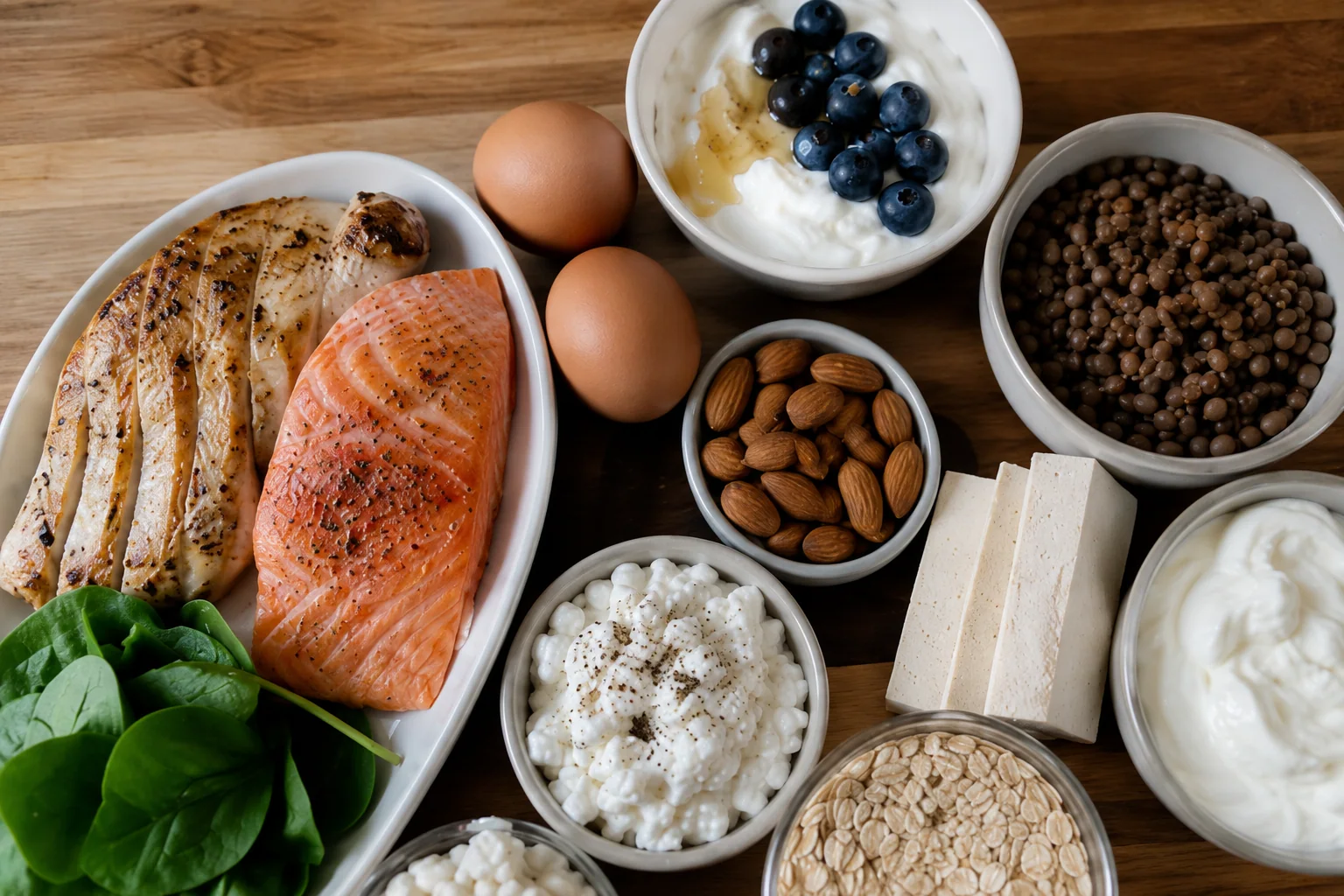
Most people trying to build muscle should aim for roughly 1.6–2.2 grams of protein per kilogram of bodyweight per day, or about 0.7–1.0 grams per pound.
You do not need to live at the top of that range.
Research suggests that around 1.6 g/kg/day is enough to maximize muscle-building benefits for many resistance-trained adults, while moving toward 2.2 g/kg provides a practical buffer for individual differences. (bjsm.bmj.com)
Protein matters because resistance training stimulates muscle remodeling, while dietary protein provides the amino acids required to repair and build muscle tissue.
But protein does not build muscle by itself.
Your training still has to create the stimulus.
If your overall training structure needs work, start with our How to Build Muscle: The Evidence-Based Hypertrophy Guide.
1. How Much Protein Do You Actually Need to Build Muscle?
One of the largest meta-analyses examining protein intake alongside resistance training found that increases in fat-free mass appeared to plateau around 1.62 g/kg of protein per day.
Because there is individual variation around that estimate, the researchers suggested that approximately 2.2 g/kg/day can be used as a practical upper target for lifters who want to maximize the likelihood that protein intake is not limiting their progress. (bjsm.bmj.com)
That gives us a simple working range:
| Bodyweight | 1.6 g/kg | 2.2 g/kg |
|---|---|---|
| 60 kg / 132 lb | 96 g | 132 g |
| 70 kg / 154 lb | 112 g | 154 g |
| 80 kg / 176 lb | 128 g | 176 g |
| 90 kg / 198 lb | 144 g | 198 g |
| 100 kg / 220 lb | 160 g | 220 g |
The StrengthCode protein rule
Do not automatically start at the highest number.
Start around 1.6 g/kg per day.
Move higher when there is a reason to.
That might mean you are dieting, prefer higher-protein foods, eat primarily plant-based protein, want a larger nutritional safety margin, or simply find a higher protein intake easier for appetite control.
For an 80 kg lifter, that means approximately 128 grams per day is a strong starting target.
You do not automatically need 176 grams.
That distinction matters because protein is only one part of your diet. Carbohydrates support hard training, dietary fats have important physiological roles, and total calorie intake influences whether your body has enough energy to support growth.
What if you are cutting?
Protein becomes particularly important during a calorie deficit because maintaining muscle becomes harder as energy availability falls.
Research on lean, resistance-trained athletes suggests that aggressive dieting may justify approximately 2.3–3.1 g/kg of fat-free mass, not total bodyweight. This recommendation is mainly aimed at lean athletes undergoing substantial calorie restriction, so it should not be blindly applied to everyone losing weight. (jissn.biomedcentral.com)
For most recreational lifters cutting body fat, staying near the upper end of the normal 1.6–2.2 g/kg bodyweight range is a practical starting point.
Then combine that with resistance training and a sensible calorie deficit.
Read How to Prevent Muscle Loss While Losing Weight for the full strategy.
2. Protein Per Meal, Timing and Protein Quality
Daily protein intake comes first.
Once that is covered, protein distribution becomes the next variable worth tightening.
The International Society of Sports Nutrition recommends approximately 20–40 grams of high-quality protein per feeding, or around 0.25 g/kg per meal, with protein distributed throughout the day. (pubmed.ncbi.nlm.nih.gov)
For someone eating 160 grams per day, that could look like four meals containing roughly 40 grams each.
It does not have to be exact.
Three substantial protein-rich meals can work. Five smaller feedings can work. The goal is to repeatedly provide your body with enough essential amino acids while still hitting the daily target.
Do you need protein immediately after training?
No.
The idea that you have only 30–60 minutes after training before your muscle-building opportunity disappears exaggerates the importance of timing.
Resistance training can elevate muscle protein synthesis well beyond the workout itself, with research showing an elevated response that can persist for up to roughly 24–48 hours depending on the lifter and training stimulus. (pubmed.ncbi.nlm.nih.gov)
That does not mean post-workout protein is useless.
It means there is no need to panic.
If you trained several hours after your last protein-containing meal, eating protein after training makes sense. If you ate a substantial meal shortly before training, there is considerably less urgency.
Daily protein intake and consistent training matter more than racing toward the shaker bottle.
Should you eat the same protein on rest days?
Yes.
Your muscles do not stop recovering because it is a rest day.
Resistance training initiates remodeling processes that continue well after you leave the gym, so your protein target should generally remain similar on training and non-training days. (pubmed.ncbi.nlm.nih.gov)
Do not cycle from 160 grams on Monday to 70 grams on Tuesday simply because you did not train.
Recovery is part of training.
Whole foods or protein powder?
Both work.
Protein powder is simply a convenient protein source.
Whey, casein, soy, pea and blended plant proteins can make it easier to hit your daily target, particularly when appetite, work or travel makes normal meals harder.
But supplements do not need to replace your diet.
Build most of your intake around foods such as meat, fish, eggs, dairy, tofu, tempeh, soy foods, legumes and other nutrient-dense protein sources.
Use powder when it makes execution easier.
Can plant protein build muscle?
Yes.
But protein quality and total intake deserve more attention.
Research comparing animal and plant proteins generally shows little or no meaningful difference in strength outcomes, while some analyses show a small advantage for animal protein in muscle-mass outcomes, particularly compared with certain non-soy plant sources. Soy tends to perform more similarly to dairy proteins. (pubmed.ncbi.nlm.nih.gov)
More recent research on acute muscle protein synthesis also suggests that differences between plant and animal proteins are not always substantial, although the evidence remains limited and varies by protein source. (pubmed.ncbi.nlm.nih.gov)
If you eat entirely plant-based, use a variety of protein sources and consider staying toward the higher end of your daily target.
You do not need to perfectly combine complementary proteins at every meal.
A varied diet across the entire day is what matters.
3. The Protein Mistakes That Hold Back Muscle Growth
The biggest protein mistake is expecting nutrition to compensate for weak training.
It cannot.
You can hit 180 grams of protein every day and still make poor progress if your workouts do not provide sufficient stimulus.
Muscle growth still depends heavily on progressive resistance training.
That means choosing exercises you can progress, performing enough productive weekly volume and training hard enough to challenge the target muscles.
See Progressive Overload: How to Build Muscle and Strength and our guide to the Best Rep Range for Muscle Growth for the training side.
Mistake: thinking more protein always means more muscle
Once your intake is already sufficient, simply adding more protein does not appear to produce endlessly greater hypertrophy.
The 1.6 g/kg figure is not a magical threshold, but the available research clearly shows diminishing returns as intake becomes adequate. (bjsm.bmj.com)
Going from 0.9 to 1.6 g/kg may matter.
Going from 1.8 to 2.8 g/kg is a completely different question.
Do not sacrifice the rest of your nutrition just to chase a bigger protein number.
Mistake: obsessing over protein timing
A perfectly timed shake will not rescue chronically inadequate protein intake.
Get your daily total right first.
Then distribute it sensibly across the day.
Timing is optimization.
Total intake is the foundation.
Mistake: ignoring calories
Protein cannot completely override inadequate energy intake.
Beginners, detrained lifters and people carrying more body fat may be able to gain muscle while losing fat under the right conditions, but substantial muscle gain generally becomes harder as the calorie deficit grows—especially in lean, experienced lifters.
If muscle growth is your primary goal, protein intake needs to exist inside an overall nutrition strategy that provides enough energy to support productive training and recovery.
Mistake: thinking protein is dangerous for every healthy lifter
The kidney discussion requires more nuance than either extreme usually provides.
A 2026 systematic review of randomized trials in adults without chronic kidney disease found that high-protein diets increased estimated filtration rates but did not produce consistent biochemical evidence of kidney injury. The researchers also noted that many studies were relatively short, meaning the very long-term effects of unusually high protein intakes remain less certain. (pubmed.ncbi.nlm.nih.gov)
That does not mean everyone should consume unlimited protein.
People with kidney disease or another medical condition affecting protein requirements should follow individualized medical guidance.
For healthy lifters, there is also little muscle-building reason to push protein dramatically beyond an already adequate intake.
How to integrate
Here is the practical system.
Calculate your bodyweight in kilograms and multiply it by 1.6.
That is your starting daily protein target.
An 80 kg lifter starts around:
80 × 1.6 = 128 grams per day.
Then adjust based on the situation.
If 128–140 grams fits your diet and your progress is moving, there is no reason to force 180 grams.
If you are cutting, prefer protein-rich meals, eat mostly plant-based or simply want a larger buffer, move toward 1.8–2.2 g/kg.
Next, divide that intake across approximately three to five meals.
An 80 kg lifter targeting 150 grams could use:
Breakfast: 35 g
Lunch: 40 g
Around training: 30–35 g
Dinner: 40–45 g
The exact distribution is not sacred.
Consistency is.
Keep roughly the same protein target on rest days, build most meals around quality food, and use protein powder only when convenience helps.
Then make sure your training earns that protein.
Protein provides the building material.
Training creates the demand.
And recovery gives your body the opportunity to adapt.
If recovery is falling behind, read Rest Days for Muscle Growth: How Many Do You Need?.
What you need to keep in mind
For most people trying to maximize hypertrophy, 1.6–2.2 g/kg of protein per day is a strong evidence-based target range.
Around 1.6 g/kg is enough for many lifters.
The upper end provides room for individual differences and specific situations.
You do not need to slam a protein shake the second your workout ends.
You do not need six protein meals every day.
You do not need absurdly high intakes.
Hit an effective daily target. Spread protein across several meals. Keep your intake consistent on rest days. Train progressively. Eat enough total food to support your goal. Recover properly.
Protein matters.
But protein works because your training gives your body a reason to use it.
FAQs
Is 1 gram of protein per pound necessary to build muscle?
No. One gram per pound—approximately 2.2 g/kg—is a useful upper-end target, not a mandatory minimum. Many lifters can maximize or come close to maximizing muscle growth with less.
Is 100 grams of protein enough to build muscle?
It depends on your bodyweight. For a 60 kg person, 100 grams equals approximately 1.67 g/kg and sits inside an effective range. For a 100 kg lifter, it is only 1.0 g/kg and may be below an optimal hypertrophy target.
Is 150 grams of protein enough to build muscle?
For many people, yes. At 80 kg, 150 grams equals approximately 1.88 g/kg—comfortably inside the evidence-supported hypertrophy range.
How much protein should I eat per meal?
Approximately 20–40 grams of high-quality protein per meal works well for many adults, with larger individuals potentially benefiting from larger servings. Your daily total remains more important than hitting an exact amount every meal. (pubmed.ncbi.nlm.nih.gov)
Should I eat protein on rest days?
Yes. Muscle remodeling continues after training, so there is normally no reason to drastically lower your protein intake on rest days. (pubmed.ncbi.nlm.nih.gov)
Do older lifters need more protein?
Older adults can have a reduced anabolic response to protein and resistance exercise. Evidence suggests that intakes around 1.2–1.6 g/kg/day can support lean mass when paired with resistance training, although individual needs vary. (pubmed.ncbi.nlm.nih.gov)
Can you build muscle without protein powder?
Absolutely. Protein powder is convenient, not mandatory. Meat, dairy, eggs, fish, soy foods, legumes and other protein-rich foods can cover your entire requirement.
Is creatine a replacement for protein?
No.
Protein supplies amino acids used to maintain and build body tissue. Creatine supports high-intensity exercise performance and training capacity through a different mechanism.
Read Creatine for Beginners: Benefits, Dosage, Timing, and Common Mistakes for the full breakdown.
Sources
Morton RW et al. A systematic review, meta-analysis and meta-regression of the effect of protein supplementation on resistance training-induced gains in muscle mass and strength in healthy adults. British Journal of Sports Medicine. Study
Jäger R et al. International Society of Sports Nutrition Position Stand: protein and exercise. Journal of the International Society of Sports Nutrition. Position stand
Helms ER et al. Evidence-based recommendations for natural bodybuilding contest preparation: nutrition and supplementation. Journal of the International Society of Sports Nutrition. Review
Tagawa R et al. Systematic review and meta-analysis of protein intake to support muscle mass and function in healthy adults. Study
Lim MT et al. Animal Protein versus Plant Protein in Supporting Lean Mass and Muscle Strength: A Systematic Review and Meta-Analysis of Randomized Controlled Trials. Nutrients. Study
Silva PRT et al. Effects of High-Protein Diets on Renal Function and Body Composition in Adults Without Chronic Kidney Disease: A Systematic Review and Meta-Analysis of Randomised Trials. Diabetes, Obesity and Metabolism, 2026. Study
Effects of Plant- vs Animal-Based Proteins on Muscle Protein Synthesis: A Systematic Review With Meta-Analysis. 2026. Study