Gym vs Home Workout: Which Actually Builds More Muscle for a Beginner?
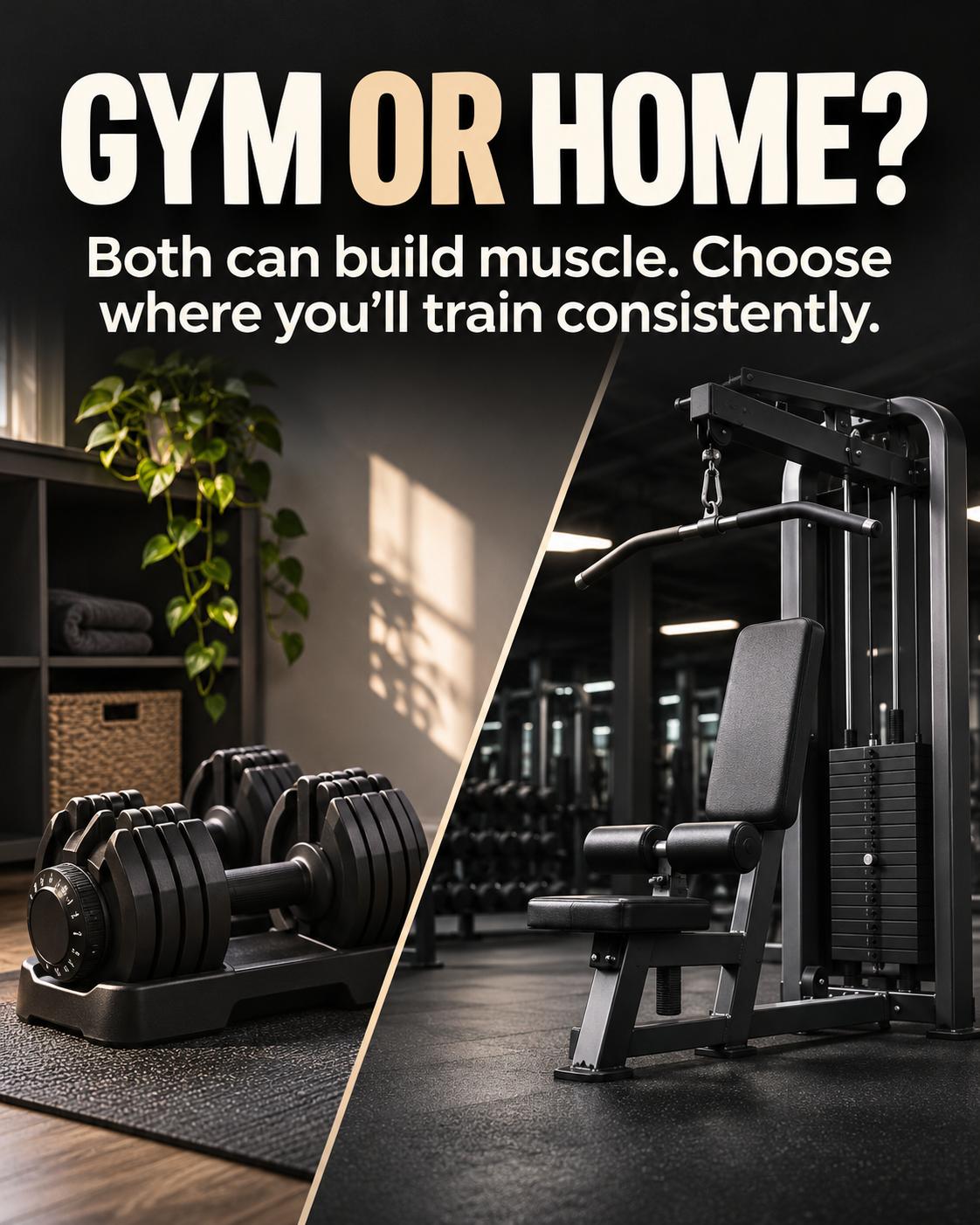
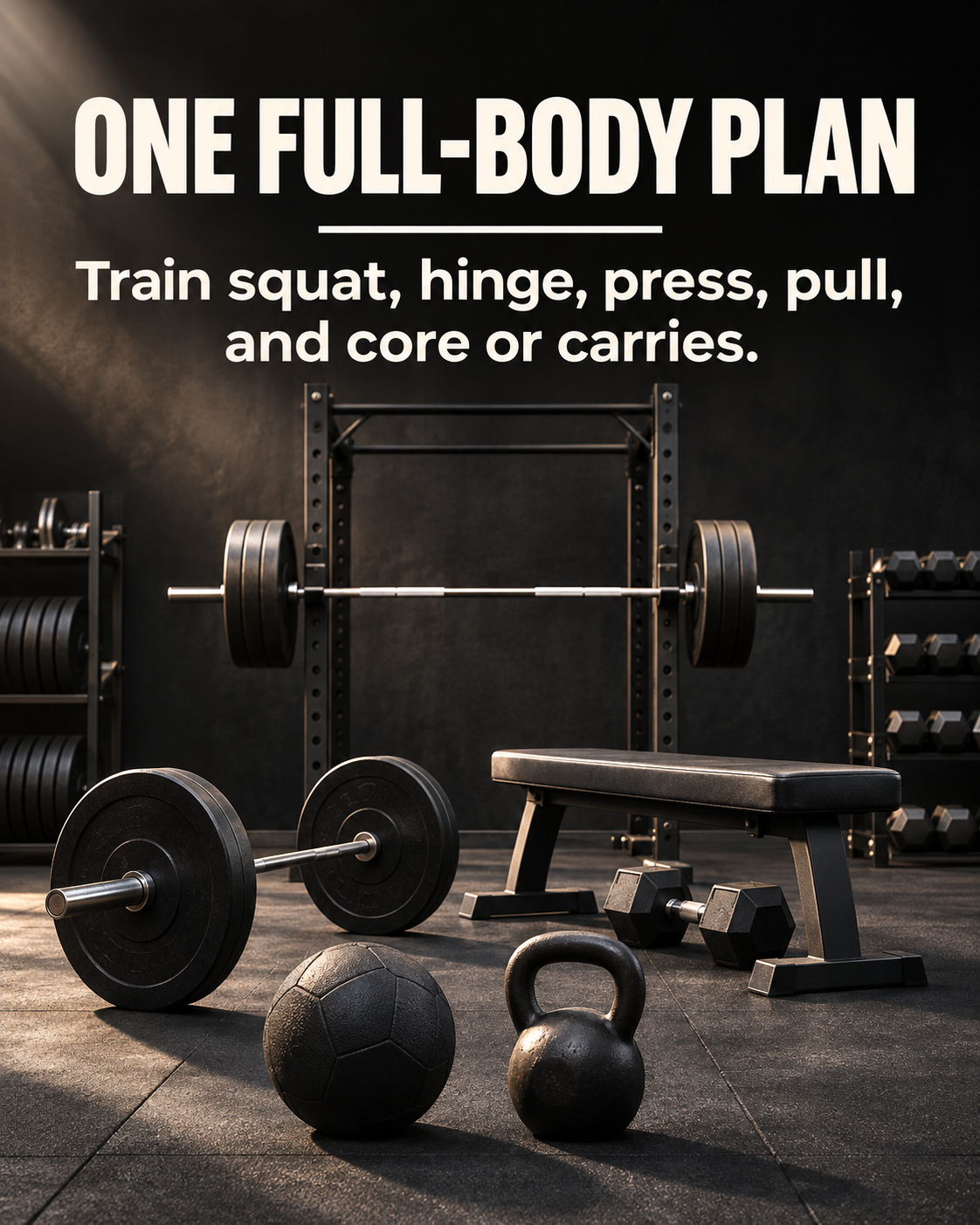
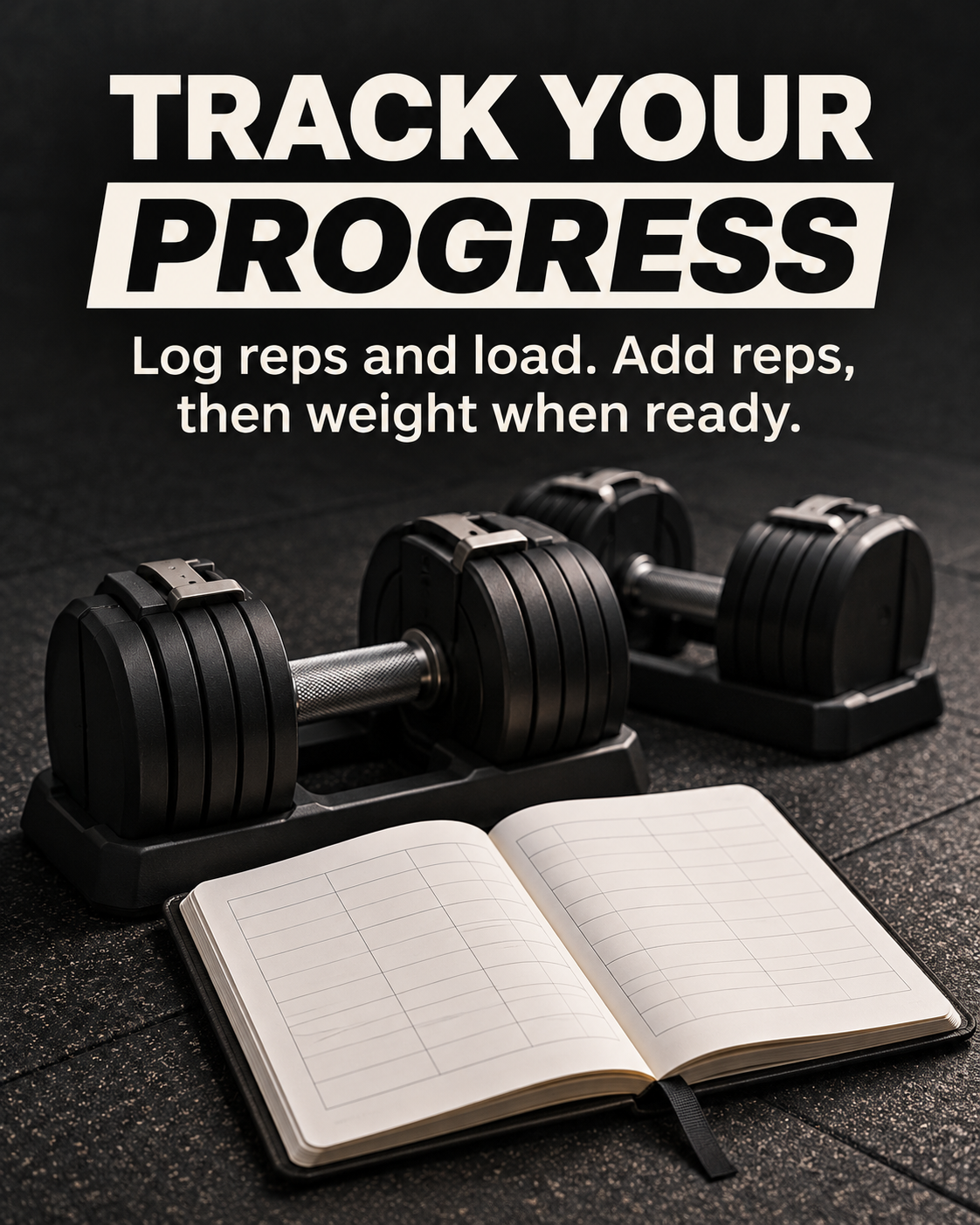
Build muscle at home or in the gym: train consistently, cover the major movement patterns, and track your progress.
Gym vs Home Workout: Which One Actually Builds More Muscle for a Beginner?
The gym vs home workout decision has a boring answer: pick the room you will actually train in three times a week. For a beginner, muscle comes from weekly hard sets, effort close to failure, and a progression rule, not the building. Home wins when your dumbbells allow small load jumps and your lower body gets genuinely hard sets. The gym earns its fee when it hands you machines for hard sets without needing a spotter and heavier leg loading.
The Short Answer: The Room Doesn't Build Muscle. The Work Does.
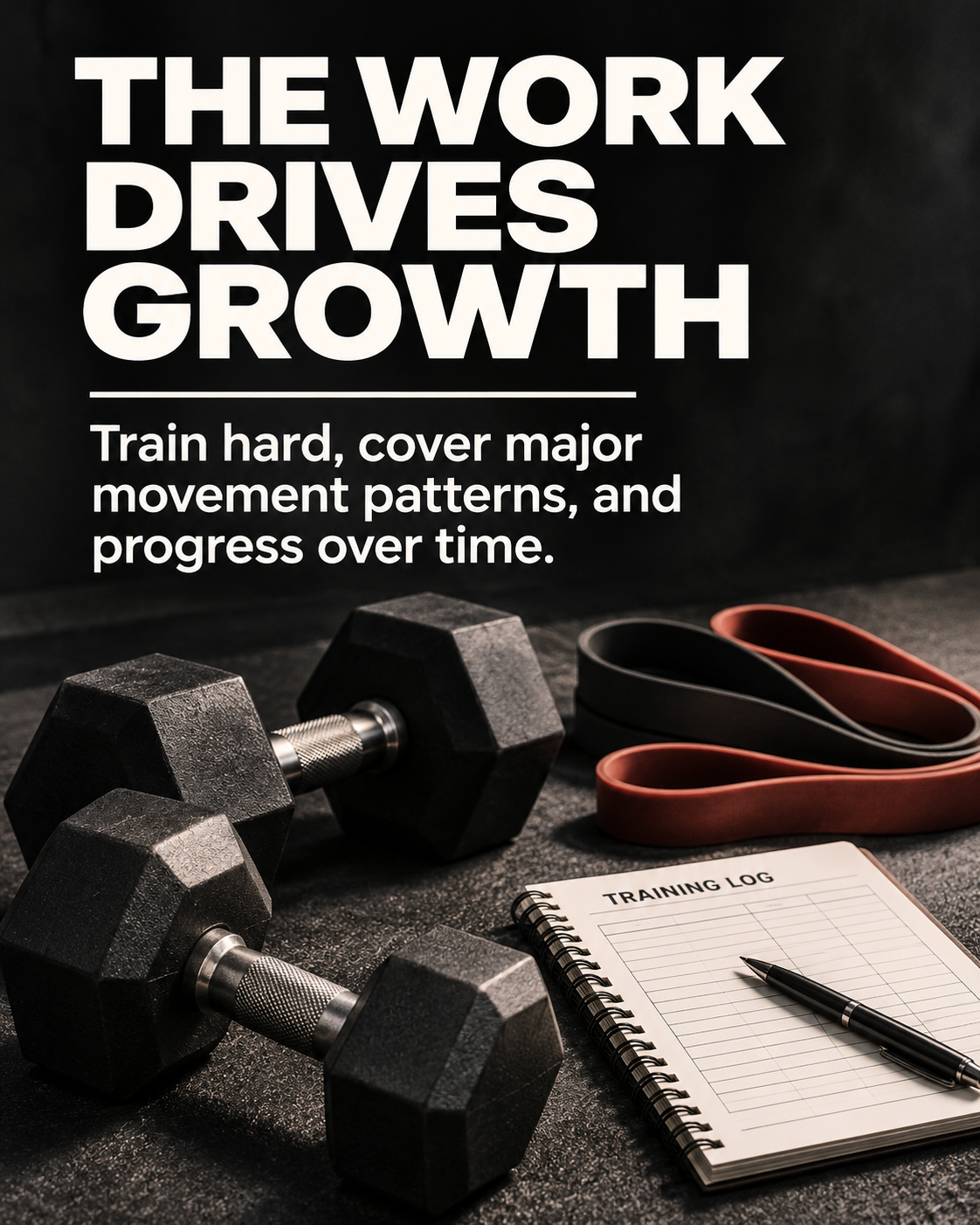
Building muscle at home vs gym is not two different physiological projects. Match the weekly hard sets, the effort, and the progression rule, and a beginner grows at the same rate in a garage as on a commercial floor. The room is a delivery method. The work is the stimulus.
Muscle growth runs on four things: enough hard sets per muscle per week, effort close to failure, exercise selection that covers squat, hinge, press, and pull, and a progression rule you can actually follow. A 2021 review in Sports Medicine put weekly volume ahead of training frequency, with a floor of roughly four weekly sets per muscle in a 6-15 rep range. Beginners should start higher, around 8-12 hard sets per muscle per week across two or three sessions. The full logic sits in how many sets per muscle per week.
Frequency is the argument that eats the most months. When weekly volume is equated, split routines and full-body routines produced similar strength and muscle thickness gains in untrained men over eight weeks. A meta-analysis of well-trained lifters found no clear difference in maximal strength between frequencies once volume was matched. Pick the structure that lets you hit your weekly sets. Training frequency explained has the detail.
Load is where home lifters panic. A network meta-analysis found hypertrophy is similar across light, moderate, and heavy loads when sets go to volitional failure. Heavy loads still win for maximal strength. For a beginner chasing size, that means a pair of 10 kg (22 lb) dumbbells can build real muscle, provided the last rep of every set is genuinely hard. Casual reps at any load build nothing.
Dumbbells vs gym machines for beginners is settled. A 2023 systematic review covering 13 studies and 1,016 participants found no difference in hypertrophy between free weights and machines, while strength gains stayed specific to the modality you trained. A leg press that lets you grind a hard set without a spotter isn't cheating. It is a tool.
A membership or a dumbbell set buys adherence and progression, not a secret stimulus. Buy whichever makes the next 20 weeks of hard sets more likely.
Where Home Wins, Where the Gym Wins
The home gym vs gym membership decision is simpler than the internet makes it: home wins on time, cost, and privacy. The gym wins on load granularity, hard-set safety, and long-term lower-body progression.
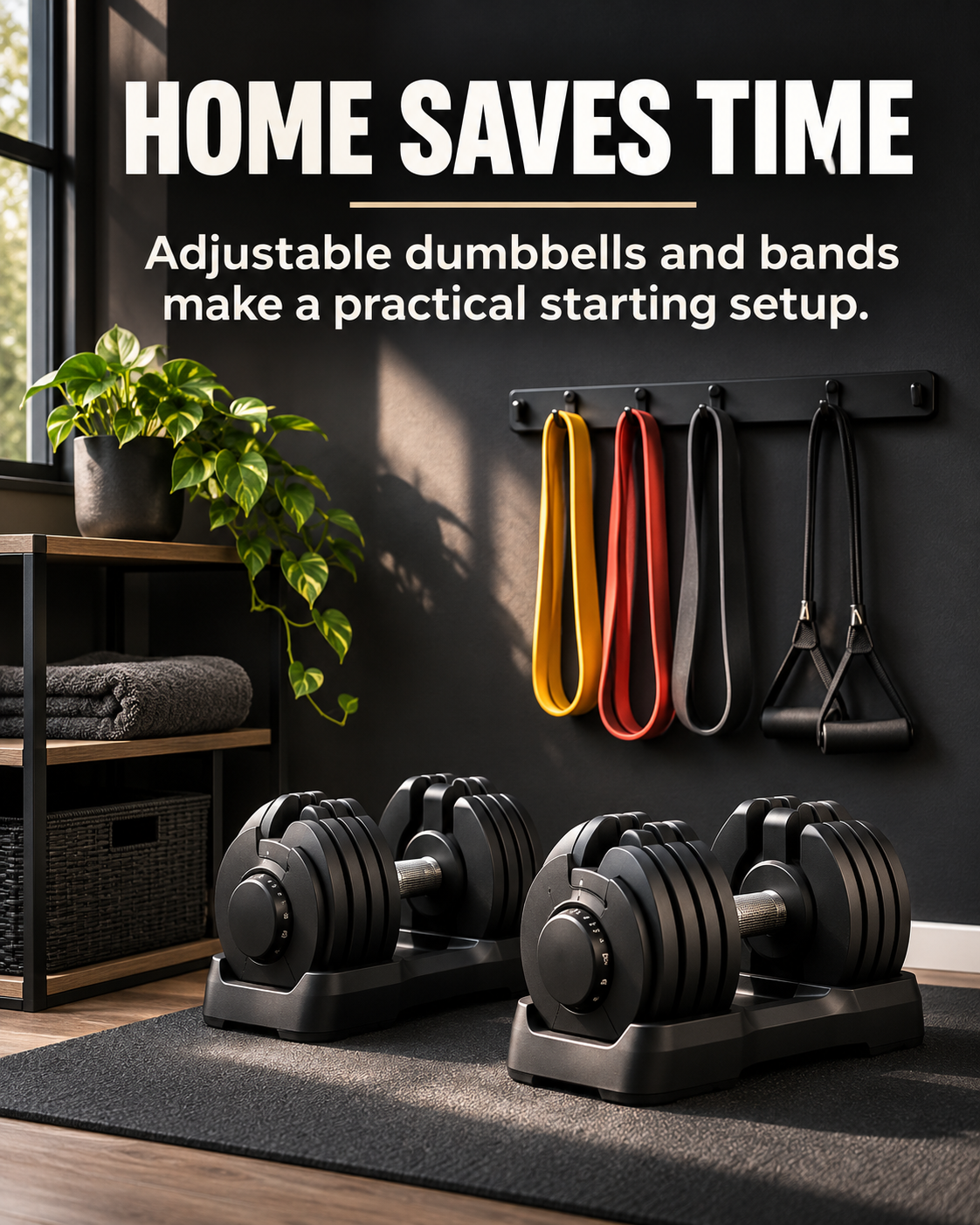
Home training removes the commute, which is the most underrated training variable a busy beginner owns. The American College of Sports Medicine lists lower membership costs, privacy, and reduced total time commitment as the main reasons people build home gyms, and recommends multipurpose kit over single-use machines. MedlinePlus names dumbbells, kettlebells, a mat, and bands as affordable strength options. A 20-minute commute each way, three sessions a week, costs you two hours weekly.
The home ceiling is real, and it has three edges. Fixed dumbbell jumps come first: 10 kg (22 lb) to 15 kg (33 lb) is a 50 percent leap, too big for a press. Thin lower-body loading is the second, because a pair of dumbbells rarely challenges a squat the way a leg press does. Heavy pressing without a spotter is the third. Tempo, pauses, unilateral work, and band tension work around all three, but you are managing a constraint, not deleting it. Read how to pick dumbbell load and progress at home before you buy a fixed pair.
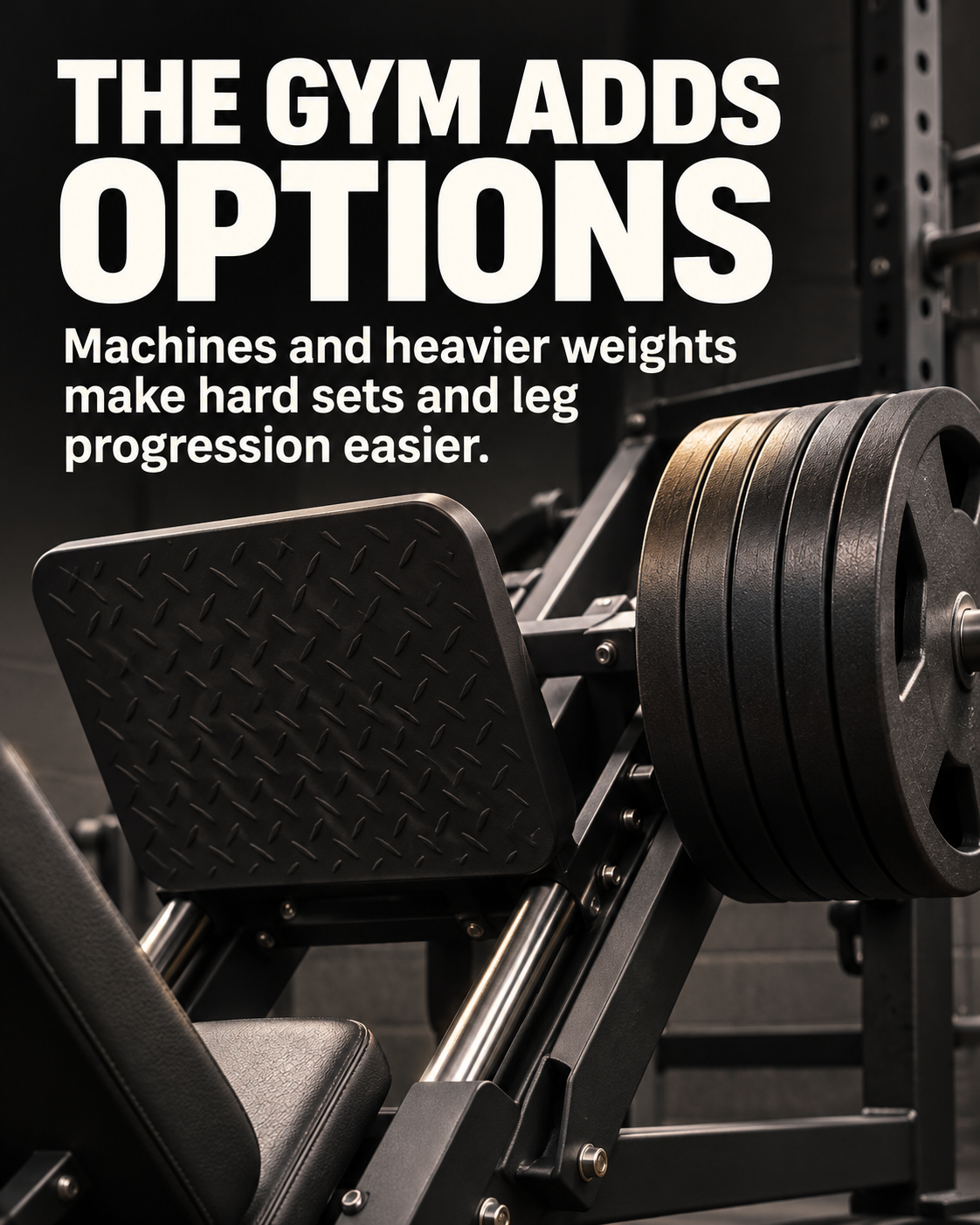
The gym wins on increments. Most commercial gyms run 1.25 kg (2.75 lb) plates and dumbbell racks in 2.5 kg (5.5 lb) steps, and that granularity matters because beginner strength climbs fast in the first 12 weeks. The gym also hands you machines that let you take a hard set close to failure alone, plus heavier lower-body loading than any dumbbell you can hold. Given the hypertrophy data above, the leg press isn't a compromise. It is how you train quads hard while you learn to squat.
One caution, kept in its lane: a 2024 trial in adults with intellectual and developmental disabilities found gym-based delivery produced better cardiorespiratory fitness and peripheral arterial outcomes than home delivery. That is a conditioning finding in a specific population. Don't stretch it into a muscle-building claim.
Decide in ten minutes:
- Space: roughly 2 m x 2 m (6.5 ft x 6.5 ft) clear? Home is viable. No? The gym is the practical answer.
- Schedule: add the round trip. If two hours of weekly travel kills the sessions, train at home.
- Current strength: can't do 8 clean push-ups and 10 bodyweight squats? Home covers the first 8-12 weeks. A 2023 review found beginners progress on one weekly session under three sets and below 50 percent of 1RM, then need more.
- Equipment you will genuinely use: adjustable dumbbells beat a rack of unused gear.
- Six-month test: trained consistently for six months? A membership is probably worth it. No? Start home.
Is a gym membership worth it for a beginner? Yes when it buys small load jumps, hard-set safety, and heavier leg work, and you will actually walk through the door. No when it buys a monthly reminder that you don't.
One Template, Two Rooms
Run three full-body sessions a week in either room: one squat, one hinge, one press, one pull, one carry or core movement. The template doesn't change. The substitutions do.
- Day A: goblet squat or leg press (6-10 reps), floor press or machine chest press, one-arm dumbbell row or cable row, Romanian deadlift or hip extension (8-12 reps), then a farmer carry or plank. Three sets of each.
- Day B: split squat or leg press, overhead press or machine shoulder press, lat pulldown or band row, hip thrust or back extension, then a side plank or carry. Three sets of each, 8-12 reps.
- Day C: repeat Day A with a different squat and press variation. Same rep ranges, same effort.
Two to three sets per exercise is plenty early. The National Institute on Aging notes that one set of 8-12 reps is effective and two or three may be more effective, and advises training major muscle groups at least two days a week without hitting the same group on consecutive days. The time-efficient training review supports the 6-15 rep range. Stop one or two reps shy of failure, and when you hit the top of the range with clean form, add reps before you add load. That is progressive overload in practice.
Home substitutions:
- No rack: goblet squat, box squat, or split squat.
- No bench: floor press or incline push-up.
- No cable stack: one-arm dumbbell row, band row, or inverted row under a sturdy table.
- No heavy dumbbells: tempo reps, pauses, unilateral work, band tension. A 2019 paper on complexity as a progression strategy lists unilateral, unstable, and multi-planar variations as legitimate ways to raise difficulty when load stalls.
Minimum home gym equipment for beginners: adjustable dumbbells, resistance bands, a sturdy chair or bench, and a mat. That covers the template for at least 12 weeks. If you want it pre-built, use this 3-day beginner dumbbell plan.
Hybrid training home and gym is legitimate, and for a lot of people it is the smartest answer. Same template. Gym for lower-body loading and machine hard sets, home for upper-body work and extra frequency. That isn't a philosophy. It is logistics.
How to integrate
Run the six-month adherence test this week. Pick one room for the next two weeks and log every set, rep, and load. Don't buy equipment or sign a contract until you have eight consistent weeks behind you. At home, start with bodyweight and bands, then buy adjustable dumbbells once the habit is proven. The minimum effective dose approach is the right first step. At the gym, go at off-peak hours, use machines for hard sets, and keep sessions under 45 minutes. A 30-minute full-body session is enough when the sets are hard and the rest periods are honest. After eight weeks, decide with data: did the room help you show up, and did you add reps or load?
What you need to keep in mind
Don't buy equipment before eight weeks of consistent training. A worse room with a better plan beats a perfect room with no progression rule. A hybrid setup is legitimate and often the long-term answer. The room isn't the program. Weekly hard sets, effort, and a progression rule are the program. Keep cardio in its lane if muscle is the priority, and combine cardio and lifting without burying recovery. Beginners can progress on very little at first, but the program has to grow after the first 8-12 weeks.
FAQ
Is a home workout as good as the gym?
For muscle growth, yes, provided weekly hard sets and progression are matched. The gym pulls ahead on small load increments, hard-set safety, and heavier lower-body loading.
Can you build muscle with only dumbbells?
Yes. Hypertrophy is similar across loads when sets go close to failure. You need enough weekly sets and a way to progress reps, tempo, or load.
Do you need a bench at home?
No. A floor press, incline push-up, and one-arm row cover the pressing and pulling patterns. A sturdy chair helps. It isn't mandatory.
Is a gym membership worth it for a beginner?
Yes if it buys small load jumps, machines for hard sets without a spotter, and heavier leg work, and you will attend. No if you won't go.
What is the minimum home setup?
Adjustable dumbbells, resistance bands, a sturdy chair or bench, and a mat. Enough for a 3-day full-body plan for at least 12 weeks.
Can you mix home and gym training?
Yes. Run the same template in both places. Gym for lower-body loading and machine hard sets, home for upper-body work and extra frequency.
Sources Used
- Iversen et al. (2021). No Time to Lift? Designing Time-Efficient Training Programs for Strength and Hypertrophy. Sports Medicine.
- Haugen et al. (2023). Effect of free-weight vs. machine-based strength training on maximal strength, hypertrophy and jump performance. BMC Sports Science, Medicine and Rehabilitation.
- Evangelista et al. (2021). Split or full-body workout routine: which is best to increase muscle strength and hypertrophy? Einstein.
- Lopez et al. (2021). Resistance Training Load Effects on Muscle Hypertrophy and Strength Gain. Medicine and Science in Sports and Exercise.
- Behm et al. (2023). Minimalist Training: Is Lower Dosage or Intensity Resistance Training Effective to Improve Physical Fitness? Sports Medicine.
- Cuthbert et al. (2021). Effects of Variations in Resistance Training Frequency on Strength Development in Well-Trained Populations. Sports Medicine.
- Phillips (2022). 3 Essentials for Building a Home Gym. American College of Sports Medicine.
- MedlinePlus. Exercise and Physical Fitness.
- National Institute on Aging. Three Types of Exercise Can Improve Your Health and Physical Ability.
- La Scala Teixeira et al. (2019). Complexity: A Novel Load Progression Strategy in Strength Training. Frontiers in Physiology.
- Melo et al. (2024). Home- vs gym-based exercise delivery modes of two multicomponent intensity training regimes. Journal of Intellectual Disabilities.