How Many Sets Per Muscle Per Week? Stop Wasting Your Training Volume
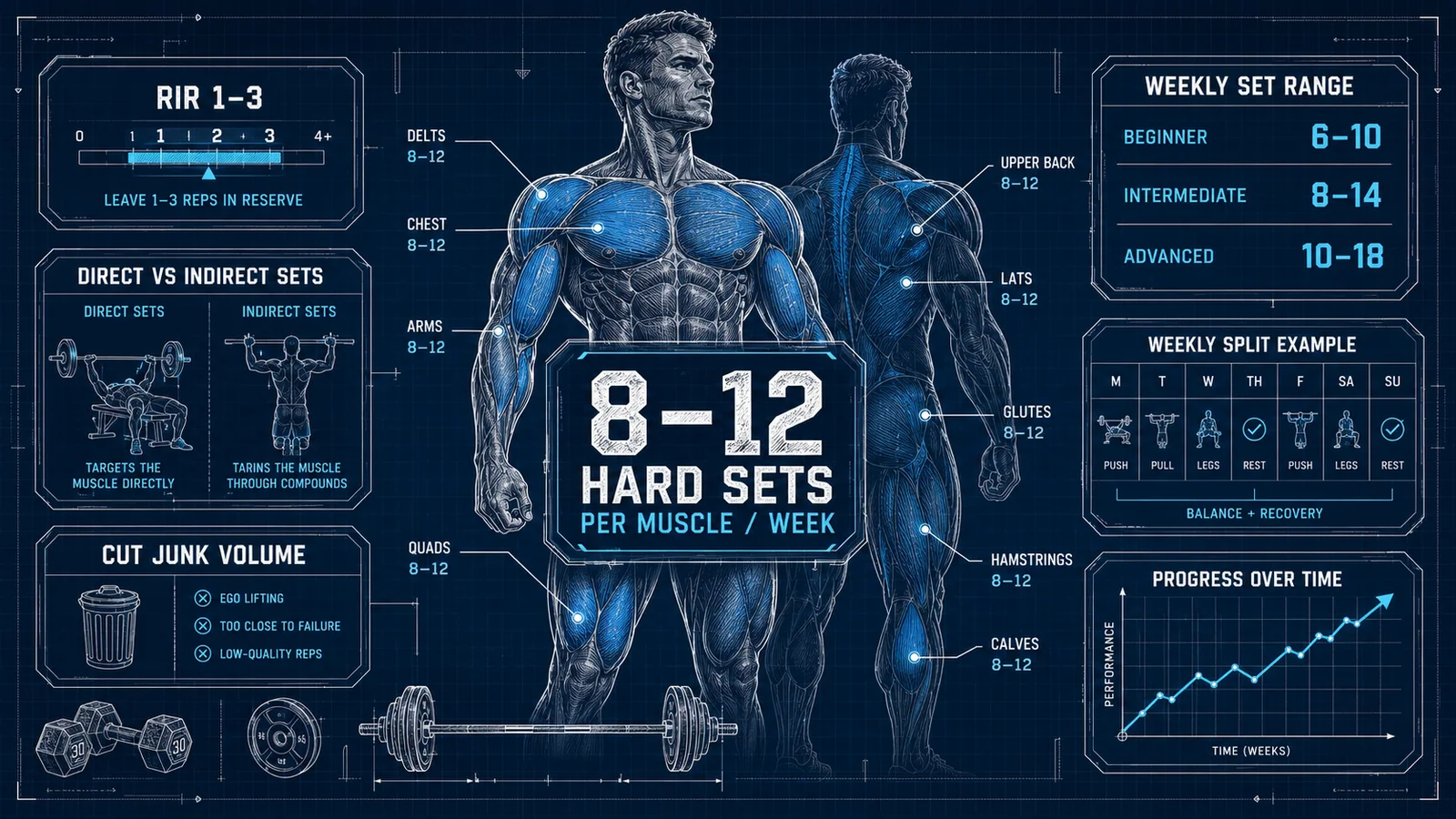
How many sets per muscle per week do you need to build muscle?
Start with 8–12 hard sets per muscle group per week. That is the working range for most lifters. Not 25 random sets, not endless drop sets, and not every exercise you can fit into two hours.
Your job is not to survive the most volume. Your job is to deliver a strong muscular stimulus, recover from it, and return ready to outperform the previous session.
If your numbers are moving and your technique is clean, the program is working. If performance is falling while fatigue keeps rising, you are not training harder. You are managing your training badly.
Let’s fix it.
1. Count Hard Sets, Not Everything You Do in the Gym
A set counts toward your weekly training volume when it forces the target muscle to work hard enough to drive adaptation.
That usually means finishing the set with approximately one to three controlled repetitions left in reserve, known as RIR.
If you stop a set at ten repetitions but could have completed another eight, do not record it as a hard hypertrophy set. That was a warm-up, technique set or low-effort set.
It may have prepared you to train. It did not provide the same stimulus as your working sets.
What counts as a hard set?
Count the set when:
- The target muscle is doing the work.
- The load is challenging.
- You use a controlled range of motion.
- Your technique remains repeatable.
- You finish close enough to failure to demand adaptation.
Do not count:
- General warm-ups.
- Light ramp-up sets.
- Technique practice performed far from failure.
- Random pump work with no progression target.
- Half-repetitions added after your form has already collapsed.
- Rehabilitation work intentionally kept at low effort.
Stop inflating your training log.
Performing six warm-up sets does not mean you completed six muscle-building sets. Completing ten exercises does not mean you trained effectively. Volume only matters when the work is productive.
Direct sets versus indirect sets
Direct sets place the muscle in a primary role.
A curl directly trains the biceps. A leg extension directly trains the quadriceps. A cable fly directly trains the chest.
Indirect sets make a muscle assist another movement. Rows involve the biceps, but the back is the primary target. Bench presses involve the triceps, but a chest-focused press is not automatically a full direct triceps set.
Indirect work still matters. It creates stimulus and fatigue. But do not count every supporting muscle as if it received a full direct set.
Use this rule:
- Count direct hard sets as full sets.
- Recognize indirect work as additional stimulus and fatigue.
- Adjust isolation volume when compound work is already high.
If you press heavily twice per week, your triceps are not starting from zero. If you row and perform pull-ups, your biceps are already working. Program your isolation exercises around that reality.
2. Use the Right Weekly Set Range
The updated 2026 ACSM resistance-training guidelines identify approximately 10 weekly sets per muscle group as a strong target for maximizing hypertrophy.
That gives you an evidence-based starting point. It does not give every lifter permission to copy the same number.
Training age, exercise selection, set quality, nutrition, sleep and recovery all determine how much weekly training volume you can use.
Weekly sets by training experience
| Training level | Starting weekly sets per muscle | Primary objective |
|---|---|---|
| Beginner | 6–10 | Master technique and build consistent progression |
| Intermediate | 8–14 | Add productive volume without burying performance |
| Advanced | 10–18 | Individualize volume and attack specific weaknesses |
These are starting ranges. Earn your adjustments through performance data.
Beginners: stop trying to train like advanced bodybuilders
Beginners do not need massive volume. You need repeatable technique, consistent effort and a program you can execute every week.
Start with six to ten hard weekly sets per major muscle group. Learn the movements. Build control. Add repetitions and load without destroying your form.
More exercises will not compensate for poor execution.
Intermediate lifters: control your fatigue
Intermediate lifters usually need more work than beginners, but this is where junk volume starts taking over.
You have enough experience to tolerate harder sessions. You also have enough confidence to add exercises you do not need.
Start around eight to fourteen weekly hard sets. Track your lifts. Keep the exercises stable. Add volume only when your existing workload has stopped producing measurable progress.
Read the progressive overload guide before blaming your set count for every plateau.
Advanced lifters: individualize the work
Advanced lifters require precision—not chaos.
Some muscles may grow on ten weekly sets. A lagging muscle may require fourteen or sixteen. Another muscle may need less direct work because it already receives heavy indirect volume.
Do not force every body part into the same range. Prioritize weak points and hold maintenance volume elsewhere.
Advanced programming is not doing more of everything. It is knowing exactly where additional work belongs.
Split the work across the week
Do not crush a muscle with twelve sloppy sets in one session because Monday is “chest day.”
For most lifters, training a muscle around twice per week keeps set quality higher and makes weekly volume easier to recover from.
Use your split to distribute the work:
- Full-body training: Two to four sets per muscle across three weekly sessions.
- Upper/lower training: Four to six sets per muscle across two weekly exposures.
- Push-pull-legs: Four to eight sets per muscle each time its workout appears.
The split is only the structure. The quality of the work determines the result.
Use the full-body training guide or push-pull-legs guide to build the right weekly structure.
3. Cut Junk Volume Before It Cuts Your Progress
Junk volume is training that creates fatigue without providing enough additional stimulus to justify it.
It drains performance, stresses your joints and reduces the quality of the work that actually matters.
Your eighth hard set may be productive. Your fifteenth may be useless if your load has dropped, your range of motion is disappearing and other muscles are taking over.
More work is only better when the work remains good.
Signs your volume is too low
Your training volume may be too low when:
- A muscle receives very little direct work.
- Recovery is easy, but progress has stalled for several weeks.
- Loads and repetitions are not increasing.
- Technique and effort are consistent, but muscular development is not moving.
- You are completing only a few challenging sets before ending the session.
Do not use soreness as your main measurement. You can build muscle without being sore, and you can create severe soreness without creating a productive program.
Measure performance.
Signs your volume is too high
Pull volume back when:
- Performance declines across consecutive workouts.
- Normal working weights suddenly feel heavy.
- Soreness repeatedly interferes with the next session.
- Joint irritation continues to increase.
- Technique breaks down earlier than normal.
- Motivation, sleep and readiness deteriorate.
- Additional sets have produced more fatigue but no measurable progress.
One bad session is not a crisis. A repeated decline is a warning.
Do not keep adding work because reducing volume feels weak. Holding useless volume is not toughness. It is poor coaching.
Do not add sets before fixing execution
Before increasing your weekly sets, check the basics:
- Are you controlling the eccentric?
- Are you using a full, repeatable range of motion?
- Are you training close enough to failure?
- Are you adding repetitions or load?
- Are you sleeping enough?
- Are you eating enough protein and total calories?
- Are you allowing the muscle to recover?
Fix those problems first.
Adding four more sets to bad execution gives you more bad execution.
How to Integrate
Run the following process exactly.
Step 1: Establish your baseline
Start with:
- Major muscle groups: 8–12 direct hard sets per week.
- Smaller muscle groups: 4–8 direct hard sets per week, depending on indirect compound work.
Do not begin at the top of every range. Leave yourself room to progress.
Step 2: Train each muscle twice per week
Divide the weekly total across two sessions.
If your chest target is ten sets, perform five sets on the first upper-body day and five on the second. That will usually produce better work than forcing all ten sets into one session.
Step 3: Keep the movements stable
Stop replacing exercises every week.
Use repeatable movements long enough to measure performance. You cannot judge whether volume is working when the entire program changes every few sessions.
Step 4: Track the numbers
Record:
- Exercise.
- Load.
- Repetitions.
- Sets.
- RIR.
- Technique or performance notes.
“Good workout” is not useful data. Record what happened.
Step 5: Adjust one muscle at a time
If a muscle has stalled despite strong execution and recovery, add approximately two weekly hard sets.
Do not add sets to every muscle simultaneously. You will not know what created progress or what destroyed recovery.
Run the adjustment for several weeks and reassess.
Sample intermediate upper/lower volume
| Muscle group | First exposure | Second exposure | Weekly direct sets |
|---|---|---|---|
| Chest | 4 | 4 | 8 |
| Back | 5 | 5 | 10 |
| Shoulders | 3 | 3 | 6 |
| Quadriceps | 4 | 4 | 8 |
| Hamstrings | 3 | 3 | 6 |
| Glutes | 3 | 3 | 6 |
| Biceps | 3 | 3 | 6 |
| Triceps | 3 | 3 | 6 |
This is enough volume to drive progress without turning every workout into a recovery problem.
Compound exercises create additional indirect work. Heavy pressing trains the triceps and front deltoids. Pulling trains the biceps. Squats and lunges train multiple lower-body muscles.
Account for that work before piling on isolation exercises.
Use appropriate rest days for muscle growth. If you cannot recover, the program is wrong—regardless of how impressive it looks on paper.
What You Need to Keep in Mind
Start with 8–12 hard sets per muscle group per week.
Train each major muscle around twice per week. Keep most working sets within one to three repetitions of failure. Use controlled technique. Track your performance. Add volume only when the current amount has stopped producing results.
Do not chase the highest number.
Your body does not reward you for collecting sets. It responds to muscular tension, progression and recovery.
Beginners need discipline and clean execution. Intermediate lifters need to control junk volume. Advanced lifters need precise adjustments.
Build the stimulus. Cut the wasted work. Recover properly. Return stronger.
That is training volume done correctly.
Frequently Asked Questions
Is 10 sets per muscle per week enough?
Yes. Ten hard weekly sets can build muscle when the sets are performed with strong technique, sufficient effort and consistent progression. Beginners may require less. Experienced lifters may need more for specific muscles.
Is 20 sets per muscle per week too much?
It can be. Twenty sets may work for a well-trained lifter targeting a specific muscle, but it is not the correct starting point for every muscle group. If performance is falling and recovery is deteriorating, the volume is too high.
Do warm-up sets count toward weekly training volume?
No. Warm-up sets prepare you for demanding work. They are generally too light and too far from failure to count as hard hypertrophy sets.
Should compound exercises count for every muscle involved?
Count the exercise fully for its primary target muscles. Supporting muscles receive indirect stimulus, but that does not automatically equal a full direct set. Use indirect work to control your isolation volume.
How many sets should I perform for one muscle in a workout?
Start with approximately four to eight hard sets for the muscle in one session. If set quality collapses, stop adding work and distribute more of the volume across another day.
Do I need to train to failure to build muscle?
No. Keep most sets approximately one to three repetitions from failure. Use failure selectively on controlled isolation exercises—not as an excuse to destroy technique on every compound lift.
When should I add more sets?
Add sets after progress has stalled for several weeks and you have confirmed that technique, effort, nutrition and recovery are in place. Add approximately two weekly sets to the stalled muscle, then reassess.
Can low-volume training build muscle?
Yes. Low-volume training works when the sets are challenging, progression is consistent and the program covers every major muscle group. Start with the minimum effective dose, then add work when your results demand it.