Full-Body Training for Strength, Muscle Growth, and Conditioning
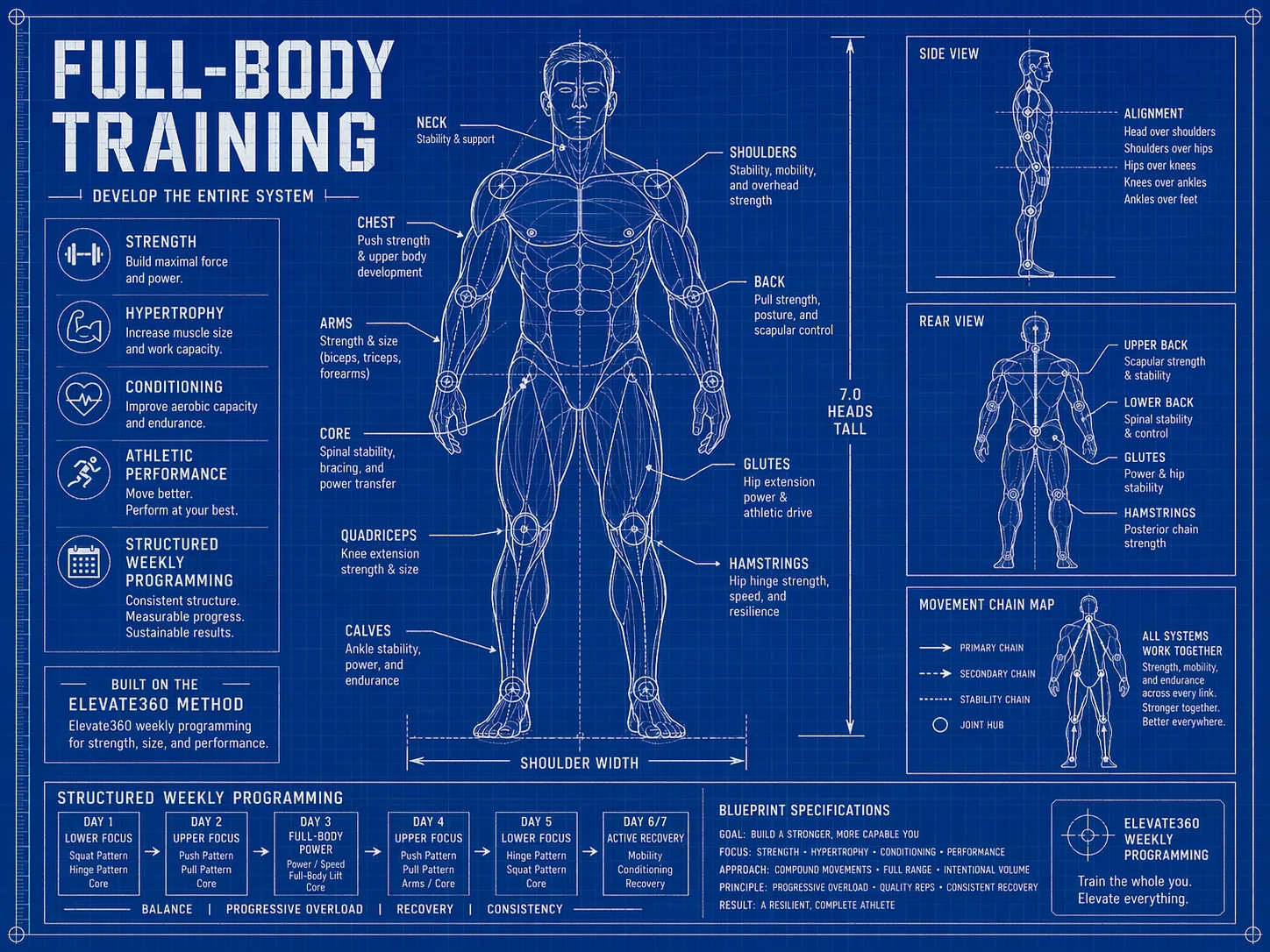
Full-body training is one of the most effective ways to build strength, muscle, and athletic conditioning when it is programmed with purpose.
The mistake most people make is thinking full-body training just means doing a little bit of everything in one training session. That is not the goal.
True full-body training is not random. It is structured. It gives your body repeated exposure to the movement patterns that build strength, lean muscle mass, control, and performance.
That means squatting, hinging, pressing, pulling, lunging, bracing, stabilizing, and moving with intent across the week.
This is the foundation behind the way we approach training inside Elevate360. The program is built around three total-body strength and hypertrophy days, with two integrated conditioning and athletic performance days. The goal is not just to look better. The goal is to build a body that performs better.
What Is Full-Body Training?
Full-body training means you train multiple major muscle groups in the same session instead of separating your week into isolated body-part days.
A typical body-part split may train chest on one day, back on another day, legs on another day, and arms later in the week. That can work, but it is not always the most efficient structure for people who want strength, muscle, conditioning, and athletic movement together.
Full-body training gives you more frequent practice with the big patterns that matter.
You are not waiting an entire week to train your legs again. You are not only pressing once per week. You are not saving all your pulling volume for one back day. Instead, your body gets multiple high-quality opportunities to produce force, create tension, and improve movement.
That is why full-body training works so well for people who want a complete result.
It allows you to train hard without relying on one massive session to do all the work. Instead of destroying one muscle group with endless volume, you spread the training stimulus across the week. That usually means better movement quality, better consistency, and more productive sessions.
A strong full-body session should usually include some combination of:
- Squat: Back squat, goblet squat, landmine squat.
- Hinge: Romanian deadlift, deadlift, hip thrust.
- Press: Bench press, dumbbell press, cable press.
- Pull: Row, pulldown, pull-up, cable row.
- Lunge: Reverse lunge, walking lunge, split squat.
- Core/Stability: Roll-outs, carries, anti-rotation work.
- Accessory Work: Curls, triceps, lateral raises, shrugs.
The goal is not to cram every exercise into every workout. The goal is to train the full body with structure, balance, and progression.
Why Full-Body Training Builds Strength and Muscle
Strength and hypertrophy are built through repeated quality work.
You need enough load to challenge the body. You need enough volume to create a muscle-building stimulus. You need enough recovery to adapt. Full-body training gives you a strong framework for all three.
For strength, full-body training works because you practice key lifts and movement patterns more often. Squats, presses, hinges, and rows improve when they are trained consistently. Skill matters in strength training. The more often you perform a movement with good technique, the better your body gets at producing force in that pattern.
For hypertrophy, full-body training works because it lets you distribute muscle-building volume across the week. Instead of trying to hit all your chest volume in one session, or all your leg volume in one session, you can train those muscles multiple times with better quality.
That matters because muscle growth is not just about doing more. It is about doing productive work that you can recover from.
Inside Elevate360, we apply this by using total-body sessions that combine heavy compound work with controlled accessory work. You will see movements like back squats, bench presses, floor presses, Romanian deadlifts, rows, lunges, split squats, hip thrusts, curls, triceps extensions, lateral raises, shrugs, and cable-based movements.
This gives the program a clear training effect:
You build strength through the main lifts.
You build muscle through repeated tension and accessory volume.
You build better movement through unilateral work and controlled tempo.
You build durability through balanced pushing, pulling, hinging, and lower-body work.
That is what separates full-body training from random full-body workouts.
Why Conditioning Belongs in a Full-Body Training Program
A strong body should not gas out quickly.
That is why conditioning should not be treated as an afterthought. The problem is that many people add conditioning in the wrong way. They either do too much of it after heavy lifting, or they treat it like punishment instead of performance work.
In a well-built full-body training plan, conditioning should support the strength work, not interfere with it.
That is why Elevate360 uses two dedicated conditioning and athletic performance days between the three total-body sessions.
The weekly split looks like this:
- Day 1 — Total-Body Session 1
- Day 2 — Upper-Body Dynamic & Conditioning
- Day 3 — Total-Body Session 2
- Day 4 — Lower-Body Dynamic & Conditioning
- Day 5 — Total-Body Session 3
- Day 6 — Rest & Regeneration
- Day 7 — Rest & Regeneration
This setup keeps the week balanced.
The total-body days focus on strength, muscle, tempo, and progressive loading. The conditioning days focus on athletic output, speed, power, work capacity, and movement quality.
Upper-body conditioning may include medicine ball chest passes, medicine ball slams, explosive push-ups, band rows, rear-delt work, EMOM blocks, and push-up finishers.
Lower-body conditioning may include box jumps, broad jumps, jumping split squats, glute-bridge variations, lateral band walks, high-knee runs, rowing intervals, bike sprints, jump rope, and loaded carries.
That is not just cardio.
That is performance conditioning.
You are training your body to move fast, control force, recover between efforts, and maintain output under fatigue.
Sample Full-Body Training Week
Here is what a full-body training week can look like when strength, hypertrophy, and conditioning are organized correctly:
Day 1-Total Body: Strength + hypertrophy emphasis.
Day 2-Conditioning: Upper-body power + work capacity.
Day 3-Total Body: Strength + unilateral control.
Day 4-Conditioning: Lower-body power + athletic conditioning.
Day 5-Total Body: Full-body strength + accessory volume.
Day 6-Recovery and Regeneration.
Day 7-Recovery and Regeneration.
This is where Elevate360 fits in.
It takes the principles of full-body training and organizes them into a phased system. The early phase builds capacity and technical foundation. The next phase increases integration and intensity. The later phase brings in more specialization, athletic performance, and explosive intent. Then the deload phase gives the body space to recover and absorb the work.
That is how training becomes sustainable.
How to integrate
To get the most out of full-body training, you need to respect the purpose of each day.
On total-body days, focus on clean execution, progressive loading, controlled tempo, and full range of motion. These are your primary strength and hypertrophy sessions. Do not rush through them. Do not turn every set into sloppy fatigue. Own the movement.
On conditioning days, focus on athletic intent. Move fast when the exercise requires speed. Jump with control. Sprint with purpose. Push the pace, but keep your mechanics sharp.
The biggest mistake is trying to make every day feel the same.
Strength days should feel strong.
Hypertrophy work should create tension.
Conditioning days should challenge output.
Recovery days should help you come back better.
That is the structure we use inside Elevate360: three total-body days, two conditioning and athletic performance days, and recovery placed where it matters.
Full-Body Training FAQs
Is full-body training good for building muscle?
Yes. Full-body training works well for muscle growth because it allows you to train major muscle groups multiple times per week with quality volume.
Can full-body training build strength?
Yes. When programmed correctly, full-body training builds strength by giving you repeated exposure to compound lifts like squats, presses, deadlifts, rows, lunges, and hip hinges.
Should conditioning be included with full-body training?
Yes, if it is placed correctly. Conditioning should support performance, not destroy recovery. That is why it works best on dedicated days between strength-focused sessions.
Who is Elevate360 best for?
Elevate360 is built for people who want strength, hypertrophy, conditioning, and athletic performance in one structured program using basic commercial gym equipment.
What you need to keep in mind
Full-body training is not basic. It is only basic when it is programmed poorly.
When done correctly, it gives you one of the strongest frameworks for building muscle, gaining strength, improving conditioning, and moving like an athlete.
The key is structure.
You need the right exercises, the right weekly layout, the right progression, and the right recovery. That is the difference between doing workouts and following a program.
Elevate360 was built from that principle.
It takes the benefits of full-body training and applies them through a complete weekly system: total-body strength and hypertrophy, athletic conditioning, explosive intent, and planned recovery.
Train the full body. Build real strength. Move with purpose. Recover with discipline. That is how you build a body that performs.