How Long Should You Rest Between Sets for Muscle Growth?
For muscle growth, rest roughly 2–3 minutes between demanding compound sets and 1–2 minutes between isolation exercises. Take longer when you need it. The goal is not to restart the timer as fast as possible — it is to recover as necessary to perform another high-quality, hard set.
Rest between sets is not wasted training time.
It is part of the training.
Rush into your next set while your muscles, breathing, and overall performance are still heavily fatigued and you may lose reps, reduce load, compromise technique, and turn productive hypertrophy work into conditioning.
But sitting around for five minutes after every cable curl is not automatically better either.
So how long should you actually rest between sets for muscle growth?
There is no universal magic number. Current research suggests muscle growth can occur across a wide range of rest intervals, although very short rest periods may become counterproductive when they reduce the amount or quality of work you can perform. A 2024 systematic review and meta-analysis found a small hypertrophy advantage for rest periods longer than 60 seconds, but did not find clear additional hypertrophy benefits once rest periods exceeded roughly 90 seconds. (pubmed.ncbi.nlm.nih.gov)
The practical rule is simple:
Rest long enough to make the next set productive.
1. How Long Should You Rest Between Sets for Hypertrophy?
For most muscle-building workouts, use this as your starting point:
| Exercise / Goal | Recommended Starting Rest |
|---|---|
| Heavy compound exercises | 2–4 minutes |
| Moderate compound exercises | 2–3 minutes |
| Machine compound exercises | 90 seconds–3 minutes |
| Isolation exercises | 1–2 minutes |
| Heavy strength-focused sets | 3–5+ minutes |
| Supersets | 1–2+ minutes after the pair |
These are not rigid rules.
They are practical starting ranges.
A hard set of squats creates very different recovery demands from a set of lateral raises. Your rest period should reflect the exercise, load, repetition range, proximity to failure, and how much your performance is affected.
Compound exercises usually need longer rest
Squats, Romanian deadlifts, bench presses, heavy rows, overhead presses, leg presses, weighted pull-ups, and similar compound exercises involve large amounts of muscle mass and often create significant systemic fatigue.
Trying to force every compound set into a 60-second rest window can reduce performance unnecessarily.
Imagine your first bench press set is:
80 kg × 10
You rest only 45–60 seconds:
80 kg × 7
Then:
80 kg × 5
You completed 22 repetitions.
Give yourself enough recovery and you might instead achieve:
80 kg × 10
80 kg × 9
80 kg × 8
Now you completed 27 repetitions with the same load.
The second workout may feel less frantic, but that does not make it less effective.
A controlled study comparing one-minute and three-minute rest periods in resistance-trained men found greater strength improvements with three-minute rests, along with greater hypertrophy in some measured muscle sites. (pubmed.ncbi.nlm.nih.gov)
That does not prove three minutes is universally superior.
It shows why deliberately restricting recovery can become a problem when performance suffers.
Isolation exercises usually need less rest
Now compare a squat with a cable curl.
Your biceps may be heavily fatigued after curls, but you are unlikely to experience the same cardiovascular and whole-body demands.
Exercises such as:
- biceps curls
- triceps extensions
- lateral raises
- cable flyes
- leg extensions
- hamstring curls
- calf raises
can often be trained effectively with around 60–120 seconds of rest.
But again, the timer does not override performance.
If your quadriceps are still destroyed 90 seconds after a hard leg-extension set, take another 30–60 seconds.
There is no hypertrophy bonus for starting the next set before you are ready.
2. Why Rest Between Sets Matters for Muscle Growth
Muscle growth is not determined by how exhausted you can make yourself.
Productive hypertrophy training requires sufficient mechanical tension, enough hard sets, appropriate effort, progressive overload, and enough recovery to continue producing quality work.
Your rest periods influence all of those variables.
Short rest can reduce training performance
Very short rest periods increase fatigue.
That is obvious.
But more fatigue is not automatically more muscle growth.
If inadequate rest causes your repetitions, load, range of motion, or technique to collapse, the increased difficulty of the workout may simply reflect greater fatigue—not a better hypertrophy stimulus.
A 2022 study illustrates this well. Researchers compared one- and three-minute rest periods while also manipulating training volume. All conditions increased strength and quadriceps size, but greater hypertrophy occurred in the conditions that accumulated more volume load. The researchers concluded that volume load appeared to play a more important role than the rest interval itself. (pubmed.ncbi.nlm.nih.gov)
That is an important distinction.
Longer rest does not magically build muscle.
Longer rest can help you preserve the quality and quantity of the work that builds muscle.
This connects directly with your overall training volume. If you are unsure how much work you actually need, read our guide to how many sets per muscle per week.
The pump is not the scoring system
Short rest creates a bigger pump.
It can increase burning.
It makes workouts feel harder.
None of those things automatically prove that the workout was better.
The target is not:
maximum discomfort.
The target is:
maximum productive training you can recover from.
A set performed after inadequate recovery may feel brutally difficult because you are breathing heavily and carrying fatigue from the previous set.
That is different from a properly rested set becoming difficult because the target muscles are approaching their actual force-producing limit.
This is also why understanding RIR, RPE, and how close to failure you should train matters.
Cardiovascular exhaustion should not constantly become the reason your hypertrophy sets end.
Current evidence does not support one perfect rest interval
The 2026 American College of Sports Medicine Position Stand reviewed 137 systematic reviews covering resistance-training prescription.
For hypertrophy specifically, the authors concluded that there was still insufficient evidence to determine whether inter-set rest duration independently influences muscle growth. (pmc.ncbi.nlm.nih.gov)
That is why claims like:
“60 seconds is optimal for hypertrophy.”
or:
“Three minutes always builds more muscle.”
go beyond what the evidence can currently support.
A better interpretation is:
Avoid unnecessarily short rest periods when they compromise the next set.
3. Rest Between Sets for Strength vs Muscle Growth
Strength and hypertrophy overlap, but they are not exactly the same goal.
Heavy strength training normally uses lower repetitions and higher absolute loads. That places a greater premium on restoring force production before the next set.
For that reason, strength work commonly needs longer rest periods.
Rest times for hypertrophy
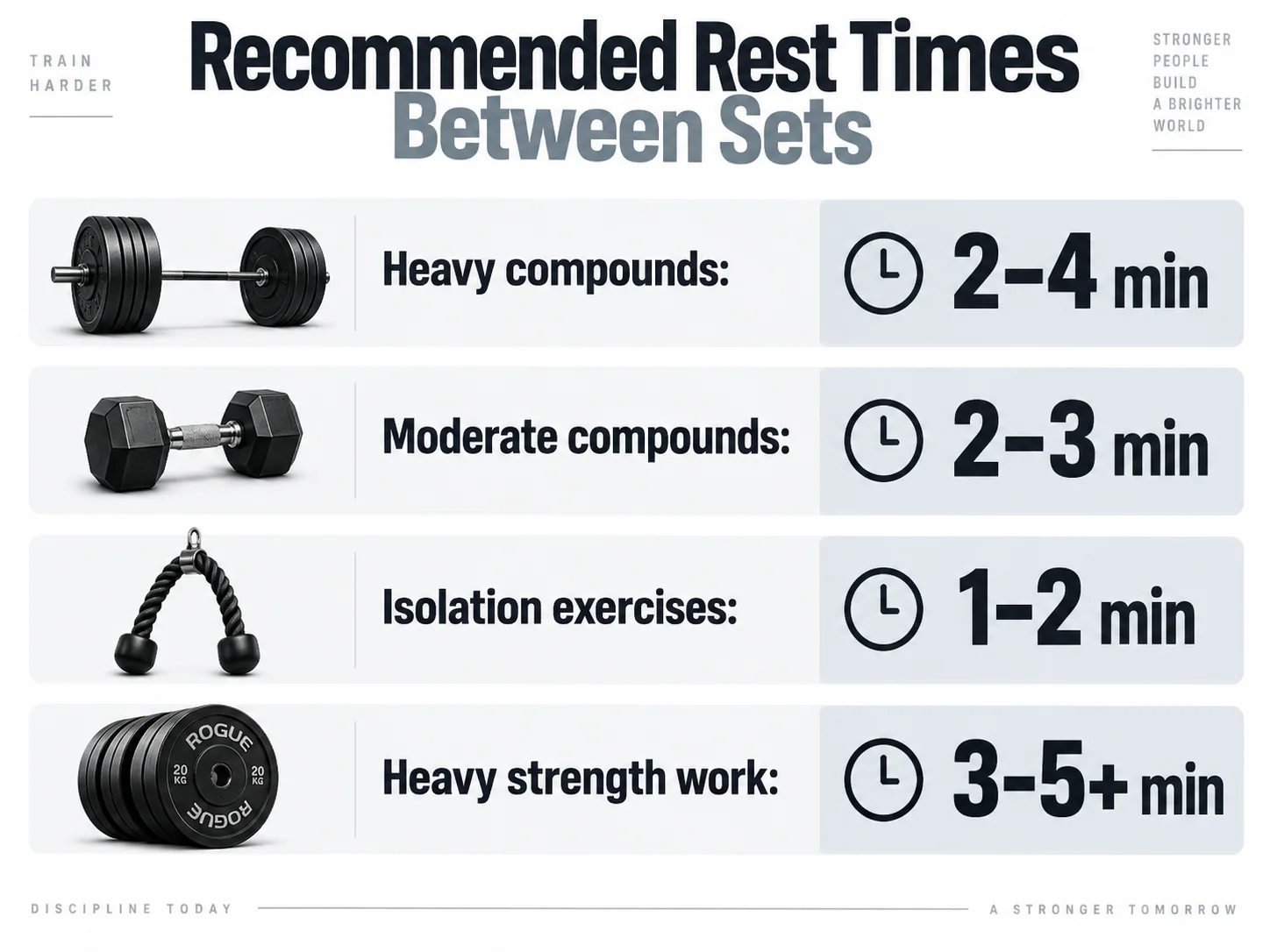
A strong default is:
Compound exercises: 2–3+ minutes
Isolation exercises: 1–2 minutes
If you are performing demanding sets close to failure, extending those rest periods may help maintain performance.
Rest times for strength
For heavy sets in lower repetition ranges, start closer to:
3–5 minutes
Some lifters may need even longer after near-maximal attempts.
You are not losing your gains because you waited four minutes before another heavy squat.
You are giving yourself enough recovery to produce force again.
Can you rest too long between sets?
Technically, yes—but not because your muscles suddenly stop growing after a certain number of minutes.
Extremely long rest periods can make workouts unnecessarily long, reduce training density, allow you to cool down, and make sessions less practical.
But for normal hypertrophy training, taking three minutes instead of exactly two is not something you need to fear.
A six-month study in trained men comparing two-minute and five-minute rest periods found similar gains in strength and muscle size between the protocols. (pubmed.ncbi.nlm.nih.gov)
Your rest interval should be long enough to preserve the next set without being longer than necessary.
How to Integrate Rest Times Into Your Training
Do not choose rest periods based only on a stopwatch.
Use the StrengthCode Rest Test.
Before starting your next hard set, check three things:
1. Is your breathing controlled?
If you are still fighting to catch your breath, especially after a compound exercise, cardiovascular fatigue may limit the next set before the target muscles do.
2. Can you produce another high-quality set?
You do not need to feel completely fresh.
But you should be recovered enough to execute the exercise with controlled technique, usable force, and the intended range of motion.
3. Will your reps collapse because you rushed the rest period?
Some rep drop-off is normal.
Massive performance loss is different.
Suppose your incline dumbbell press looks like this:
32 kg × 12
32 kg × 11
32 kg × 10
Good.
Your recovery is probably sufficient.
Now compare:
32 kg × 12
32 kg × 7
32 kg × 5
If you are using a similar effort target on every set and the collapse is largely caused by incomplete recovery, extend your rest period.
Do not automatically lower the weight.
The rest interval may be the problem.
Match rest time to the exercise
A practical hypertrophy workout might look like:
Barbell Squat — 3 minutes
Romanian Deadlift — 3 minutes
Leg Press — 2–3 minutes
Leg Extension — 90 seconds
Hamstring Curl — 90 seconds
Calf Raise — 60–90 seconds
That is more intelligent than forcing every exercise into exactly 60 seconds or exactly three minutes.
Match rest to your rep range and effort
Heavier sets generally need more recovery.
Sets taken very close to failure often need more recovery.
High-repetition isolation work may recover faster systemically but can still create substantial local fatigue.
Your best rep range for muscle growth and your rest periods should therefore work together—not be programmed independently.
Rest enough to support progressive overload
If your goal is to add repetitions, load, sets, or improve execution over time, you need enough recovery to demonstrate that progression.
Constantly sabotaging your next set with insufficient rest makes progressive overload harder to track.
Your workout should challenge the muscle.
It should not hide your actual performance behind unnecessary fatigue.
What You Need to Keep in Mind
There is no universal perfect rest time for muscle growth.
Current evidence suggests that very short rest periods may slightly disadvantage hypertrophy when they reduce training performance, while rest periods beyond roughly 90 seconds have not consistently shown additional direct hypertrophy benefits.
That does not mean 90 seconds is optimal.
It means rest duration should be treated as a tool rather than a magic number.
For most lifters, a strong starting point is:
2–3+ minutes for demanding compound exercises.
1–2 minutes for isolation exercises.
3–5+ minutes for heavy strength-focused work.
Then adjust according to your performance.
If another 30–60 seconds allows you to perform more quality repetitions with better technique and the intended effort level, take it.
You are not training to beat the clock.
You are training to build muscle.
FAQs
How long should you rest between sets for muscle growth?
For most hypertrophy training, rest around 2–3 minutes between compound exercises and 1–2 minutes between isolation exercises. Extend the rest period if your performance drops significantly because you have not recovered.
Is 30 seconds between sets enough for muscle growth?
Muscle growth can occur with short rest periods, but 30 seconds is likely too short for many demanding exercises. If it substantially reduces repetitions, load, or technique on the next set, rest longer.
Is 1 minute between sets enough for hypertrophy?
Sometimes.
One minute may work well for smaller isolation exercises. However, research suggests there may be a small hypertrophy advantage to resting longer than 60 seconds, potentially because longer recovery helps preserve training performance and volume. (pubmed.ncbi.nlm.nih.gov)
Is 2 minutes between sets good for muscle growth?
Yes.
Two minutes is a strong general starting point for hypertrophy training. Some isolation exercises may require less, while demanding compound lifts may require three minutes or longer.
Is 3 minutes too long between sets for hypertrophy?
No.
Three minutes can be completely appropriate, especially for heavy compound exercises. Research in trained lifters has shown successful hypertrophy with three-minute rest intervals. (pubmed.ncbi.nlm.nih.gov)
Should you rest longer when training close to failure?
Often, yes.
Hard sets performed close to muscular failure create greater fatigue. Additional recovery can help you maintain force production, repetitions, and technique on subsequent sets.
How long should you rest between sets for strength?
A practical starting range is 3–5 minutes for heavy strength-focused sets. Higher loads and lower-repetition work generally benefit from more recovery between attempts.
Do shorter rest periods increase muscle growth because they create a bigger pump?
Not necessarily.
A larger pump or greater burning sensation does not automatically mean greater long-term hypertrophy. Productive volume, mechanical tension, effort, progression, and recovery remain more useful considerations.
Are supersets bad for muscle growth?
No.
Supersets can make workouts more time-efficient, particularly when pairing exercises that do not heavily compete with each other. The problem begins when the superset creates so much local or cardiovascular fatigue that performance on the important exercises drops substantially.
Sources
Singer A, Wolf M, Generoso L, et al. (2024). Give it a rest: a systematic review with Bayesian meta-analysis on the effect of inter-set rest interval duration on muscle hypertrophy. Frontiers in Sports and Active Living.
Currier BS, D'Souza AC, Fiatarone Singh MA, et al. (2026). American College of Sports Medicine Position Stand: Resistance Training Prescription for Muscle Function, Hypertrophy, and Physical Performance in Healthy Adults. Medicine & Science in Sports & Exercise.
Schoenfeld BJ, Pope ZK, Benik FM, et al. (2016). Longer Interset Rest Periods Enhance Muscle Strength and Hypertrophy in Resistance-Trained Men. Journal of Strength and Conditioning Research.
Longo AR, Silva-Batista C, Pedroso K, et al. (2022). Volume Load Rather Than Resting Interval Influences Muscle Hypertrophy During High-Intensity Resistance Training. Journal of Strength and Conditioning Research.
Ahtiainen JP, Pakarinen A, Alen M, Kraemer WJ, Häkkinen K. (2005). Short vs. Long Rest Period Between the Sets in Hypertrophic Resistance Training. Journal of Strength and Conditioning Research.