Push Pull Legs Split
Push Pull Legs Split: Benefits, Weekly Schedule, and Best PPL Routine
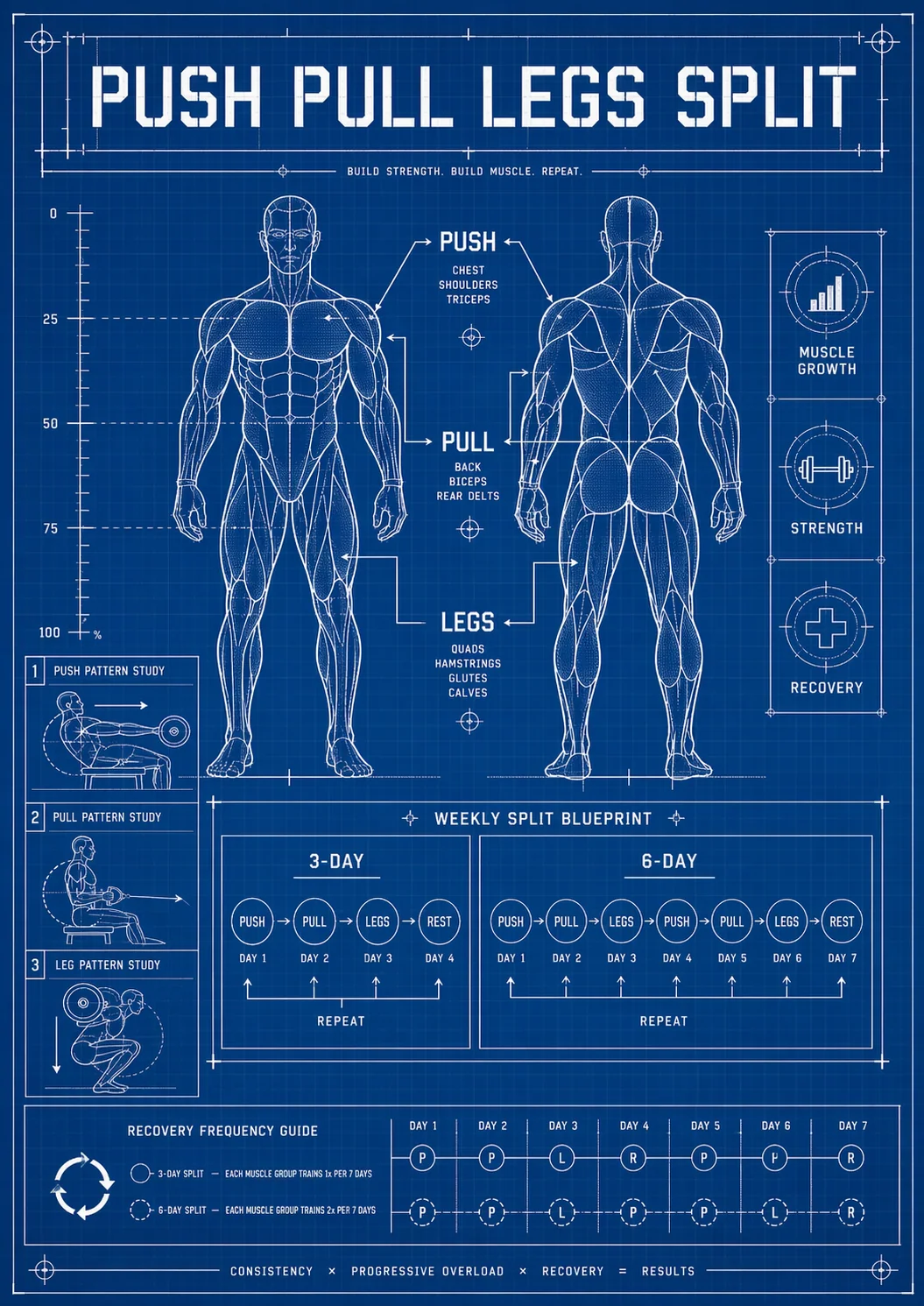
The push pull legs split is one of the most effective training structures for building muscle, improving recovery, and keeping your program organized. Instead of training body parts at random, this split groups exercises by movement pattern. Push days target the chest, shoulders, and triceps. Pull days hit the back, rear delts, and biceps. Leg days focus on quads, hamstrings, glutes, and calves.
That setup is simple, but that is exactly why it works. It gives you structure, repeatability, and a clean way to manage training volume across the week. Whether you train three days or six, the push pull legs split gives you a scalable system that can fit beginners, intermediate lifters, and serious hypertrophy-focused athletes.
What Is the Push Pull Legs Split?
The push pull legs split is a training routine built around three sessions:
Push day includes exercises where you press the weight away from your body. That usually means bench press variations, overhead presses, chest flys, lateral raises, and triceps work.
Pull day includes exercises where you pull the weight toward your body. That means rows, pull-ups, pulldowns, face pulls, rear delt work, and biceps training.
Leg day covers lower-body training, including squat patterns, hinges, lunges, leg curls, leg extensions, and calves.
The reason this split stays popular is because it makes programming cleaner. Muscles that work together stay on the same day. That reduces overlap, makes recovery easier to manage, and lets you train hard without guessing what to hit next.
Compared with a random body-part plan, PPL gives you a clearer progression path. Compared with a bro split, it usually gives you better training frequency. Compared with full body, it lets you push more volume into each session without turning every workout into a marathon.
That is the real strength of the push pull legs routine: it balances structure and flexibility.
Why the Push Pull Legs Split Works
A strong training split does two things well: it lets you train hard, and it lets you recover hard. The push pull legs workout does both.
First, it organizes fatigue intelligently. Heavy presses stress the chest, shoulders, and triceps together. Rows and pull-ups stress the back and biceps together. Squats, hinges, and unilateral work stress the lower body together. Instead of smashing the same muscles on back-to-back days, you create a more logical training flow.
Second, the split makes progression easier. When your sessions are consistent, it is easier to track performance. You know what lifts belong on each day. You know when to add load, reps, or volume. That matters because muscle growth is built on repeated high-quality training, not random intensity.
Third, the push pull legs split works for a wide range of goals. If your priority is hypertrophy, it gives you enough room to include compounds and accessories. If your goal is strength with size, you can anchor each day around one big lift and build around it. If your goal is consistency, this split is easy to follow week after week.
The biggest mistake lifters make is assuming PPL is automatically the best split for everyone. It is not. It works best when your schedule supports it and when your exercise selection matches your recovery capacity. A six-day PPL looks great on paper, but if your sleep, food, and recovery are average, it can bury performance. A three-day version is often a better move for real-world lifters who want results without burning out.
The split is only as good as the execution. Good exercise selection, smart volume, and consistent progression matter more than the label.
How to Choose the Best Push Pull Legs Routine
The best push pull legs split is the one you can run hard, recover from, and repeat long enough to grow. That is the decision filter.
If you train three days per week, PPL is straightforward. One push day, one pull day, one legs day. This is the cleanest option for beginners and busy lifters. You get full-body coverage each week, enough recovery between sessions, and a clear structure without living in the gym.
If you train four to five days per week, you can still use PPL on a rolling rotation. Instead of forcing a seven-day calendar, you simply continue the sequence where you left off. That keeps frequency strong without adding junk volume.
If you train six days per week, the classic setup is push, pull, legs, then repeat. This version can be highly effective for intermediate and advanced lifters who recover well and want more weekly volume. It also creates more opportunities to specialize. You can make one push day chest-dominant and the second shoulder-dominant. You can make one pull day row-focused and the second vertical-pull focused. You can make one leg day quad-dominant and the other hinge-dominant.
That is where the 6 day push pull legs approach becomes powerful. It is not about doing more for the sake of more. It is about distributing volume across the week so each session stays productive.
For beginners, the best entry point is usually the 3 day push pull legs version. It teaches movement patterns, keeps recovery under control, and builds the habit of structured progression. Once training age, work capacity, and recovery improve, volume can go up.
That is why the best push pull legs for beginners plan is not the most advanced one. It is the one that keeps progress moving without crushing recovery.
How to integrate into your training routine
Here is how to apply the push pull legs split in real training.
3-Day Push Pull Legs Example
- Monday: Push
- Wednesday: Pull
- Friday: Legs
6-Day Push Pull Legs Example
- Monday: Push
- Tuesday: Pull
- Wednesday: Legs
- Thursday: Push
- Friday: Pull
- Saturday: Legs
- Sunday: Rest
A strong push day can include:
- Bench press
- Incline dumbbell press
- Overhead press
- Lateral raise
- Triceps pressdown
A strong pull day can include:
- Barbell row or chest-supported row
- Pull-up or lat pulldown
- Seated cable row
- Face pull or rear delt fly
- Dumbbell curl
A strong legs day can include:
- Back squat or leg press
- Romanian deadlift
- Walking lunge or split squat
- Leg curl
- Standing calf raise
Keep the big lifts early. Use accessories to fill gaps, not to waste energy. Train with intent. Track reps, load, and execution quality. Do not turn every session into a max-effort grind. The goal is progression, not survival.
For hypertrophy, most lifters do well with hard working sets spread across compounds and accessories. For strength-biased training, keep the main lift priority high and control the accessory volume. For fat loss phases, keep the structure intact and adjust calories, not the entire system.
The best push pull legs routine is not the flashiest template online. It is the plan you can recover from consistently while adding reps, load, and better execution over time.
What you need to keep in mind
The push pull legs split remains one of the best training structures because it is simple, scalable, and brutally effective when programmed well. It gives you clear workout organization, strong recovery management, and enough flexibility to work for three-day lifters and six-day lifters alike.
If you want a routine that makes sense, drives progression, and stays easy to follow, PPL is hard to beat. Start with the version your schedule and recovery can actually support. Train hard. Recover harder. Progress the basics. That is how the push pull legs split delivers real results.