Upper Body, Lower Body, Dynamic and Conditioning Routine
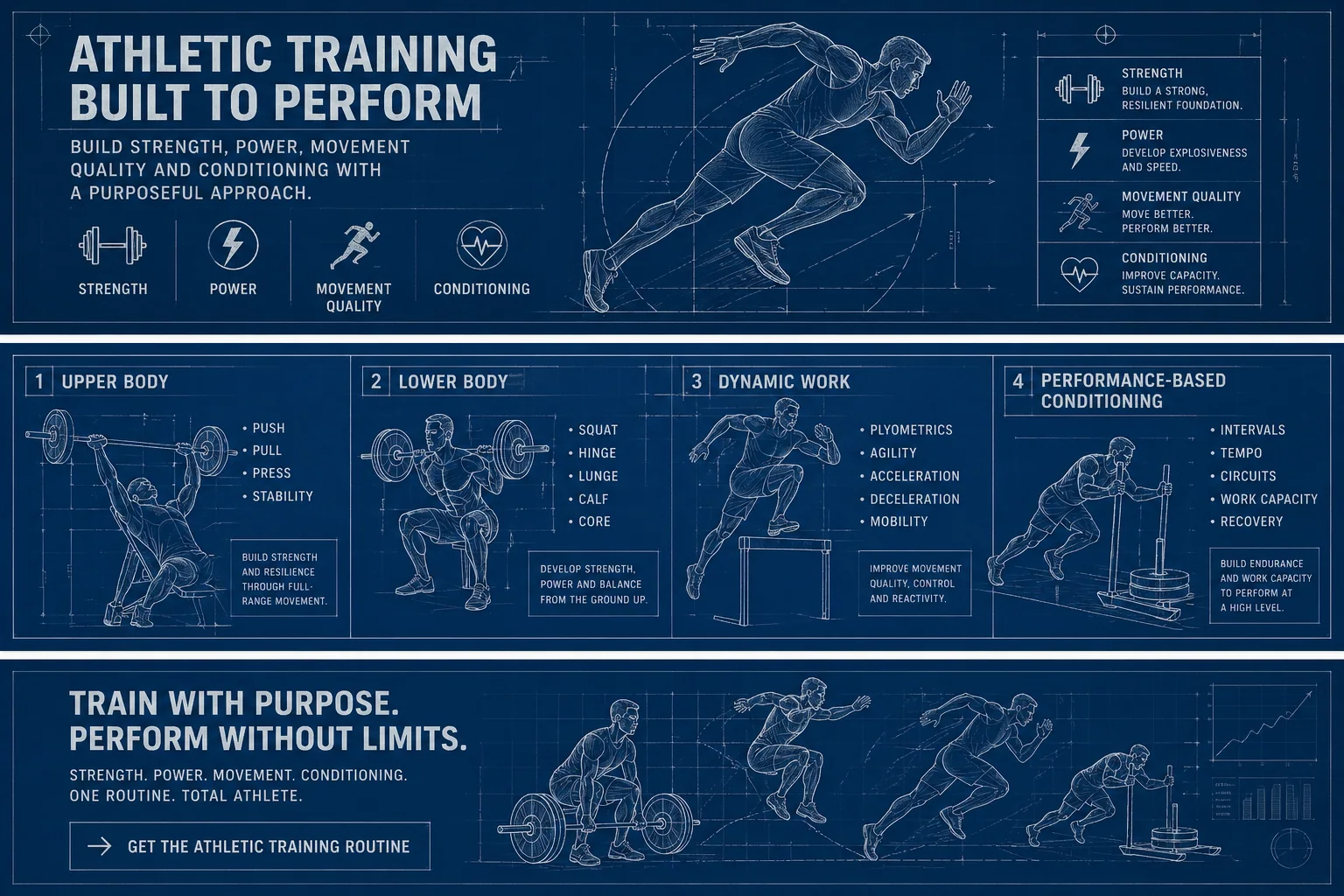
Upper Body, Lower Body, Dynamic and Conditioning Routine for Athletic Performance
A real training routine should do more than make you sweat. It should build a body that is strong, explosive, durable, conditioned and ready to perform.
That is where an upper body, lower body, dynamic and conditioning routine becomes a serious weapon. This structure gives you the best of performance training: strength work for muscle and force production, dynamic movement for athletic output, and conditioning that builds the engine without turning every session into random exhaustion.
This is not about giving away a full paid program. The exact workouts, sequence, progressions, tempos, loading and coaching cues belong inside a complete system. This article breaks down the training method so you understand why this routine works, how it is structured, and how to apply the principles without copying a full program blindly.
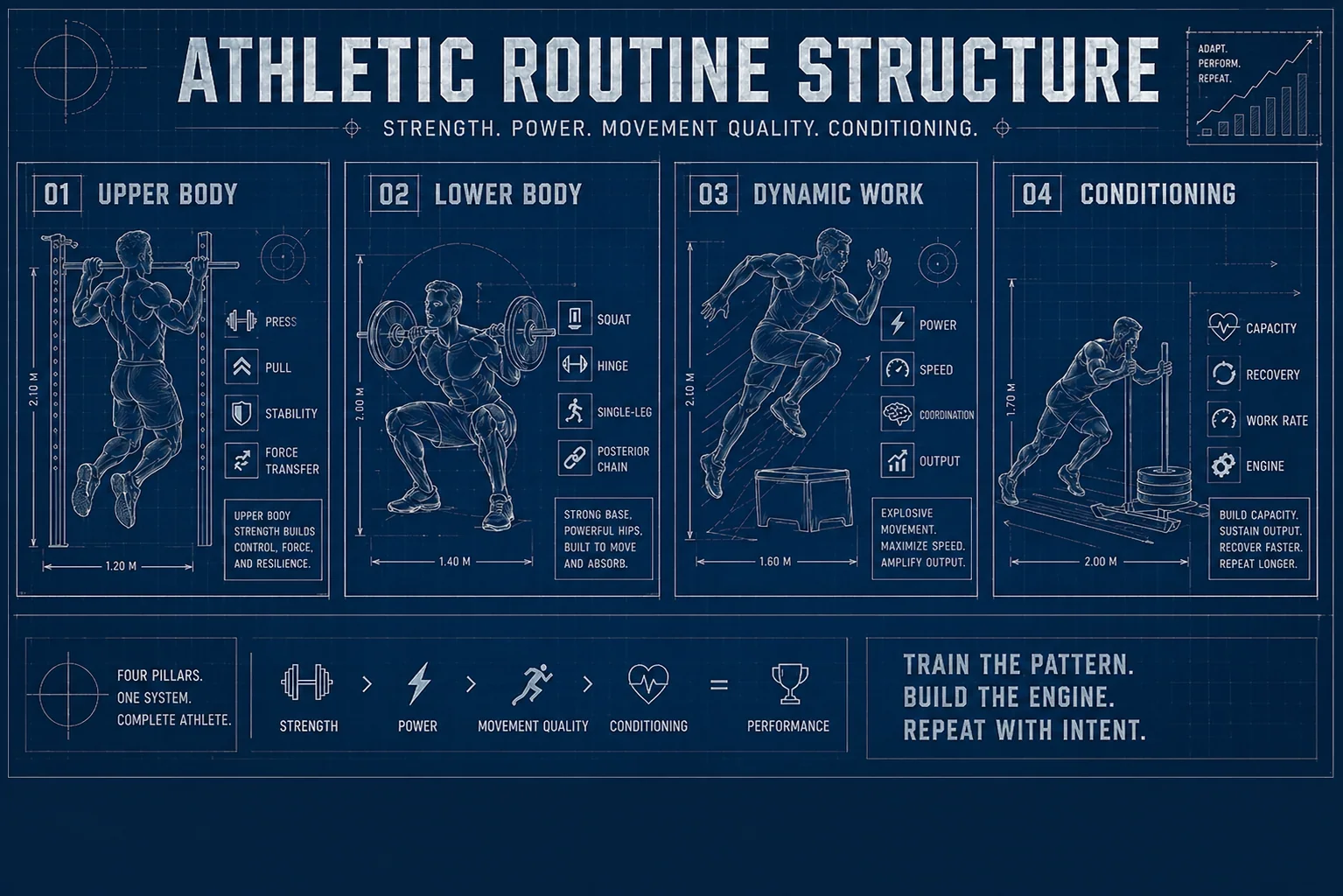
1. Upper Body Training: Build Strength, Stability and Athletic Control
Upper body training for athletic performance is not just bench press, curls and shoulder burnouts. The upper body has to press, pull, stabilize, brace and transfer force.
A smart upper body session should include pushing and pulling patterns. Pressing builds the chest, shoulders and triceps. Pulling builds the lats, traps, rear delts, rhomboids and upper-back control. When these patterns are balanced, the shoulders move better, posture improves and strength becomes more usable.
Most lifters make one big mistake: they overtrain the mirror muscles and undertrain the support system. If you press hard but neglect rows, pulldowns, rear-delt work and shoulder stability, your performance will eventually hit a wall. Worse, your shoulders may start paying the price.
For athletic training, the upper body needs controlled strength. That means clean reps, full range of motion, tight bracing and no sloppy momentum. You want pressing power, but you also want scapular control. You want strong arms, but you also need a strong upper back. You want muscle, but the muscle needs to move well.
A strong upper body routine should train:
- Horizontal pressing
- Vertical pressing
- Horizontal pulling
- Vertical pulling
- Shoulder stability
- Upper-back control
- Arm strength as support work
The goal is not to crush the upper body with junk volume. The goal is to build a strong, stable frame that can produce force and handle fatigue.
2. Lower Body Training: Build Power From the Ground Up
Your lower body is the base of athletic performance. Sprinting, jumping, changing direction, lifting, carrying, absorbing impact and producing power all start from the ground.
A proper lower body routine should train more than just squats. Squat patterns build leg strength. Hip-hinge patterns build the posterior chain. Single-leg work improves balance and control. Lateral patterns improve mobility and athletic position. Hamstring and calf work support speed, knee health and lower-leg durability.
This is where performance training separates itself from basic gym training. You are not just chasing sore legs. You are building force production, joint control and movement capacity.
Lower body work should usually start with preparation. That can include activation, mobility or low-level stability work to get the hips, glutes and trunk online. From there, the session should move into heavier compound strength work while the body is fresh. After that, accessory work fills the gaps.
A complete lower body routine should target:
- Squat strength
- Hip-hinge strength
- Glute output
- Hamstring control
- Single-leg stability
- Lateral movement
- Calf and ankle stiffness
- Core bracing under load
This matters because weak links show up fast. Poor hip stability can affect knee tracking. Weak hamstrings can limit sprinting and power output. Poor ankle stiffness can reduce jumping and landing quality. Weak trunk control can leak force on nearly every major lift.
The lower body is not just trained for size. It is trained to produce force, absorb force and repeat force with control.
3. Dynamic Movement and Conditioning: Build the Engine and the Output
Strength is the foundation, but athletic performance also needs speed, timing, coordination and conditioning.
Dynamic movement teaches the body to express strength quickly. This can include jumps, explosive pulls, athletic carries, resisted movement, controlled marches, movement prep drills and power-based patterns. The purpose is simple: take strength from the weight room and turn it into usable athletic output.
Conditioning is the other side of the equation. A strong athlete who gasses out too early is not fully prepared. But conditioning has to be programmed correctly. Random high-intensity finishers after every workout are not a system. They are just fatigue.
Smart conditioning improves your ability to repeat effort, recover between sets and maintain quality under pressure. Depending on the goal, conditioning can focus on power, strength endurance, aerobic capacity or trunk control.
A good dynamic and conditioning block may include:
- Explosive movement for power
- Loaded carries for total-body strength endurance
- Sled, band or bodyweight drills for work capacity
- Core finishers for trunk control
- Low-impact conditioning to build the engine
The key is placement. Conditioning should support the workout, not sabotage it. If the legs are already heavily loaded, the conditioning choice should be smart. If the goal is power, fatigue must be managed. If the goal is capacity, the work should be challenging but repeatable.
A real athletic routine does not chase exhaustion. It builds output.
How to Integrate This Routine
To integrate an upper body, lower body, dynamic and conditioning routine, think like a coach. Do not throw exercises together and hope they work. Build the week with purpose.
A strong weekly structure usually includes dedicated lower body work, upper body work, dynamic power training, conditioning and recovery. The exact order depends on training level, schedule, recovery, equipment and goal.
Use this framework:
Start with preparation.
Open sessions with activation, mobility or movement prep. This improves positioning and prepares the joints for heavier work.
Train the main pattern first.
Big strength or power movements belong early. That is when the nervous system is fresh and technique is sharp.
Build the secondary patterns.
After the main lift, use accessory movements to train weak links, improve control and build muscle where it matters.
Use circuits with intent.
Circuits should not be random. They should support the goal of the session, whether that is capacity, stability, posterior-chain strength or upper-body durability.
Condition without destroying recovery.
Conditioning should match the training phase. Some days need short finishers. Some days need carries. Some days need aerobic work. Some days need no finisher at all.
Respect recovery.
Rest and regeneration are part of performance. If you train hard five days per week, your recovery has to be structured. Sleep, nutrition, hydration, mobility and stress management all affect results.
Progress slowly. Add load, reps, volume, density or complexity over time. Do not max out every week. Athletes are built through repeatable intensity, clean movement and consistent progression.
FAQ: Upper Body, Lower Body, Dynamic and Conditioning Routine
Is this routine good for building muscle?
Yes. This style of routine can build muscle because it includes strength work, accessory training and enough volume to create adaptation. The difference is that the goal is not just size. The goal is muscle that performs.
How many days per week should I train?
Most people do well with three to five training days per week, depending on recovery and experience. More advanced athletes can handle more frequency, but only if sleep, nutrition and workload are managed.
Should conditioning be done after lifting?
Sometimes. Conditioning can work after lifting when it is programmed correctly. But it should not ruin your strength work, joint quality or recovery. The method matters.
Is dynamic training only for athletes?
No. Dynamic training helps everyday lifters move better, build power and improve coordination. You do not need to play a sport to train athletically.
What You Need to Keep in Mind
The best athletic training routine is not the hardest workout on paper. It is the one that builds strength, power, conditioning and movement quality in the right order.
Upper body training gives you pressing strength, pulling power and shoulder control. Lower body training builds the foundation for force, speed and stability. Dynamic movement teaches the body to use strength fast. Conditioning builds the engine so you can repeat effort without falling apart.
Do not confuse being tired with getting better. A real program has structure. It controls intensity. It balances movement patterns. It progresses over time. It builds the body instead of just beating it up.
If you want the full result, you need more than a list of exercises. You need the exact weekly structure, exercise selection, loading, progression, tempo, rest periods and coaching execution.
Train with intent. Move with control. Build strength you can use. That is how you turn workouts into performance — Checkout One of Our Signature Training Programs STATUM:BUILT. It Integrates All those components for you. All you have to do is simply follow through the training.