Eccentric Training
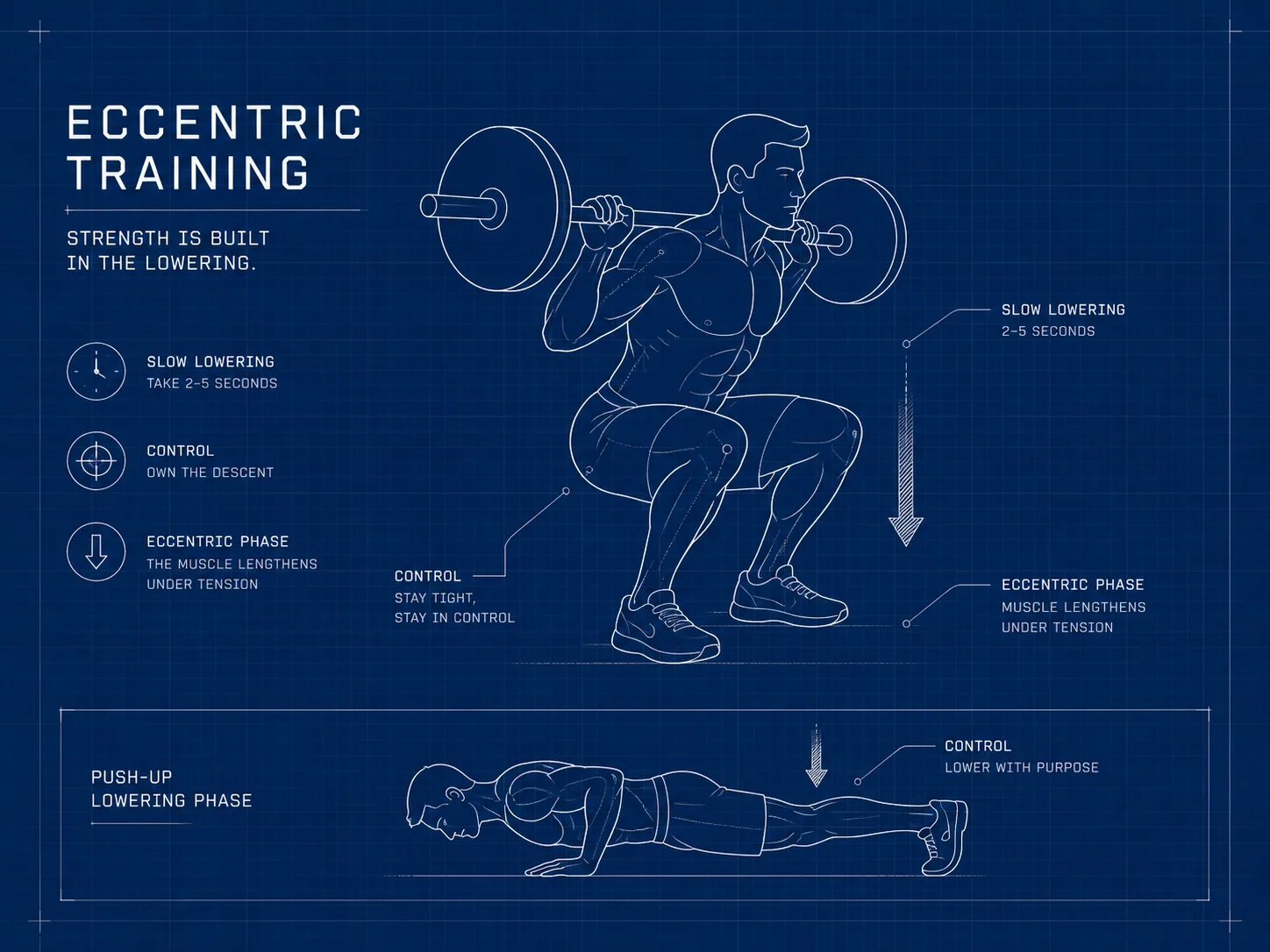
Eccentric Training: Build Strength, Muscle, and Control With the Lowering Phase
Most lifters obsess over lifting the weight. Smart lifters master lowering it.
That is where eccentric training comes in. Eccentric training focuses on the lengthening phase of a movement—the part where your muscle is working while being stretched. Think lowering into a squat, lowering your chest during a push-up, lowering a dumbbell during a curl, or descending from the top of a pull-up.
This method is simple, brutal, and effective. You do not need fancy equipment. You do not need a new workout split. You need control, intent, and patience under tension.
Eccentric resistance training has been studied for strength, hypertrophy, athletic performance, and functional ability. Research shows eccentric-focused training can improve strength and performance markers in athletes, while newer evidence in older adults suggests it may offer a small strength advantage over traditional resistance training.
What Is Eccentric Training?
Every strength exercise has three main muscle actions.
The concentric phase is when the muscle shortens. In a biceps curl, that is when you curl the dumbbell up. In a squat, it is when you stand up.
The eccentric phase is when the muscle lengthens under load. In a biceps curl, that is when you lower the dumbbell. In a squat, it is when you descend.
The isometric phase is when the muscle creates tension without visible movement. In a squat, that could be holding the bottom position.
Eccentric training puts more attention on the lowering phase. Instead of dropping into the bottom of a rep, you control it. Instead of letting gravity do the work, you make your muscles own the movement.
Example: a normal squat might take one second to lower. An eccentric squat may use a 3–5 second descent before standing back up. That longer lowering phase increases time under tension, improves movement control, and forces better body awareness.
This is why eccentric training works so well for people who want to build muscle, improve strength, clean up technique, and protect their joints through better control.
Why Eccentric Training Builds Strength and Muscle
Eccentric training works because it attacks one of the biggest gaps in most training programs: control under load.
Most people rush the lowering phase. They bounce through squats. They drop through push-ups. They swing through curls. That leaves strength, muscle, and technique on the table.
When you slow the eccentric phase down, you create more mechanical tension. Mechanical tension is one of the main drivers of muscle growth. You also spend more time in the positions that usually expose weakness: the bottom of the squat, the stretched position of a Romanian deadlift, the bottom of a push-up, or the lower range of a pull-up.
That matters because muscle is not built only by moving weight from point A to point B. Muscle is built by producing force with control.
For hypertrophy, eccentric and concentric actions both matter. A 2025 systematic review reported similar hypertrophy outcomes between eccentric and concentric muscle actions in healthy adults, which means eccentric training should not replace full-range lifting—but it absolutely deserves a planned role inside the program.
For athletes, eccentric strength is even more important. Sprinting, jumping, cutting, landing, and changing direction all demand force absorption. You need to produce force, but you also need to absorb it. A 2023 systematic review supports eccentric resistance training for improving strength, jump, sprint, and change-of-direction performance in youth athletes.
For general fitness, eccentric training gives you a cleaner way to progress without always adding more weight. If your squat feels sloppy, slow down the descent. If your push-up collapses at the bottom, use eccentric reps. If your pull-up is not there yet, start with controlled negatives.
The goal is not to make every rep slow forever. The goal is to build control so your normal reps become stronger, cleaner, and more powerful.
Best Eccentric Exercises
The best eccentric exercises are simple movements you already know. The difference is execution.
Eccentric squat: Lower for 3–5 seconds, keep the ribs stacked, knees tracking, and feet rooted. Pause briefly at the bottom, then stand with power. This builds leg strength, bracing, and positional control.
Eccentric push-up: Start at the top of a push-up. Lower your chest for 3–5 seconds. Keep your elbows controlled and your body locked from shoulders to ankles. If needed, drop to the knees to press back up. This is one of the best ways to build real push-up strength.
Negative pull-up: Start with your chin over the bar using a box or jump. Lower yourself slowly for 3–6 seconds until your arms are fully extended. This builds the exact strength needed for strict pull-ups.
Eccentric Romanian deadlift: Hinge slowly for 3–5 seconds while keeping the spine neutral and the lats tight. Feel the hamstrings load. Stand tall with control. This is elite for hamstrings, glutes, and posterior-chain strength.
Eccentric calf raise: Rise with both feet, then lower on one foot for 3–5 seconds. Use a full range of motion. This is a strong option for calf strength and Achilles tendon loading when progressed carefully.
Eccentric split squat: Lower slowly until the back knee approaches the floor. Keep the front foot stable and torso controlled. This builds single-leg strength, balance, and hip control.
Eccentric biceps curl: Curl normally, then lower the dumbbell for 3–5 seconds. Do not let the shoulder roll forward. Own the bottom position.
The rule is simple: pick exercises where you can control the full range. If you cannot lower with control, the load is too heavy.
How to Integrate Eccentric Training
Do not turn your entire workout into slow-motion suffering. Use eccentric training with precision.
Start with 1–2 eccentric-focused exercises per workout, two or three times per week. Use a 3–5 second lowering phase, keep the reps clean, and avoid training to complete failure at first. Eccentric work can create more delayed muscle soreness when introduced aggressively, so progression matters.
A strong beginner setup looks like this:
Lower-body day:
Eccentric squat — 3 sets of 5 reps with a 4-second descent
Eccentric Romanian deadlift — 3 sets of 6 reps with a 3-second descent
Upper-body day:
Eccentric push-up — 3 sets of 5 reps with a 4-second descent
Negative pull-up — 3 sets of 3 reps with a 5-second descent
Accessory day:
Eccentric calf raise — 3 sets of 8 reps per side
Eccentric biceps curl — 2–3 sets of 8 reps
Use lighter weight than normal. A 4-second lowering phase will expose weaknesses fast. That is the point. Keep the movement smooth, stay tight, and stop the set before your position breaks.
For muscle growth, use eccentric work after your main lift or as part of controlled accessory work. For strength, use it on key movements like squats, pull-ups, presses, and hinges. For beginners, use it to learn clean movement patterns before chasing heavier loads.
The best tempo to start with is 4 seconds down, no bounce, controlled return. Once you own that, you can progress by adding load, reps, range of motion, or harder variations.
What You Need to Keep in Mind
Eccentric training is not a gimmick. It is one of the most practical ways to make basic exercises more effective.
You are not just slowing reps down to make them harder. You are teaching your body to control load, absorb force, build tension, and stay strong in positions where most people collapse.
Use eccentric training when you want better technique, more muscle, stronger tendons, better pull-ups, cleaner squats, stronger push-ups, and more control through full range of motion.
Do it right: start light, lower slowly, stay tight, and progress gradually.
The athlete who controls the lowering phase controls the lift.